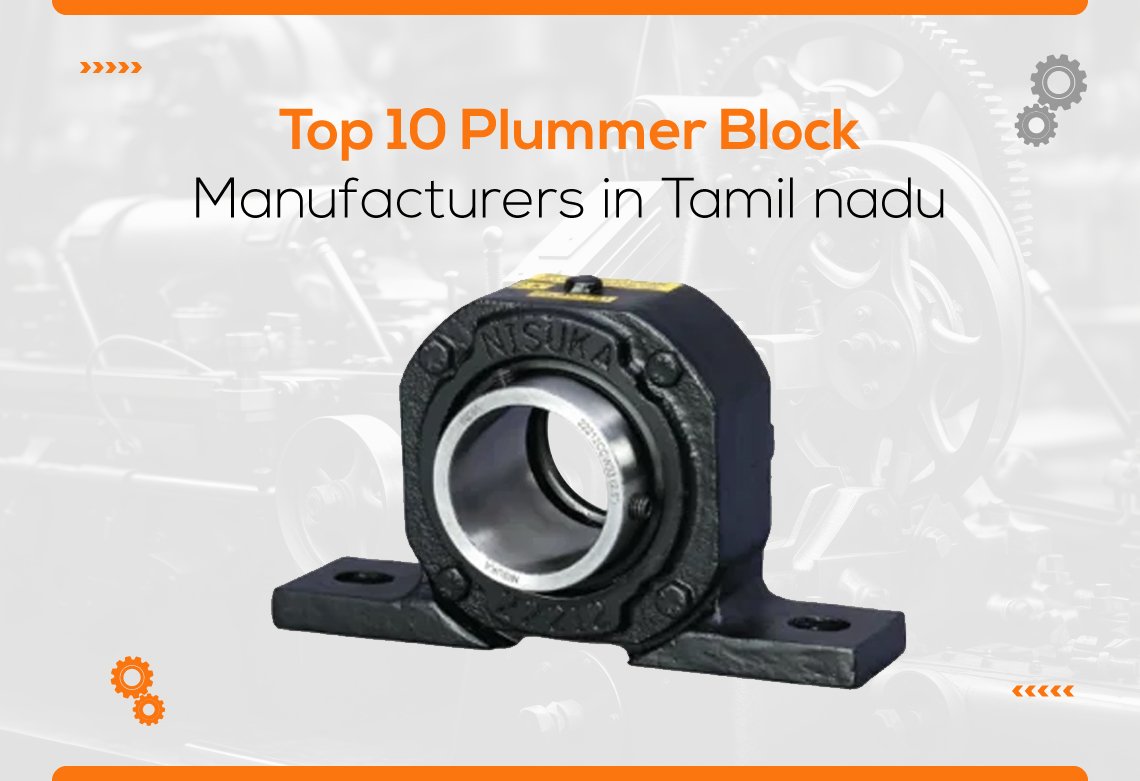
Top 10 Plummer block Manufacturer in Tamil nadu

Tamil Nadu has emerged as one of India’s strongest industrial manufacturing hubs, especially in the field of mechanical components and heavy engineering products. Among these, plummer blocks play a critical role in supporting rotating shafts, reducing friction, and ensuring smooth operation across industries such as cement, mining, power generation, textiles, steel, and material handling. Choosing the right manufacturer directly impacts machine performance, safety, and long-term maintenance costs.

With decades of foundry expertise, advanced machining capabilities, and strict quality control practices, plummer block manufacturers in Tamil Nadu are widely recognised for delivering durable, precision-engineered bearing housings that meet both Indian and international standards. Many companies in this region serve OEMs, EPC contractors, and global export markets, offering both standard and custom-designed plummer blocks based on load capacity, shaft size, speed, and operating conditions. In addition to plummer blocks, several manufacturers also support allied power transmission needs, including components for SMSR gearbox manufacturer, ensuring compatibility and reliability in heavy industrial applications.

This blog presents a carefully curated list of the Top 10 Plummer Block Manufacturers in Tamil Nadu, ranked based on manufacturing experience, product quality, engineering capability, industry reputation, and customer trust. Leading manufacturers such as Nisuka Industries stand out for their consistent quality, application-specific solutions, support for SMSR gearbox–related installations, and dependable after-sales service. Together, these manufacturers reflect Tamil Nadu’s strong position as a trusted hub for industrial bearing housings and power transmission components.

Whether you are a procurement manager, plant engineer, or industrial buyer, this guide will help you identify reliable plummer block manufacturers that align with your operational and performance requirements.

How We Selected the Top Plummer Block Manufacturers

Selecting the best Plummer Block Manufacturer in Tamil Nadu requires more than checking product availability or pricing. Our evaluation process is based on real industry requirements, technical reliability, and long-term performance. We focused on manufacturers that consistently deliver quality, support industrial needs, and follow proven engineering practices. Below are the key factors we used to shortlist the most reliable plummer block manufacturers trusted by businesses across Tamil Nadu.

1. Manufacturing Quality & Engineering Standards

Manufacturing quality is the foundation of a dependable plummer block. We carefully analysed whether each Plummer Block Manufacturer in Tamil Nadu follows strict quality control processes and modern engineering standards. Manufacturers using high-grade raw materials, precision machining, and advanced testing methods were given priority.

We also considered adherence to national and international standards, as this reflects engineering expertise, product durability, and operational safety. A strong focus on quality ensures smooth bearing performance, reduced maintenance, and longer service life in industrial applications.

2. Product Range and Customisation Capability

A top Plummer Block Manufacturer in Tamil Nadu must serve diverse industrial needs. We evaluated manufacturers based on the variety of plummer blocks they offer, including standard sizes and heavy-duty models for different load conditions.

Equally important was their ability to provide custom solutions. Manufacturers who could customise designs, materials, and finishes according to client specifications stood out. This flexibility shows technical experience and a customer-first approach, which is essential for industries with unique operating environments.

3. Industry Experience and Market Reputation

Experience plays a vital role in manufacturing reliability. We shortlisted manufacturers with a proven track record and strong market presence as a trusted Plummer Block Manufacturer in Tamil Nadu. Years of industry experience reflect deep technical knowledge and the ability to handle complex and demanding requirements. We also evaluated client feedback, repeat business, and industry recognition to understand real-world performance. A strong market reputation indicates consistent product quality, ethical business practices, and long-term trust built with customers.

This experience also enables manufacturers to deliver solutions that support a wide range of Applications of Plummer Blocks in Different Industries, including cement, steel, power generation, mining, paper, sugar, and heavy engineering, where durability and reliability are critical for uninterrupted operations.

4. Supply Capacity, Lead Time & After-Sales Support

Reliable supply and service are critical for uninterrupted operations. We assessed each Plummer Block Manufacturer in Tamil Nadu based on production capacity, delivery timelines, and inventory management.

Manufacturers who ensured timely dispatch and handled bulk orders efficiently were rated higher. After-sales support was another key factor, including technical guidance, quick issue resolution, and spare part availability. Strong after-sales service demonstrates commitment to customer success and reinforces long-term business relationships.

Top 10 Plummer Block Manufacturers in Tamil Nadu

Tamil Nadu is a major industrial centre with strong demand for reliable bearing solutions. To identify the most trusted names, we analysed companies that not only manufacture quality products but also operate as a dependable Plummer Block supplier in Tamil Nadu.

Our selection focuses on real-world performance, supply consistency, and industry credibility. Among all, Nisuka Industries clearly stands out as a top-ranked manufacturer and supplier.

1. Nisuka Industries - Plummer Block manufacturer
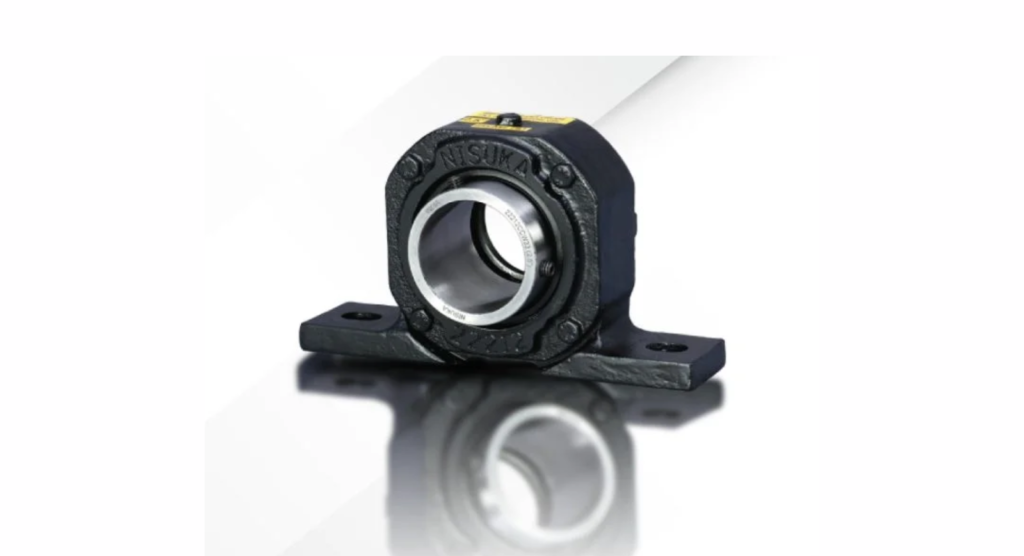
Plummer Block manufacturer

Nisuka Industries is widely recognised for its consistent quality, engineering reliability, and customer-focused service. The company has earned a strong position as a trusted Plummer Block manufacturer in Tamil Nadu by meeting the practical needs of industries that demand long-lasting and precision-engineered bearing housings. Its approach combines technical expertise with dependable supply, making it a preferred choice for industrial buyers.

Company Overview and Manufacturing Strength

  • Nisuka Industries operates with modern manufacturing facilities and skilled engineers.
  • Every production stage follows strict quality control and inspection procedures.
  • The company focuses on precision machining to ensure accurate fitting and smooth performance.
  • As an experienced Plummer Block supplier in Tamil Nadu, it delivers products built for durability and stable operation.

Wide Product Range and Customisation Capability

  • Standard plummer blocks for general industrial applications
  • Heavy-duty plummer blocks designed for high-load and continuous operations
  • Customised plummer blocks manufactured as per client drawings and specifications
  • Flexible material and design options to suit different working environments

This broad portfolio allows Nisuka Industries to support both routine and complex requirements as a reliable Plummer Block supplier in Tamil Nadu.

Industries Served Across Tamil Nadu

  • Cement, steel, and heavy engineering industries
  • Mining and material handling operations
  • Power generation and energy sector
  • Paper mills, sugar plants, and manufacturing units

By understanding industry-specific challenges, Nisuka Industries provides solutions that improve machinery life and reduce downtime.

Supply Reliability and After-Sales Support

  • Strong production capacity to handle bulk and repeat orders
  • Consistent lead times that support project schedules
  • Technical assistance for product selection and installation
  • Responsive after-sales service that builds long-term trust

These strengths reinforce Nisuka Industries’ reputation as a dependable Plummer Block supplier in Tamil Nadu.

Why Nisuka Industries is No.1 Plummer block manufacturer

  • Proven manufacturing quality and engineering standards
  • Ability to deliver customised and standard products reliably
  • Strong market reputation backed by industry experience
  • Customer-first approach with ongoing technical support

Overall, Nisuka Industries stands out as the No.1 Plummer Block supplier in Tamil Nadu, offering industries a balance of quality, reliability, and professional service that supports long-term operational success.

2. Jyoti Bearing and Mill Stores — Chennai

Jyoti Bearing and Mill Stores is a trusted name in the export supply of industrial bearing components. As a reliable Plummer Block exporter in Tamil Nadu, the company focuses on cast iron and heavy-duty plummer blocks designed for long service life and high-load conditions.

Its products are widely used in manufacturing plants, processing units, and OEM applications. Strong knowledge of export documentation, secure packaging, and timely dispatch helps the company serve overseas clients smoothly. Consistent quality, repeat international orders, and industrial trust make Jyoti Bearing and Mill Stores a dependable exporter from Chennai.

3. NU-Tech Bearings — Chennai

NU-Tech Bearings supplies precision bearing housings and plummer blocks that meet global industrial standards. As an emerging Plummer Block exporter in Tamil Nadu, the company focuses on dimensional accuracy, compatibility, and performance reliability.

Each product undergoes strict quality checks before dispatch, ensuring export readiness. NU-Tech Bearings serves machinery manufacturers, engineering companies, and industrial distributors across international markets. Its professional approach, consistent supply, and focus on quality control make it a preferred exporter for buyers seeking dependable plummer block solutions.

4. MBM Engineering Infotech Limited — Chennai

MBM Engineering Infotech Limited specialises in design-based and application-specific solutions. Known as a professional Plummer Block exporter in Tamil Nadu, the company delivers custom-engineered plummer blocks for specialised industrial requirements. Its expertise includes mild steel and special housing designs developed for load, speed, and environmental conditions.

MBM Engineering supports export projects that demand technical accuracy and structural reliability. Strong engineering knowledge, customisation capability, and export-oriented production processes make the company a trusted global supplier.

5. Saicon — Coimbatore

Saicon is recognised for its precision-engineered industrial components and advanced material expertise. As a quality-focused Plummer Block exporter in Tamil Nadu, the company manufactures high-accuracy plummer block housings suitable for heavy-load and corrosive environments.

Stainless steel and precision-finished housings form a key part of its export portfolio. Saicon serves global industries where performance stability and long-term reliability are critical. Its focus on precision, material strength, and export-grade manufacturing supports consistent international demand.

6. Sri Kumaran Alloys Private Limited — Coimbatore

Sri Kumaran Alloys Private Limited is known for its strong casting capabilities and large-scale production capacity. As an established Plummer Block exporter in Tamil Nadu, the company supplies heavy-duty cast iron and alloy components for demanding industrial applications.

Its products are widely used in cement, steel, and heavy engineering industries across global markets. The ability to manage bulk export orders while maintaining quality consistency makes Sri Kumaran Alloys a preferred exporter for large industrial buyers.

7. Anant Engineering — Chennai

Anant Engineering offers both standard and customised plummer block solutions for domestic and international clients. As a dependable Plummer Block exporter in Tamil Nadu, the company focuses on durability, load stability, and functional design. Its products are suitable for continuous-operation machinery used  and processing industries.

Flexible production planning, consistent quality, and export-friendly supply practices help Anant Engineering build long-term relationships with overseas buyers.

8. Radiant Chain & Bearing Centre — Coimbatore

Radiant Chain & Bearing Centre supplies integrated bearing and housing solutions for industrial applications. Operating as a growing Plummer Block exporter in Tamil Nadu, the company supports conveyor systems, material handling equipment, and machinery used in global industries. Its strength lies in product compatibility, responsive supply, and reliable sourcing.

Export-focused service, combined with industrial application knowledge, makes Radiant Chain & Bearing Centre a consistent supplier for international clients.

9. International Bearings — Chennai

International Bearings has built a strong presence in both domestic and export markets. As a recognised Plummer Block exporter in Tamil Nadu, the company supplies industrial bearing housings and plummer blocks that meet global standards. Efficient logistics handling, bulk supply capability, and repeat export orders highlight its reliability. The company supports distributors, OEMs, and industrial users worldwide with consistent quality and timely delivery.

10. Industrial Bearing Corporation — Chennai

Industrial Bearing Corporation is known for cost-effective and high-volume supply solutions. As a trusted Plummer Block exporter in Tamil Nadu, the company serves industries that require bulk quantities without compromising on quality.

Its efficient manufacturing planning and inventory management support steady export operations. Competitive pricing, dependable supply, and industrial-grade products make Industrial Bearing Corporation a preferred exporter for international buyers seeking value-driven solutions.

Final Thoughts: Choosing the Right Plummer Block Manufacturer in Tamil Nadu

Tamil Nadu stands as one of India’s leading industrial states, offering a strong network of manufacturers known for reliable engineering and consistent product quality. This blog on the Top 10 Plummer Block manufacturers in Tamil Nadu highlights companies that have earned industry trust through performance, durability, and dependable supply. Each manufacturer listed here supports industries with solutions designed to meet real operating conditions and long-term usage requirements.

Choosing the right plummer block manufacturer goes beyond pricing. It involves evaluating manufacturing quality, material strength, customisation capability, delivery timelines, and after-sales support. The manufacturers featured in this list serve a wide range of industries such as cement, steel, power generation, mining, and heavy engineering, offering both standard and customised plummer block solutions. During the selection process, many buyers also seek clarity on the Difference Between a Pillow Block and a Plummer Block, as understanding the correct bearing housing type is essential for ensuring proper load handling and long-term performance.

Tamil Nadu–based manufacturers are recognised for their modern production facilities, skilled technical teams, and commitment to consistent quality. Whether sourcing plummer blocks for new machinery, replacement needs, or large-scale industrial projects, choosing a trusted manufacturer helps ensure smooth operations and reduced maintenance downtime.

By partnering with the right plummer block manufacturer in Tamil Nadu, businesses can achieve improved equipment reliability, higher operational efficiency, and long-term value for their industrial investments.

FAQS

Tamil Nadu is home to several reputed manufacturers known for quality and reliability. Companies like Nisuka Industries and other established firms listed in this blog are considered among the top plummer block manufacturers due to their engineering strength, industry experience, and customer trust.

Tamil Nadu has strong foundry infrastructure, skilled manpower, modern machining facilities, and easy access to industrial markets. These factors make it a preferred location for high-quality plummer block manufacturing.

 Plummer blocks are widely used in cement plants, steel industries, power generation, mining, paper mills, sugar factories, conveyors, and heavy engineering industries where shaft support and load handling are critical.

You should evaluate manufacturing quality, material standards, customisation options, delivery timelines, after-sales support, and the manufacturer’s industry reputation before making a decision.

 Yes, many leading manufacturers provide customised plummer blocks based on shaft size, load capacity, operating conditions, and specific industry requirements.

 Plummer blocks are commonly manufactured using cast iron, ductile iron, mild steel, stainless steel, and special alloys depending on application and load requirements.

Yes, several manufacturers in Tamil Nadu supply plummer blocks to export markets, meeting both Indian and international quality standards with proper testing and packaging.

A plummer block is generally used for heavy-duty and large shaft applications, while a pillow block is more compact and used for lighter loads. Choosing the right type depends on application and load conditions.
What Is an Electric Motor? A Complete Guide

Electric motors are an essential part of everyday life, even though they often work silently in the background. From home appliances like fans and washing machines to industrial machines, pumps, conveyors, and electric vehicles, electric motors make modern living and industrial operations possible. As the demand for energy-efficient and reliable machines continues to grow, many people search online to understand what an electric motor is, how it works, and where it is used.

This complete guide to electric motors is written to provide a clear and easy-to-understand explanation for beginners as well as professionals. Instead of using complex technical terms, the guide explains the fundamentals in a simple and practical manner. You will learn about the basic working principle of an electric motor, its main components, different types of electric motors, and their real-world applications across industries.

The content is structured to answer common questions people search for on Google, making it useful for students, engineers, technicians, and business owners. It focuses on real-life usage and practical understanding rather than theory alone, including insights into industrial use cases such as Conveyor Belt Application. By the end of this guide, you will have a strong foundation in electric motors, helping you understand how they function, why they are important, and how to choose the right motor for different applications.

What Is an Electric Motor?

What Is an Electric Motor?

An electric motor is a machine that converts electrical energy into mechanical energy to create motion. In simple terms, it takes electricity as input and produces rotating movement that can be used to run machines, tools, and equipment. When people search What Is an Electric Motor?, they usually want a clear and easy explanation of how this device works and why it is so important in daily life and industry.

An electric motor works using the interaction between an electric current and a magnetic field. When current flows through the motor, it creates magnetic force, which causes the motor shaft to rotate. This rotation is then used to perform useful work such as turning a fan, pumping water, moving a conveyor belt, or powering industrial machines.

Today, electric motors are everywhere. You can find them in home appliances, factories, vehicles, and automation systems. They are preferred because they are efficient, reliable, and easy to control. Understanding What Is an Electric Motor? helps users make better decisions when selecting motors for different applications, whether for household use or large-scale industrial operations.

In short, an electric motor is the backbone of modern technology, enabling smooth operation, energy efficiency, and consistent performance across countless applications.

How Does an Electric Motor Work?

How Does an Electric Motor Work

An electric motor works by converting electrical energy into mechanical energy through the interaction of electric current and magnetic fields. When electricity flows through the motor’s coils, it creates a magnetic field. This magnetic field interacts with another magnetic field inside the motor, producing a force that causes the motor’s shaft to rotate. This rotating motion is what allows machines and devices to perform useful work and is widely used in industrial systems supported by components supplied by a plummer block manufacturer.

To understand How Does an Electric Motor Work?, it is helpful to look at the process in simple terms. Electricity enters the motor and passes through the windings placed inside a magnetic field. As soon as current flows, a force is generated that pushes the rotor to move. The design of the motor ensures that this movement continues in a circular motion, creating steady rotation instead of stopping after one turn.

In basic operation, an electric motor works in the following way:

  • Electrical power is supplied to the motor windings
  • A magnetic field is produced around the windings
  • The magnetic interaction creates force on the rotor
  • The rotor starts rotating and delivers mechanical output

This continuous rotation can be used to run fans, pumps, conveyors, compressors, and many other machines. Understanding How Does an Electric Motor Work? helps users see why electric motors are efficient, reliable, and widely used in both household and industrial applications.

Types of Electric Motors

Types of Electric Motors

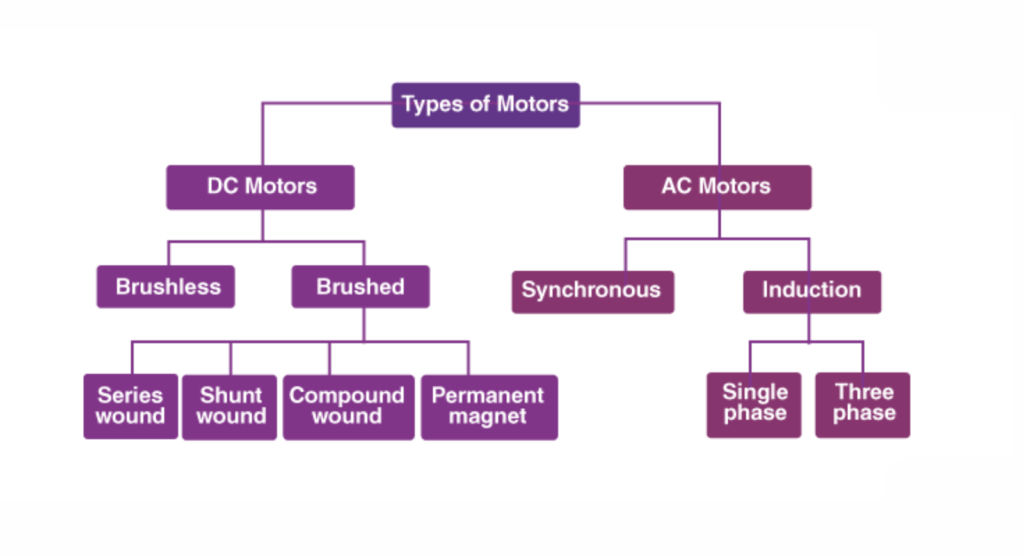
There are different types of electric motors, and each type is designed to perform a specific task based on power supply, speed requirement, load condition, and application. Understanding the types of electric motors helps users choose the right motor for better efficiency, safety, and long-term performance. These motors are mainly classified into AC motors, DC motors, and special-purpose motors.

1. AC Electric Motors

AC electric motors operate on alternating current and are the most commonly used motors in industries and commercial systems. They are popular because of their simple design, low maintenance, and long operating life.

- Induction Motor

The induction motor is the most widely used electric motor in the world. It works on the principle of electromagnetic induction, where current is induced in the rotor when the stator produces a rotating magnetic field.

The rotor starts rotating slightly slower than the magnetic field speed, which creates motion. Induction motors are known for their strong construction, high reliability, and ability to run continuously for long hours. They are commonly used in pumps, fans, compressors, conveyor belts, and industrial machinery.

- Synchronous Motor

A synchronous motor rotates at a constant speed that is exactly synchronized with the supply frequency. Unlike induction motors, there is no slip between the rotor and the magnetic field. These motors are used where constant speed is required, regardless of load changes.

Synchronous motors are often found in power plants, large industrial compressors, and heavy-duty material handling setups that operate across different types of conveyor belt systems, where stable speed and precise control are essential for smooth and efficient operation.

- Single Phase Motor

Single phase motors are designed to work on single phase power supply, which is commonly available in homes and small commercial places. These motors are simple in design and suitable for low-power applications.

Because single phase supply cannot create a rotating magnetic field on its own, additional components like capacitors are used to start the motor. Single phase motors are used in ceiling fans, washing machines, water pumps, and small air conditioning units.

- Three Phase Motor

Three phase motors operate on three phase power supply and are mainly used in industrial environments. They provide higher efficiency, better torque, smoother operation, and lower power loss compared to single phase motors.

These motors start automatically without additional starting devices and are ideal for heavy-duty applications. Common uses include elevators, cranes, rolling mills, large pumps, and factory equipment.

2. DC Electric Motors

DC electric motors run on direct current and are mainly used where precise speed control and high starting torque are required.

- Brushed DC Motor

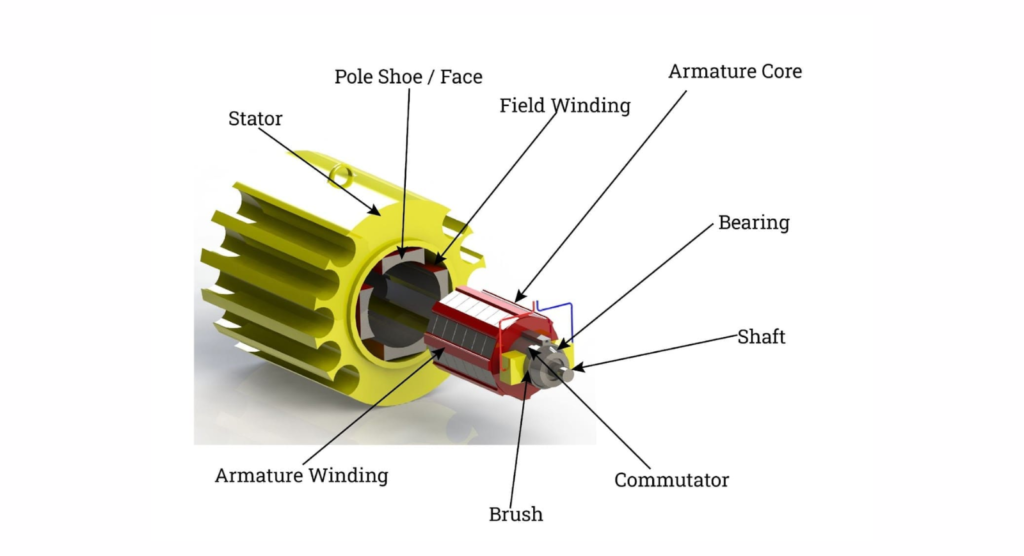
Brushed DC motors use brushes and a commutator to supply current to the rotating part of the motor. They are easy to control and inexpensive, making them suitable for simple applications. However, brushes wear out over time, which increases maintenance. These motors are commonly used in toys, portable tools, automotive systems, and small machines.

-Brushless DC Motor (BLDC)

Brushless DC motors do not use brushes, which reduces friction, heat, and maintenance. Instead, electronic controllers manage the motor operation.

BLDC motors are highly efficient, quiet, and have a long service life. They are widely used in electric vehicles, drones, computer cooling fans, air conditioners, and modern household appliances.

3.Special Purpose Electric Motors

Special purpose motors are designed for applications that require precise control, accuracy, or specific motion.

-Servo Motor

Servo motors are used in systems where accurate control of position, speed, and torque is required. They use a feedback mechanism to compare actual position with the desired position and correct errors instantly. Servo motors are commonly used in robotics, CNC machines, automated manufacturing lines, and industrial control systems.

-Stepper Motor

Stepper motors move in fixed steps rather than continuous rotation. This allows very precise positioning without the need for feedback systems. Stepper motors are easy to control and are widely used in 3D printers, medical equipment, cameras, and digital measuring instruments.

-Linear Motor

A linear motor produces straight-line motion instead of rotational motion. It works on the same electromagnetic principle as rotary motors but eliminates the need for mechanical conversion systems. Linear motors are used in high-speed trains, sliding doors, material handling systems, and precision industrial equipment.

Applications of Electric Motors Across Industries

Applications of Electric Motors

The applications of electric motors vary across multiple industries, where they are used to power machines, automate processes, and improve productivity. Each industry depends on electric motors for reliable motion, energy efficiency, and continuous operation.

Below are the major industries where electric motors play a critical role, explained in a clear and practical way, with support from essential components supplied by a UCP Pillow Block manufacturer that ensure smooth shaft alignment and reliable machine performance.

1. Manufacturing Industry

In the manufacturing industry, electric motors are used to run production lines, machine tools, and automated systems. They power equipment such as lathes, milling machines, presses, and assembly conveyors.

The applications of electric motors in manufacturing help maintain consistent speed, improve product quality, and reduce manual effort.

2. Mining Industry

The mining industry relies heavily on electric motors for heavy-duty operations. Motors are used in crushers, drilling machines, conveyor belts, and ventilation systems. These applications of electric motors support continuous operation in harsh environments while ensuring safety and efficiency.

3. Cement Industry

In the cement industry, electric motors are used to operate crushers, kilns, ball mills, and material handling systems. Motors help manage high-load operations and maintain smooth production flow, making them essential for large-scale cement plants.

4. Power Generation Industry

Electric motors are widely used in power plants for running pumps, cooling fans, compressors, and auxiliary systems. The applications of electric motors in this industry support reliable power generation and system stability.

5. Oil and Gas Industry

The oil and gas industry uses electric motors in drilling rigs, pumping systems, compressors, and refineries. Motors provide precise control and continuous performance in demanding and hazardous environments.

6. Water and Wastewater Treatment Industry

In water treatment plants, electric motors are used to run pumps, aerators, mixers, and filtration systems. These applications of electric motors ensure efficient water distribution, purification, and wastewater management.

7. Food and Beverage Industry

The food and beverage industry depends on electric motors for mixers, grinders, packaging machines, and conveyor systems. Motors help maintain hygiene standards, consistent processing, and efficient packaging operations.

8. Automotive and Transportation Industry

Electric motors are essential in electric vehicles, hybrid vehicles, railways, and automated transport systems. These applications of electric motors support energy-efficient movement and reduced emissions.

9. HVAC and Building Services Industry

In HVAC systems, electric motors are used in fans, blowers, compressors, and air handling units. The applications of electric motors help control temperature, airflow, and indoor comfort in residential and commercial buildings.

10. Agriculture Industry

In agriculture, electric motors are used in irrigation pumps, grain processing machines, dairy equipment, and farm automation systems. These motors improve productivity and reduce manual labor.

Conclusion

Electric motors are the foundation of modern technology, quietly powering countless devices and machines that support daily life and industrial progress. From simple household appliances to complex industrial systems, understanding what an electric motor is helps create a clear picture of how electrical energy is transformed into useful mechanical work. This complete guide has covered the core concepts of electric motors, including how they work, their main types, efficiency levels, and wide-ranging applications across industries.

Knowing the basics of electric motors is no longer limited to engineers or technicians. Business owners, students, and decision-makers also benefit from understanding how electric motors affect energy consumption, performance, and long-term operating costs. Choosing the right motor can improve efficiency, reduce breakdowns, and support sustainable operations in both small and large-scale applications.

As technology continues to evolve, electric motors are becoming more efficient, smarter, and better suited for automation and clean energy systems. Innovations such as high-efficiency motors and advanced control systems are shaping the future of manufacturing, transportation, and renewable energy, often working alongside solutions provided by an SMSR Gearbox manufacturer for effective power transmission. By understanding the fundamentals explained in this guide, readers are better prepared to make informed choices, optimize performance, and adapt to future developments. In short, electric motors will remain a vital force behind innovation, productivity, and technological growth for years to come.

FAQS

An electric motor is a machine that converts electrical energy into mechanical energy. It uses electricity and magnetism to produce motion. This motion is used to run devices like fans, pumps, machines, and vehicles, making electric motors essential in homes, industries, and modern technology.

An electric motor works by allowing electric current to flow through coils placed in a magnetic field. This interaction creates force that causes the rotor to rotate. Continuous supply of electricity maintains rotation, producing mechanical energy that powers machines, tools, and equipment.

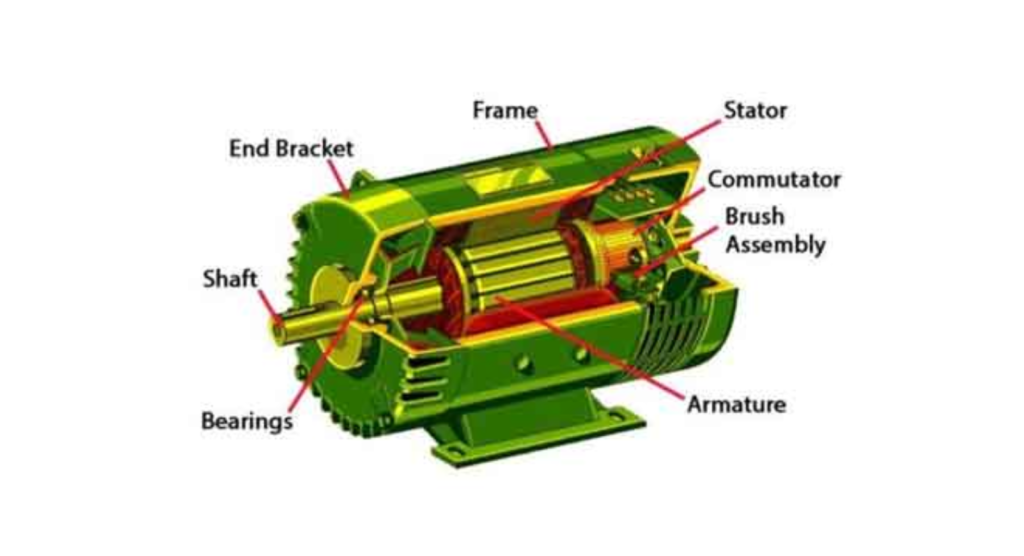
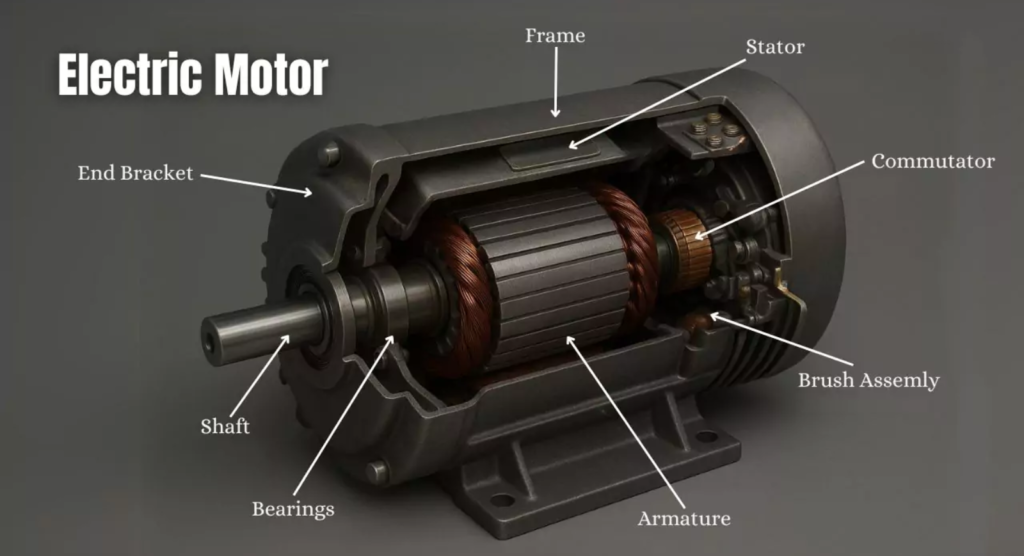
The main parts of an electric motor include the stator, rotor, windings, shaft, bearings, and cooling system. The stator creates the magnetic field, while the rotor rotates to produce motion. Bearings reduce friction, and cooling systems prevent overheating during operation.

Electric motors are mainly classified into AC motors, DC motors, single phase motors, three phase motors, and special motors like servo and stepper motors. Each type is designed for specific power supply conditions, speed control needs, and applications in household, commercial, and industrial use.

Electric motors are widely used in daily life through appliances such as fans, washing machines, refrigerators, air conditioners, mixers, and water pumps. They are also used in elevators, escalators, electric vehicles, and automated systems that make everyday tasks easier and more efficient.

An AC motor operates on alternating current and is commonly used in industrial and commercial applications due to its durability and low maintenance. A DC motor runs on direct current and is preferred where precise speed control, high starting torque, and flexible operation are required.

Electric motor efficiency refers to how well a motor converts electrical input power into useful mechanical output power. Higher efficiency means less energy loss as heat, lower electricity consumption, reduced operating cost, and better overall performance, especially in continuous industrial applications.

Electric motors overheat due to overload, poor ventilation, voltage imbalance, frequent starting, bearing failure, or lack of maintenance. Overheating reduces motor efficiency and lifespan. Proper motor selection, regular servicing, and adequate cooling help prevent overheating problems.

Conveyor belts are mainly used for transporting materials and products in industries such as mining, cement, manufacturing, food processing, agriculture, logistics, and warehousing. They support continuous material movement, reduce manual handling, and improve operational efficiency.

Industries that use conveyor belt systems the most include mining, cement plants, manufacturing units, food processing facilities, agriculture, power plants, and logistics centers. These industries rely on conveyor belts for bulk material handling and continuous production flow.

Conveyor belts are important because they improve productivity, reduce labor costs, enhance safety, and ensure consistent material flow. They help industries automate processes and maintain smooth operations even in high-volume environments.

Conveyor belts improve productivity by enabling continuous and controlled movement of materials. They reduce delays, minimize manual handling, and help maintain a steady workflow across different production stages.

Different applications use different conveyor belts, such as flat belts, troughed belts, cleated belts, heat-resistant belts, and food-grade belts. The selection depends on material type, load capacity, temperature, and operating conditions.

In mining and cement industries, conveyor belts are used for transporting raw materials, clinker, coal, minerals, and finished products. They support long-distance and heavy-load material handling in harsh environments.

Conveyor belt systems support automation by connecting multiple processes into a continuous workflow. This reduces human intervention, improves accuracy, and helps industries scale production efficiently.

Conveyor belt systems support automation by connecting multiple processes into a continuous workflow. This reduces human intervention, improves accuracy, and helps industries scale production efficiently.

The right conveyor belt is chosen based on factors such as material type, load weight, operating environment, temperature conditions, and production requirements. Selecting the correct belt ensures durability, safety, and long-term performance

Conveyor Belt Application: A Complete Guide

Conveyor belt systems have become a backbone of modern industrial operations, quietly driving efficiency across countless sectors. From moving raw materials in mining sites to handling finished goods in warehouses, conveyor belt applications play a critical role in keeping production lines running smoothly and safely. As industries continue to scale and automate, the demand for reliable, application-specific conveyor belt solutions has grown significantly.

This complete guide to conveyor belt applications explores how different industries use conveyor belts to streamline material handling, reduce manual labor, and improve operational consistency. Each application has unique requirements—such as load capacity, environmental conditions, speed, and durability—which makes choosing the right conveyor belt system essential for long-term performance and cost control.

Understanding where and how conveyor belts are applied helps decision-makers, engineers, and plant managers design more efficient workflows while minimizing downtime and maintenance issues. Whether used for bulk material transport, product sorting, packaging, or continuous production processes, conveyor belt systems offer measurable benefits when properly selected and implemented. When these systems are paired with reliable drive solutions from a trusted SMSR gearbox manufacturer, industries can achieve smoother power transmission, improved load handling, and long-term operational reliability across demanding industrial applications.

By focusing on real-world industrial applications, this guide provides practical insight into how conveyor belts support productivity across sectors like mining, manufacturing, cement, food processing, logistics, and power generation. The goal is to help readers make informed, experience-based decisions grounded in industry best practices and proven operational needs.

What Is a Conveyor Belt?

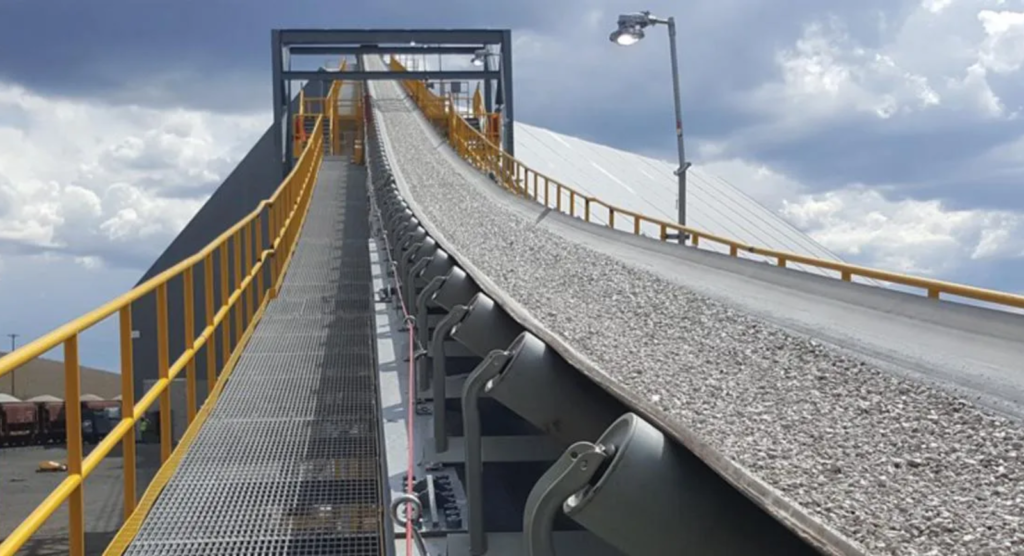
A conveyor belt is a mechanical system used to move materials, products, or goods from one place to another in a continuous and controlled manner. When people search What Is a Conveyor Belt, they are usually trying to understand how industries handle material movement efficiently while reducing manual effort. Conveyor belts are designed to support smooth workflow and consistent production across different industrial environments.

  • A conveyor belt system includes a moving belt, rollers or pulleys, and a motor that drives the belt.
  • It allows materials to be transported safely over short or long distances without interruption.

Understanding What Is a Conveyor Belt is important because these systems play a key role in improving productivity and operational efficiency.

  • Conveyor belts help reduce labor dependency and minimize handling-related injuries.
  • They ensure steady material flow, which supports faster and more reliable operations.

Due to their flexibility and reliability, conveyor belts are widely used in industries such as manufacturing, mining, logistics, food processing, and packaging, where continuous and controlled material movement is essential.

Conveyor Belt Applications in Mining Industry

Conveyor Belt Applications in Mining Industry

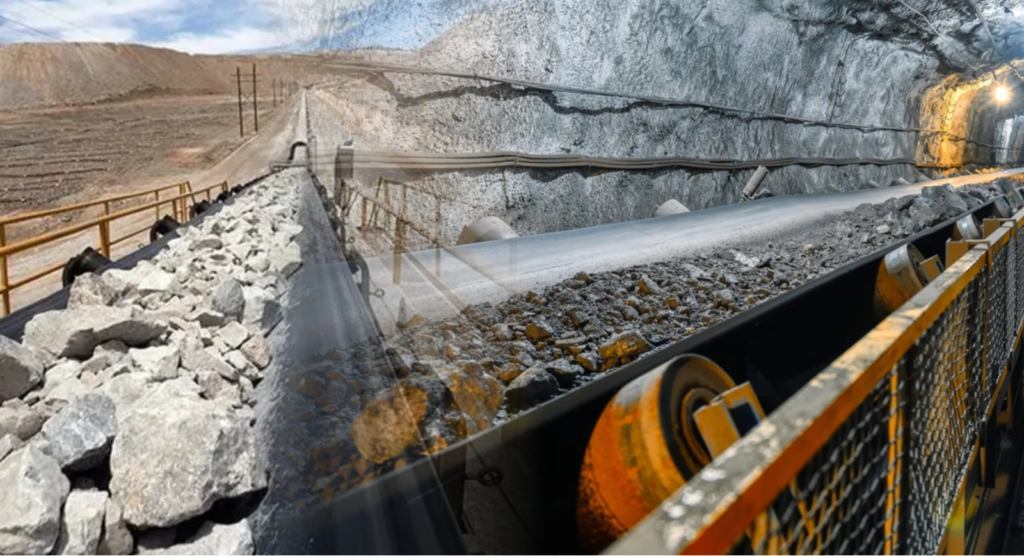
Conveyor belt systems are essential for efficient material handling in modern mining operations. Conveyor Belt Applications in Mining Industry focus on transporting large quantities of ore, minerals, and overburden material in a safe and continuous manner. These systems support smooth workflow by reducing manual handling and limiting the use of heavy vehicles inside mining sites.

Conveyor belts are designed to operate reliably in harsh environments such as dust, moisture, and uneven terrain. By enabling steady material flow, they help improve productivity, reduce operational costs, and enhance overall safety standards in both surface and underground mining operations.

1. Transportation of Ore and Minerals

  • Conveyor belts are widely used to transport mined ores and minerals such as coal, iron ore, limestone, and bauxite from extraction points to crushers or processing units.
  • Conveyor Belt Applications in Mining Industry ensure continuous and controlled material movement, even over long distances.

In mining sites, conveyor belts help reduce material spillage and avoid delays caused by truck-based transport. They maintain a steady flow of raw materials, which is important for consistent processing and production planning. By replacing or reducing heavy vehicle movement, conveyor belts lower fuel consumption and maintenance costs. They also reduce congestion within mining areas, improving worker safety. Supported by durable bearing housings from a reliable plummer block manufacturer, these conveyor belt systems deliver stable shaft support and long-term reliability, making them a cost-effective solution for handling bulk materials in large-scale mining operations.

2. Conveyor Belt Use in Underground Mining

  • Underground mining requires safe and efficient material transport in narrow and confined spaces.
  • Conveyor Belt Applications in Mining Industry are commonly used to move extracted materials through tunnels to surface-level facilities.

Conveyor belts in underground mines help minimize manual handling and reduce worker exposure to hazardous conditions. These systems are designed to operate effectively in dusty, damp, and low-visibility environments. By supporting continuous material flow, conveyor belts help maintain steady production rates without frequent interruptions. They also improve overall mine safety by limiting the movement of vehicles and equipment in tight spaces. As a result, conveyor belts play a vital role in improving efficiency and safety in underground mining operations.

3. Heavy-Duty Conveyor Belts for Mining Operations

  • Mining operations demand conveyor belts that can handle heavy loads and abrasive materials.
  • Conveyor Belt Applications in Mining Industry rely on heavy-duty conveyor belts built for durability and long service life

These conveyor belts are reinforced to withstand impact, moisture, and extreme operating conditions. Their strong construction reduces the risk of belt damage and unexpected breakdowns, helping to minimize downtime. Heavy-duty conveyor belts support continuous operation in large mining projects where reliability is critical. By using belts designed specifically for mining environments, operators achieve better performance, lower maintenance requirements, and consistent material handling. This makes heavy-duty conveyor belts a dependable choice for high-capacity mining operations.

Conveyor Belt Applications in Cement Industry

Conveyor Belt Applications in Cement Industry

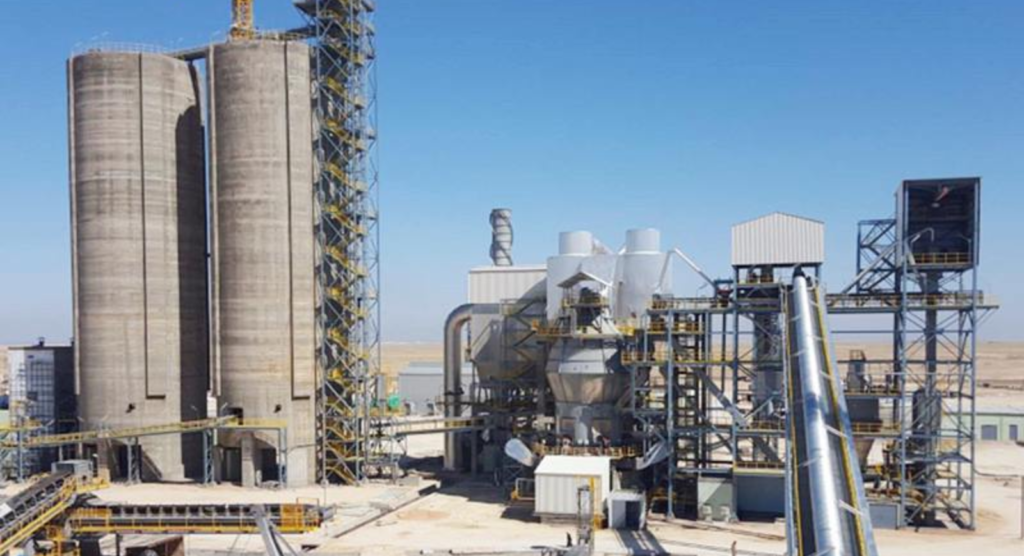
Conveyor Belt Applications in Cement Industry are essential for maintaining smooth, continuous, and cost-efficient operations in modern cement plants. Conveyor belts are used at every major stage of cement production to move raw materials, semi-processed materials, and finished products safely and efficiently.

They help reduce manual handling, minimize material loss, and ensure a steady production flow. In cement plants, conveyor belts operate in dusty, heavy-load, and demanding environments, making reliability and durability critical. By supporting automated material movement, conveyor belt systems improve productivity, enhance workplace safety, and reduce operational downtime, which makes them a core part of cement manufacturing infrastructure.

1. Raw Material Handling in Cement Plants

Raw material handling is a primary area where Conveyor Belt Applications in Cement Industry are widely used. Conveyor belts transport limestone, clay, shale, and additives from mines or storage yards to crushers and grinding units. This ensures a continuous and controlled supply of materials, which is essential for consistent cement quality.

Conveyor belts reduce dependency on trucks and loaders, lowering fuel costs and congestion inside the plant. They also minimize spillage and material wastage. By enabling long-distance and high-capacity material movement, conveyor belts help cement plants maintain efficient production schedules and reduce handling delays.

2. Clinker and Finished Cement Transportation

Clinker and finished cement transportation is another critical use of Conveyor Belt Applications in Cement Industry. After the kiln process, hot clinker is conveyed to coolers, storage silos, or grinding units using specialized conveyor systems.

Conveyor belts are also used to move finished cement, either in bulk or bagged form, to packing and dispatch areas. This controlled transportation improves logistics efficiency and reduces turnaround time. By maintaining continuous material flow, conveyor belts help cement plants achieve higher output while ensuring safe and organized product handling.

3. Conveyor Belts for High-Temperature Cement Processes

High-temperature conditions are common in cement manufacturing, especially during clinker handling. Conveyor Belt Applications in Cement Industry include the use of heat-resistant conveyor belts designed to handle hot materials without damage.

These belts are engineered to withstand extreme temperatures while maintaining strength and flexibility. Their use helps prevent frequent belt failures, reduces maintenance requirements, and supports uninterrupted operations. Heat-resistant conveyor belts play a key role in maintaining safety, reliability, and long-term efficiency in high-temperature cement processes.

Conveyor Belt Applications in Manufacturing Industry

Conveyor Belt Applications in Manufacturing Industry

Conveyor Belt Applications in Manufacturing Industry are essential for maintaining efficient, accurate, and high-speed production processes. Conveyor belts are widely used to move raw materials, components, and finished products between different stages of manufacturing. They help reduce manual handling, improve workplace safety, and ensure consistent material flow.

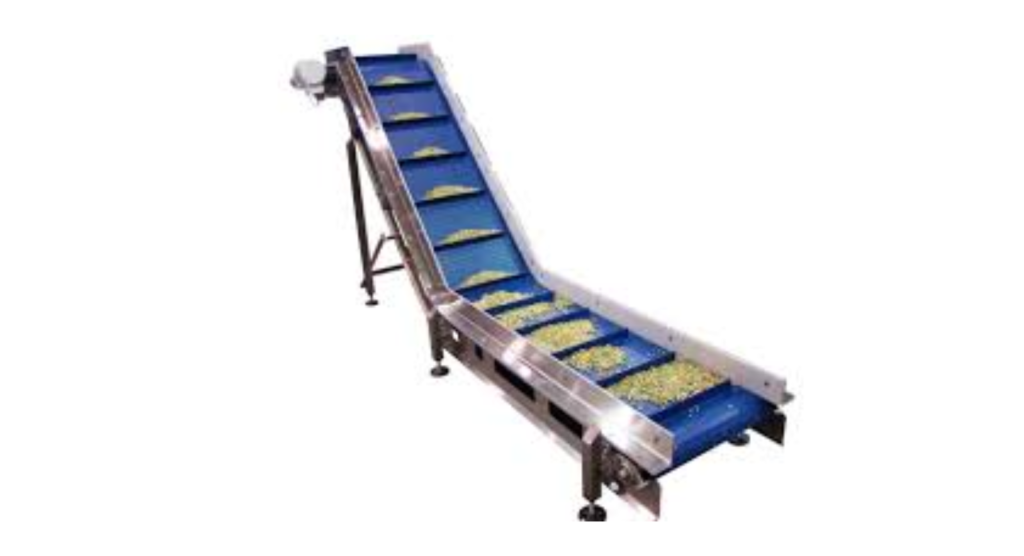
By supporting automation, conveyor belt systems allow manufacturers to increase productivity while maintaining quality standards. Depending on the application, different types of conveyor belt systems, such as flat belt conveyors, roller conveyors, and modular belt systems are used, making them suitable for various manufacturing setups—from small assembly units to large-scale production plants

1. Assembly Line Material Movement

  • Conveyor Belt Applications in Manufacturing Industry are commonly used in assembly lines to move parts smoothly between workstations.
  • Conveyor belts ensure materials arrive on time, helping workers complete tasks efficiently.

Assembly line conveyor systems help maintain a steady production pace and reduce delays caused by manual transport. They minimize handling errors and support organized workflow, which leads to improved productivity and better coordination across the manufacturing process.

2. Conveyor Belts in Automotive Manufacturing

  • Automotive plants use conveyor belts to transport heavy and complex vehicle components.
  • Conveyor Belt Applications in Manufacturing Industry support engine, body, and part movement across production stages.

Conveyor belts reduce physical strain on workers and improve accuracy in automotive assembly. Their continuous operation helps maintain high production volumes while ensuring safety and consistency in manufacturing operations.

3. Conveyor Systems for Continuous Production Flow

  • Continuous production relies on uninterrupted material movement.
  • Conveyor Belt Applications in Manufacturing Industry connect multiple processes into a smooth workflow.

Conveyor systems help reduce downtime, maintain production stability, and support scalable manufacturing operations. This makes conveyor belts a reliable solution for continuous and efficient production environments.

Conveyor Belt Applications in Food Processing Industry

Conveyor Belt Applications in Food Processing Industry

Conveyor Belt Applications in Food Processing Industry are critical for maintaining hygiene, efficiency, and consistent production in food manufacturing units. Conveyor belts are used to move raw materials, semi-processed items, and finished food products safely across different processing stages. They help reduce manual contact with food, lowering the risk of contamination.

By supporting continuous and controlled movement, conveyor belt systems improve productivity while meeting strict food safety and quality standards. Their flexibility allows food processors to handle different product types and production volumes with ease.

1. Hygienic Conveyor Belts for Food Handling

  • Hygiene is a top priority in food processing operations.
  • Conveyor Belt Applications in Food Processing Industry use food-grade belts that are easy to clean and resistant to bacteria and moisture.

These conveyor belts help prevent cross-contamination by reducing direct human handling. Their smooth surfaces support effective cleaning and sanitation routines. By maintaining hygienic material movement, conveyor belts help food manufacturers comply with safety regulations and protect product quality.

2. Conveyor Belt Use in Sorting and Packaging

  • Sorting and packaging require accuracy and consistent product flow.
  • Conveyor Belt Applications in Food Processing Industry support efficient sorting by size, weight, or type before packaging.

Conveyor belts ensure steady movement of food items to packaging machines, reducing delays and handling errors. This automation improves packaging speed and consistency, helping manufacturers meet production targets without compromising quality.

3. Temperature-Resistant Belts for Food Processing

  • Food processing often involves high or low temperature conditions.
  • Conveyor Belt Applications in Food Processing Industry include temperature-resistant belts designed for hot, chilled, or frozen food handling.

These belts maintain durability and flexibility under temperature changes. Their use ensures safe food transport, reduced maintenance, and uninterrupted processing across temperature-sensitive operations.

Conveyor Belt Applications in Agriculture Industry

Conveyor Belt Applications in Agriculture Industry are widely used to improve efficiency and reduce manual effort in agricultural operations. Conveyor belts help move grains, seeds, fertilizers, and agricultural produce smoothly across different stages such as harvesting, storage, and processing. These systems support continuous material flow, reduce handling losses, and improve workplace safety. By minimizing manual handling, conveyor belts also help maintain product quality and hygiene. When designed using a proper Gearbox Selection Guide for Your Application, conveyor belt systems deliver reliable performance and long-term efficiency, making them suitable for farms, warehouses, and agro-processing units where consistent material movement is essential.

1. Grain Handling and Storage Conveyor Belts

  • Conveyor belts are used to transport grains like wheat, rice, and maize from collection points to storage silos.
  • Conveyor Belt Applications in Agriculture Industry ensure uniform and controlled grain movement with minimal spillage.

These systems reduce grain damage and help maintain quality during loading and unloading. Conveyor belts also improve efficiency in storage facilities by speeding up material transfer and reducing labor requirements.

2. Conveyor Belts for Fertilizer and Seed Handling

  • Fertilizers and seeds require careful handling to avoid wastage and contamination.
  • Conveyor Belt Applications in Agriculture Industry use conveyor belts to move these materials safely during packaging and distribution.

Conveyor belts help reduce dust formation and limit direct human contact with chemicals. This improves safety while ensuring consistent material flow across agricultural supply processes.

3. Conveyor Systems in Food Grain Processing Units

  • Food grain processing units rely on conveyor systems for cleaning, grading, and packaging operations.
  • Conveyor Belt Applications in Agriculture Industry support continuous movement between processing stages.

By maintaining steady workflow, conveyor belts help increase productivity and preserve grain quality in processing facilities.

Conclusion

Conveyor belt systems play a vital role in modern industrial operations, and this guide has highlighted how conveyor belt applications support efficient material handling across a wide range of industries. From mining and cement plants to manufacturing, food processing, and agriculture, conveyor belts help move materials smoothly, safely, and consistently. Their ability to support continuous operations makes them an essential solution for industries focused on productivity and operational reliability, especially when integrated with reliable components from a trusted Conveyor Belt Tensioner Manufacturer to maintain proper belt alignment and performance.

One of the key advantages of conveyor belt applications is their flexibility. Different industries require different belt types based on load capacity, environmental conditions, hygiene standards, and temperature requirements. When the right conveyor belt system is selected, businesses can reduce manual labor, minimize material loss, improve safety, and maintain steady production flow. These benefits directly contribute to lower operational costs and better output quality.

As automation and large-scale production continue to grow, conveyor belt applications will remain central to efficient material handling systems. Understanding how and where conveyor belts are used allows businesses to make informed decisions that support long-term performance. By applying the insights from this complete guide, industries can optimize their operations and build a more efficient, reliable, and future-ready production environment.

FAQS

Conveyor belts are mainly used for transporting materials and products in industries such as mining, cement, manufacturing, food processing, agriculture, logistics, and warehousing. They support continuous material movement, reduce manual handling, and improve operational efficiency.

Industries that use conveyor belt systems the most include mining, cement plants, manufacturing units, food processing facilities, agriculture, power plants, and logistics centers. These industries rely on conveyor belts for bulk material handling and continuous production flow.

Conveyor belts are important because they improve productivity, reduce labor costs, enhance safety, and ensure consistent material flow. They help industries automate processes and maintain smooth operations even in high-volume environments.

Conveyor belts improve productivity by enabling continuous and controlled movement of materials. They reduce delays, minimize manual handling, and help maintain a steady workflow across different production stages.

Different applications use different conveyor belts, such as flat belts, troughed belts, cleated belts, heat-resistant belts, and food-grade belts. The selection depends on material type, load capacity, temperature, and operating conditions.

In mining and cement industries, conveyor belts are used for transporting raw materials, clinker, coal, minerals, and finished products. They support long-distance and heavy-load material handling in harsh environments.

Conveyor belt systems support automation by connecting multiple processes into a continuous workflow. This reduces human intervention, improves accuracy, and helps industries scale production efficiently.

The right conveyor belt is chosen based on factors such as material type, load weight, operating environment, temperature conditions, and production requirements. Selecting the correct belt ensures durability, safety, and long-term performance