What Is a Bearing? Everything You Need to Know

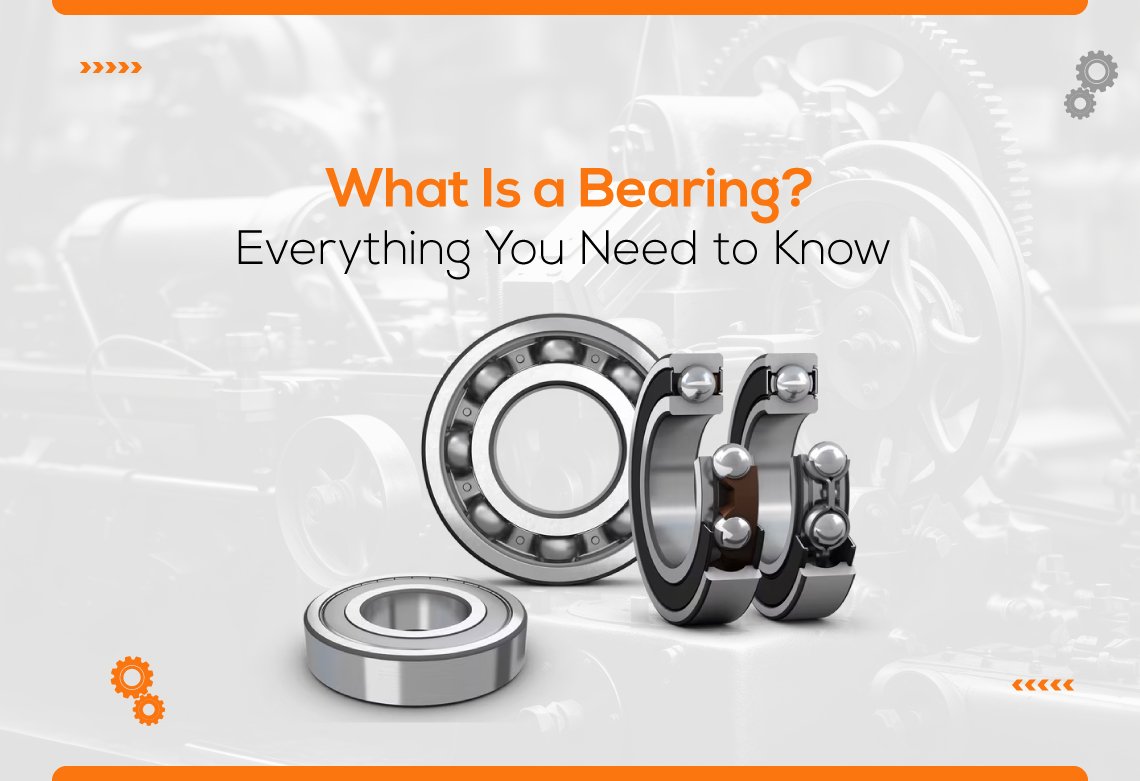
A bearing is a mechanical component that supports moving or rotating parts while reducing friction and controlling their movement. In rotating machinery, bearings support shafts, transmit loads, maintain shaft position, and allow smooth rotation between moving and stationary components.

Understanding what is a bearing is essential for anyone working with industrial machinery. Motors, pumps, conveyors, gearboxes, fans, crushers, agricultural equipment, and material-handling systems all depend on appropriately selected bearing arrangements.

Bearings are not simply friction-reduction devices. They help control shaft movement, accommodate radial and axial loads, maintain the relationship between rotating and stationary components, and contribute to reliable machine operation. Different designs use balls, rollers, or sliding surfaces depending on the application.

Industrial environments can make bearing selection particularly demanding. Steel plants, cement plants, mines, power-generation facilities, paper mills, textile machinery, sugar mills, and conveyor systems may expose bearings to high loads, vibration, dust, moisture, temperature changes, shock, and long operating cycles.

Selecting the correct bearing therefore requires more than matching a shaft diameter. Load, speed, temperature, contamination, lubrication, alignment, mounting arrangement, available space, and maintenance requirements all need to be considered.

This guide explains the bearing meaning, how bearings work, major bearing types, bearing components, industrial applications, selection criteria, maintenance practices, common failure causes, and procurement considerations.

What Is a Bearing?

A bearing is a mechanical component that supports and guides moving parts while reducing friction between contacting surfaces. It allows controlled movement, carries machine loads, maintains shaft position, and helps transfer forces between rotating and stationary components.

In a rotating machine, a bearing typically supports a shaft while allowing it to rotate relative to a housing or machine structure. The bearing controls the contact between the moving shaft and its support so that the machine can operate with less friction and wear.

The main functions of a bearing include:

  • Supporting radial loads
  • Supporting axial loads where the design permits
  • Reducing friction
  • Controlling shaft movement
  • Maintaining shaft position
  • Transmitting loads into the machine structure
  • Supporting rotational movement
  • Helping manage alignment
  • Reducing wear between moving components

The exact function depends on bearing construction. A deep groove ball bearing, cylindrical roller bearing, spherical roller bearing, thrust bearing, and plain bearing do not perform identically.

This is why the bearing definition should be understood as more than “a component that reduces friction.” A bearing is part of a complete mechanical system involving the shaft, housing, lubricant, load, alignment, and operating environment.

For example, a conveyor pulley may use bearings at both ends of its shaft. The bearings support the pulley assembly and transfer loads into the supporting structure while allowing the shaft to rotate.

How Does a Bearing Work?

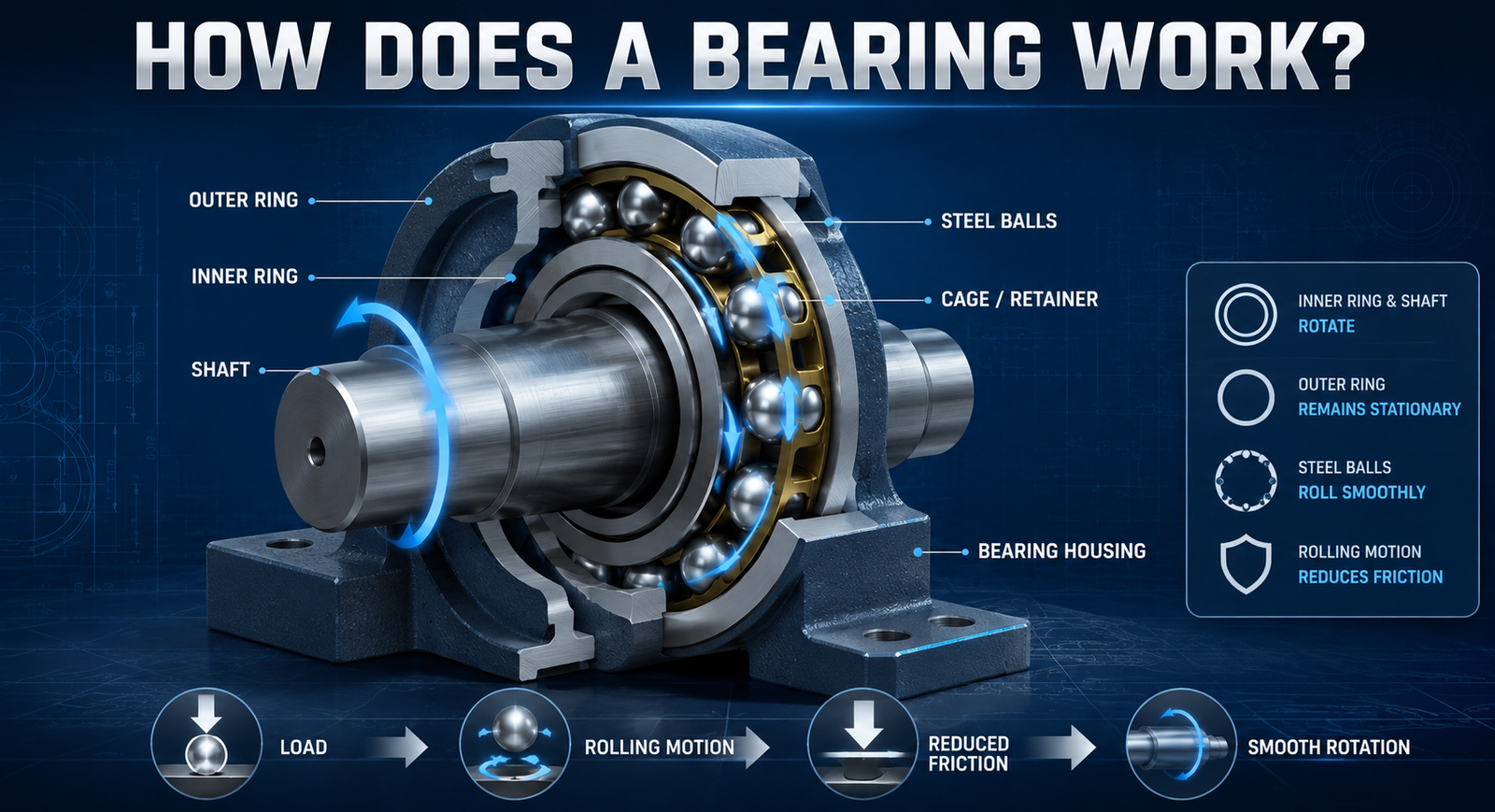
How Does a Bearing Work?

A bearing works by controlling contact between moving and stationary components so that motion occurs with reduced resistance while the bearing carries the required load. Rolling bearings use balls or rollers; plain bearings use controlled sliding surfaces.

In a rolling-element bearing, the shaft is connected to or supported by the inner ring, while the outer ring is supported by the housing. Balls or rollers move between the two rings.

The basic operating process is:

  1. The shaft or bearing ring rotates.
  2. The applied load acts on the bearing.
  3. Rolling elements transfer the load between the inner and outer rings.
  4. The cage keeps rolling elements appropriately spaced.
  5. Lubricant reduces friction and surface damage.
  6. Seals or shields can help retain lubricant and control contamination.
  7. Correct clearance and alignment allow the bearing to operate properly.
Rolling Contact vs Sliding Contact

Rolling-element bearings use balls or rollers between surfaces. Instead of two surfaces sliding directly against each other, the rolling elements provide controlled rolling contact.

Plain or sliding bearings work differently. Their surfaces slide relative to each other, normally with a suitable material and lubrication system.

Neither approach is automatically suitable for every machine. How bearings work must be evaluated alongside the load, speed, temperature, space, lubrication, alignment, and operating environment.

A conveyor shaft is a simple example. The shaft needs to rotate continuously while the supporting structure remains stationary. A suitable bearing arrangement transfers the shaft loads to the structure while permitting rotation.

What Are the Main Components of a Bearing?

A typical rolling-element bearing consists of several components designed to work together.

1. Inner Ring

The inner ring normally interfaces with the shaft. It contains the internal raceway on which the rolling elements operate.

The shaft-to-inner-ring relationship is important. An incorrect fit can result in movement between components, excessive stress, or difficulty during installation.

2. Outer Ring

The outer ring normally interfaces with the housing or machine structure. Its raceway forms the second rolling contact surface.

The outer ring and housing must provide appropriate support without creating harmful distortion or alignment problems.

3. Rolling Elements

Rolling elements carry the load between the rings.

Common forms include:

  • Balls: Used in many ball-bearing designs and suitable for a wide range of applications.
  • Cylindrical rollers: Provide line contact and are commonly used where high radial load capability is required.
  • Tapered rollers: Designed for applications involving radial and axial loads in suitable arrangements.
  • Spherical rollers: Used where high radial loading and accommodation of certain misalignment conditions are important.
  • Needle rollers: Long, relatively small-diameter rollers used where compact radial dimensions are required.
4. Cage

The cage maintains spacing between rolling elements and guides their movement. It helps prevent excessive rolling-element-to-rolling-element contact.

5. Seals and Shields

Seals and shields help control the internal bearing environment. Depending on their design, they can help retain lubricant and reduce the entry of dust, moisture, and other contaminants.

6. Lubricant

Grease or oil reduces friction, controls heat, minimizes wear, and protects bearing surfaces.

Lubrication is one of the most important factors influencing bearing performance and service life.

What Are the Different Types of Bearings?

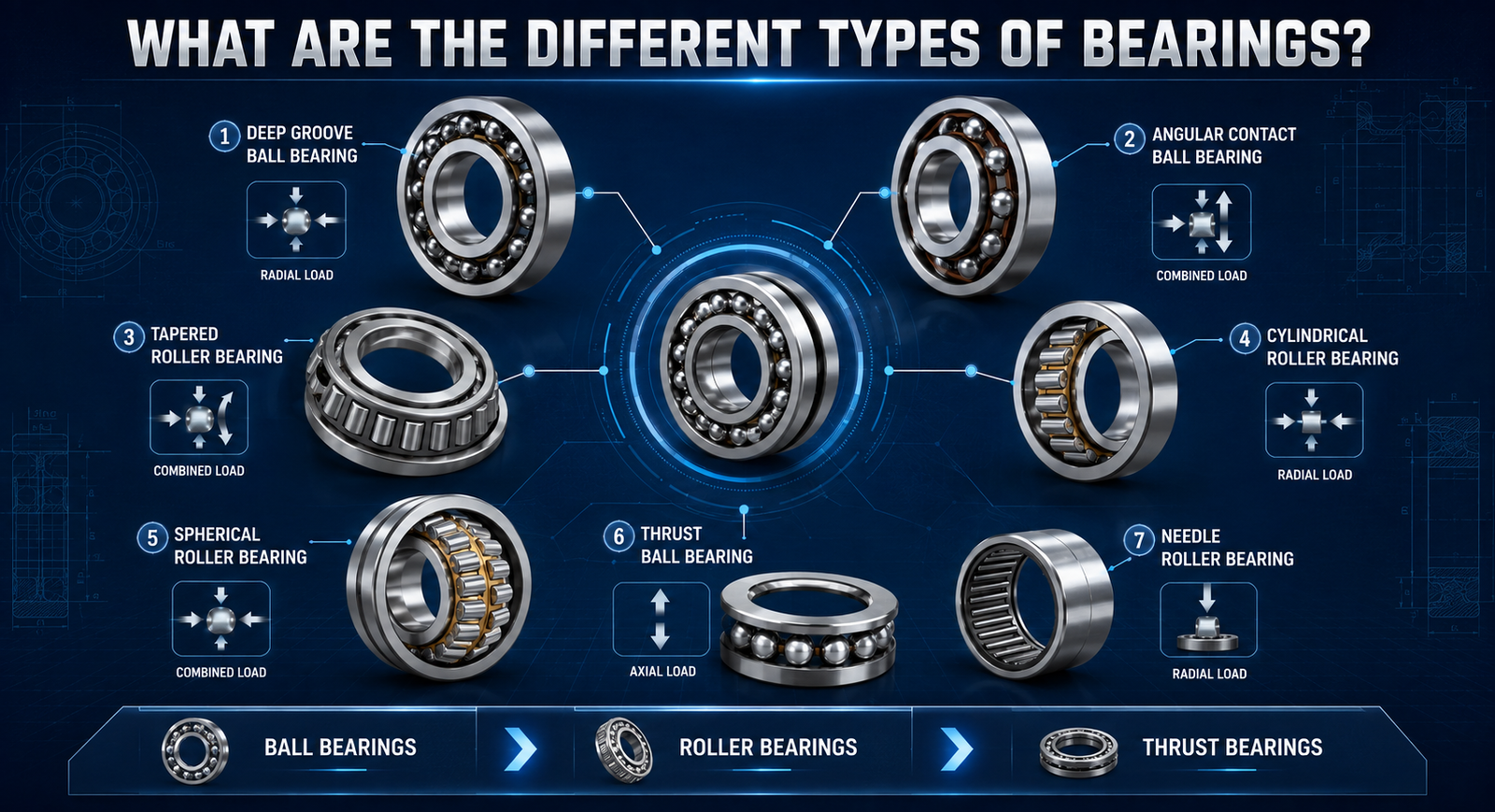
What Are the Different Types of Bearings?

Different bearing designs exist because machines experience different combinations of load, speed, alignment, temperature, space, and environmental conditions.

1. Deep Groove Ball Bearings

Deep groove ball bearings are widely used for general rotating machinery. Their design can accommodate radial loads and, depending on the arrangement, certain axial loads.

They are common in motors, pumps, fans, and general industrial equipment.

2. Angular Contact Bearings

Angular contact bearings are designed to carry radial and axial loads in appropriate configurations. They are frequently used where axial forces are important alongside radial loading.

3. Cylindrical Roller Bearings

Cylindrical roller bearings use rollers rather than balls and provide line contact. They are commonly considered for applications requiring substantial radial load capability.

4. Tapered Roller Bearings

Tapered roller bearings are designed to handle radial and axial loads in suitable arrangements. They are often found in machinery where combined loading is significant.

5. Spherical Roller Bearings

Spherical roller bearings are commonly selected for high radial loading and applications where the bearing arrangement needs to accommodate certain shaft or housing misalignment conditions.

6. Needle Roller Bearings

Needle bearings use relatively small-diameter rollers and can provide useful load capability within compact radial spaces.

7. Thrust Bearings

Thrust bearings are primarily designed for axial loading. They are used where forces act substantially along the shaft axis.

8. Mounted Bearings

Mounted units such as pillow blocks and UCP units combine a bearing insert with a housing, making them practical for many shaft-support applications.

What Is a Pillow Block Bearing?

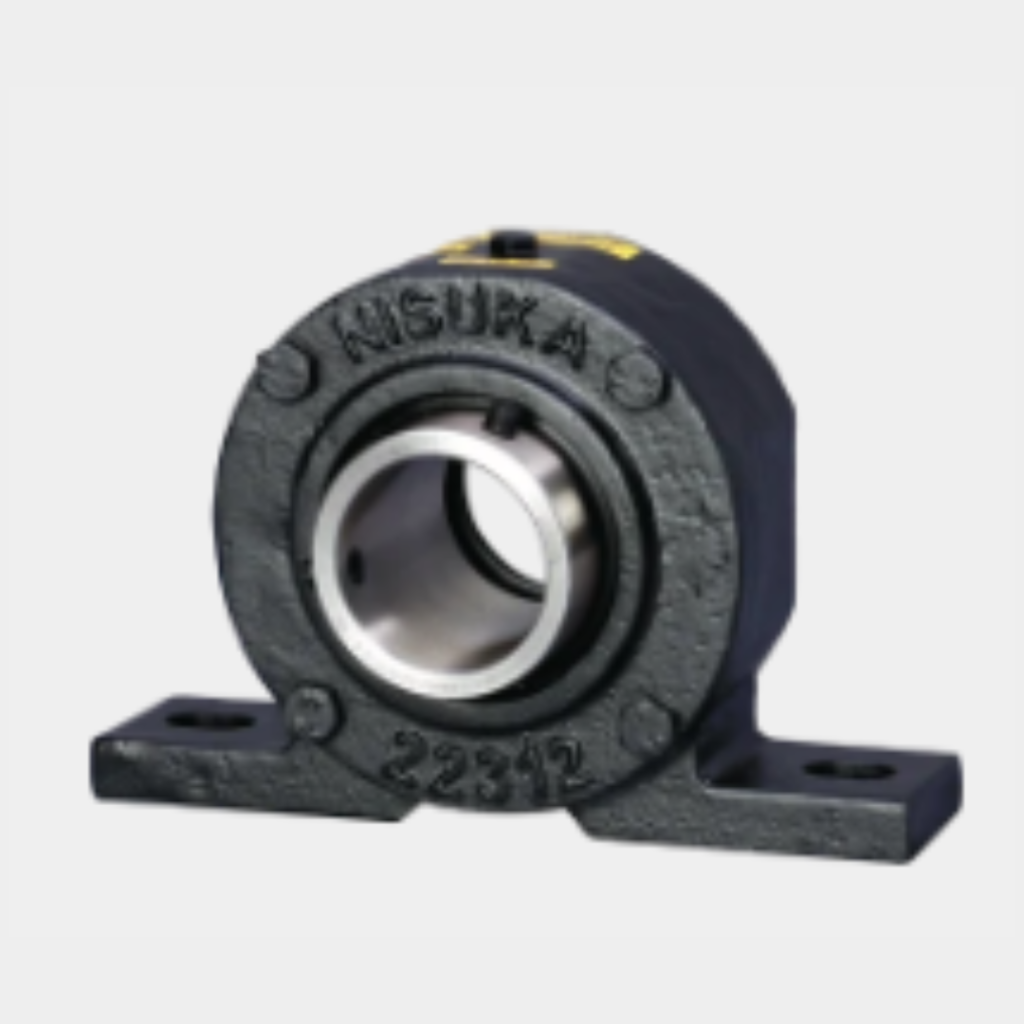
A pillow block bearing is a mounted bearing unit in which a bearing insert is installed inside a housing that can be fixed to a machine structure. It provides shaft support while simplifying mounting and replacement in many industrial applications.

A typical pillow block arrangement includes:

  • Bearing housing
  • Bearing insert
  • Mounting base
  • Shaft-locking arrangement appropriate to the design
  • Sealing arrangement
  • Lubrication provision where applicable

Pillow block units are commonly used in:

  • Conveyor systems
  • Material-handling equipment
  • Agricultural machinery
  • Fans
  • Packaging machinery
  • General industrial equipment

The housing supports the bearing while the insert provides the rolling interface for the shaft.

When selecting Pillow Block Bearings, engineers should consider shaft diameter, radial and axial loads, operating speed, temperature, contamination, alignment, lubrication, mounting arrangement, and expected service conditions.

For readers researching suppliers, a related internal resource such as Top 10 Pillow Block Manufacturers in India can be useful when comparing manufacturers and understanding procurement considerations.

Nisuka Industries can also be considered as an Indian industrial component manufacturer relevant to pillow block bearings, bearing housings, and related power-transmission components. Actual product selection should be based on the technical requirements of the machine.

What Is a Plummer Block?

A plummer block is a housed bearing arrangement used to support a rotating shaft, particularly in industrial machinery where robust shaft support and maintenance accessibility are important

Many plummer block designs use split housings. This can make bearing inspection and replacement more accessible because the housing can be opened without necessarily removing the entire shaft assembly, depending on the machine design.

Plummer blocks are commonly encountered in:

  • Mining equipment
  • Cement plants
  • Steel plants
  • Conveyors
  • Material-handling machinery
  • Heavy engineering equipment
  • Crushers and associated systems

The terminology is not completely uniform across industries and regions. In some markets, “pillow block” and “plummer block” can be used differently. Therefore, buyers should verify the actual housing design, bearing arrangement, and mounting method.

Companies researching regional suppliers may also use resources such as Plummer Block Manufacturer in Ahmedabad, Top 10 Plummer Block Manufacturers in Hyderabad, and Top 10 Plummer Block Manufacturers in West Bengal when evaluating available manufacturing sources.

How to Choose the Right Bearing?

The right bearing is selected by matching the bearing design to the application’s load, speed, shaft dimensions, temperature, environment, alignment, lubrication, mounting arrangement, and required service life.

A practical selection process is:

  1. Determine the load type. Identify radial, axial, combined, and shock loads.
  2. Calculate or estimate the required load capacity. Use actual machine information wherever possible.
  3. Determine operating speed. Consider both normal and peak speeds.
  4. Check shaft diameter. Confirm the bearing bore and shaft interface.
  5. Consider operating temperature. Temperature affects lubricant and bearing materials.
  6. Evaluate contamination. Consider dust, water, process material, chemicals, and other contaminants.
  7. Determine lubrication requirements. Select grease or oil based on the machine and bearing requirements.
  8. Check available space. Consider bearing dimensions and surrounding components.
  9. Consider shaft and housing alignment. Determine whether misalignment may occur.
  10. Consider shock and vibration. Heavy-duty machinery may require a different bearing arrangement from lightly loaded equipment.
  11. Evaluate expected service life. Consider both calculated life and actual operating conditions.
  12. Confirm housing and mounting requirements. Check the complete bearing unit, not just the bearing itself.

Procurement teams should provide suppliers with as much application information as possible. A bearing designation without application details may not be sufficient to determine whether a replacement is technically appropriate.

What Causes Bearing Failure?

Bearing failure can result from lubrication problems, contamination, misalignment, overloading, incorrect installation, unsuitable fits, vibration, temperature, corrosion, electrical damage, or fatigue.

If a plant is experiencing repeated equipment breakdowns, bearing failure should also be evaluated in the broader context of machine design and maintenance. An internal guide such as Top 10 Causes of Industrial Equipment Failure can provide useful context for investigating recurring failures.

How to Maintain Industrial Bearings

Industrial bearing maintenance involves controlling lubrication, contamination, alignment, temperature, vibration, installation condition, and mounting integrity while identifying abnormal operating conditions early.

Recommended practices include:

  • Inspect bearings regularly.
  • Check lubrication condition.
  • Follow appropriate relubrication practices.
  • Monitor vibration where practical.
  • Monitor bearing or housing temperature.
  • Control dust and moisture.
  • Check shaft alignment.
  • Inspect bearing housings.
  • Check mounting fasteners.
  • Inspect seals.
  • Investigate abnormal noise.
  • Maintain records of recurring failures.
  • Plan replacement for critical equipment when appropriate.

Industrial Applications of Bearings

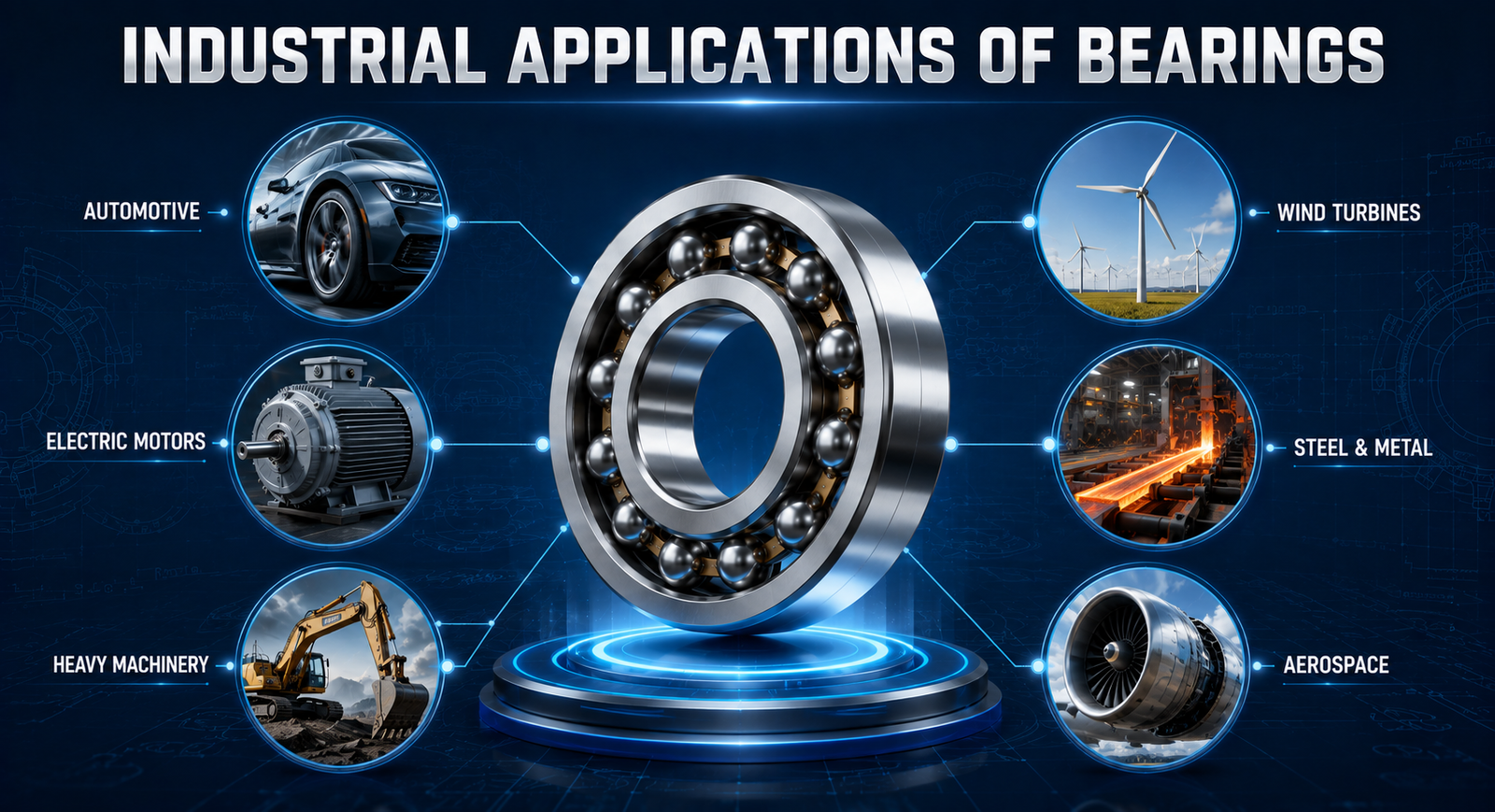
Industrial Applications of Bearings

Bearings are used throughout industrial machinery wherever controlled movement and load support are required.

1. Steel Plants

Steel plants use bearings in conveyors, rollers, fans, pumps, motors, gearboxes, and other rotating equipment. Applications can involve high loads, vibration, heat, water, dust, and continuous operation.

2. Cement Plants

Cement plants use bearings in conveyors, crushers, fans, mills, pumps, and material-handling equipment. Dust contamination is an important consideration in many areas.

3. Mining

Mining machinery may expose bearings to heavy loads, shock, vibration, abrasive dust, and difficult maintenance conditions.

4. Power Plants

Fans, pumps, motors, conveyors, and auxiliary rotating machinery depend on appropriate bearing arrangements.

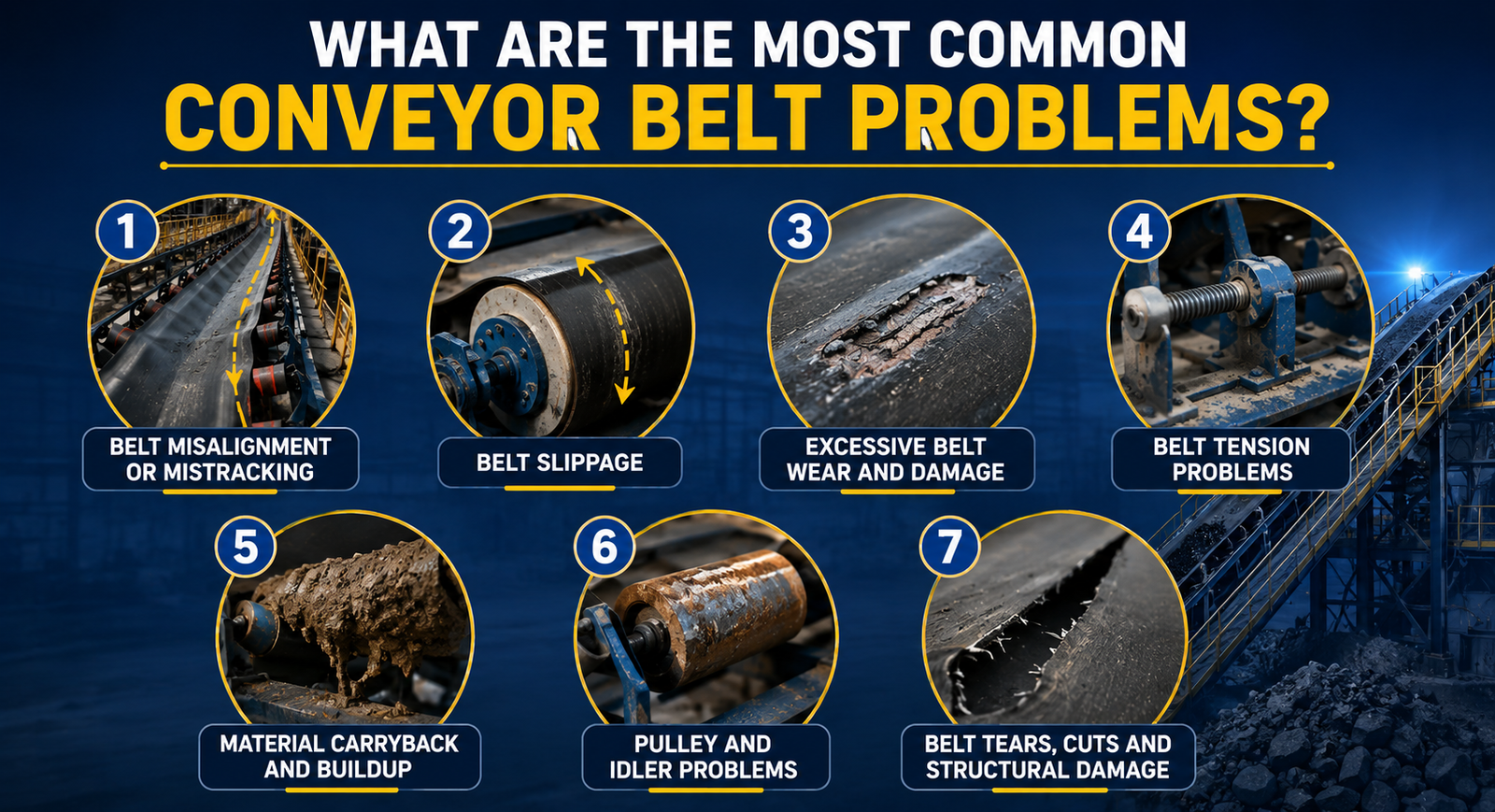
5. Conveyor Systems

Bearings support shafts, pulleys, rollers, and drive assemblies throughout conveyor systems.

6. Material Handling

Material-handling systems use bearings in rollers, pulleys, drive shafts, and other rotating components.

7. Textile Machinery

Textile machinery can require bearings that operate at controlled speeds with suitable vibration, lubrication, and contamination management.

8. Paper Mills

Paper machinery includes numerous rotating shafts and rollers and may require careful consideration of speed, moisture, temperature, load, and continuous operation.

9. Sugar Mills

Sugar mills use bearings in conveyors, rollers, pumps, drives, and other machinery exposed to demanding operating conditions.

10. Food Processing and Packaging

Food-processing and packaging equipment may require special consideration of contamination control, cleaning conditions, sealing, lubrication, and applicable equipment requirements.

Other applications include agricultural machinery, pumps, fans, electric motors, heavy engineering equipment, and OEM machinery.

Where rotating equipment incorporates speed-reduction systems, bearings also work alongside components such as Industrial Gearboxes and SMSR Gearbox arrangements.

Benefits of Using High-Quality Industrial Bearings

Appropriately selected and properly maintained industrial bearings can contribute to:

  • Longer useful service life
  • Reduced friction
  • Reliable shaft support
  • Appropriate alignment control
  • Reduced vibration
  • Lower maintenance requirements
  • Reduced risk of unplanned downtime
  • Improved machine reliability
  • Better operating efficiency
  • Lower total cost of ownership

However, bearing quality alone does not guarantee performance.

A high-quality bearing can still fail because of contamination, overloading, inadequate lubrication, incorrect installation, poor alignment, unsuitable shaft fits, or excessive vibration.

The most reliable approach is therefore to consider the bearing, shaft, housing, lubricant, load, environment, and maintenance program as one system.

Conclusion

Understanding what is a bearing provides the foundation for making better decisions about rotating machinery. Bearings support shafts, transfer loads, reduce friction, control movement, and help industrial machines operate efficiently and reliably.

The correct bearing is not simply the one that fits a shaft. Engineers and procurement teams must consider radial and axial loads, operating speed, temperature, contamination, lubrication, alignment, shock, vibration, available space, housing arrangement, and expected operating conditions.

Mounted solutions such as Pillow Block Bearings, UCP Pillow Block Bearings, and Plummer Blocks can provide practical shaft-support arrangements for conveyors and other industrial equipment when correctly matched to the machine.

Good maintenance is equally important. Correct lubrication, installation, alignment, contamination control, inspection, and vibration or temperature monitoring can help identify problems before they become major failures.

For companies sourcing industrial bearing components in India, an experienced industrial bearing manufacturer can provide bearing and housing solutions appropriate to specific applications. Nisuka Industries can be considered as an Indian manufacturer of industrial bearing housing and related power-transmission components, subject to technical suitability for the application.

Whether the requirement involves conveyor equipment, heavy-duty machinery, material handling, mining, cement, steel, or another industrial application, the most effective approach is to select the complete bearing arrangement according to the machine’s actual operating requirements—not simply by size, name, or purchase price.

FAQS

The main purpose of a bearing is to support moving components while allowing controlled movement with reduced friction. Bearings also help maintain shaft position, transfer loads, control movement, and reduce wear between moving and stationary machine components.

A rolling bearing reduces friction by using balls or rollers between its rings, replacing much of the direct sliding contact with rolling contact. Lubrication further reduces resistance and protects the contacting surfaces. Plain bearings use controlled sliding surfaces and appropriate lubrication.

Major types include deep groove ball bearings, angular contact bearings, cylindrical roller bearings, tapered roller bearings, spherical roller bearings, needle roller bearings, thrust bearings, pillow block units, and plummer blocks. Selection depends on load, speed, alignment, space, environment, and machine requirements.

A ball bearing uses spherical rolling elements, while a roller bearing uses cylindrical, tapered, spherical, or needle-shaped elements. Roller bearings provide line contact and can be advantageous for certain high-load applications, while ball bearings are widely used across many general rotating-machine applications.

The suitable conveyor bearing depends on pulley and shaft loads, speed, shaft diameter, alignment, contamination, shock, mounting arrangement, and maintenance requirements. Pillow block units and plummer block arrangements are both used in conveyor systems, but the machine’s actual operating conditions should determine the selection.

Top 10 Causes of Industrial Equipment Failure and How to Prevent them

A conveyor suddenly stops. The gearbox temperature has climbed beyond its normal operating range. A bearing starts producing an unusual grinding sound. Within minutes, an apparently small mechanical problem can turn into an unplanned production stoppage.

This is how Industrial Equipment Failure often develops in manufacturing and processing plants. The failure itself may appear sudden, but the underlying condition can have been developing for weeks or months through inadequate lubrication, misalignment, contamination, overloading, component wear, or missed inspections.

Unexpected equipment failure affects much more than a single machine. It can interrupt production, increase emergency maintenance costs, delay customer deliveries, reduce equipment availability, create safety risks, and accelerate wear on connected components. In conveyor-based operations, for example, a problem with a bearing, pulley, gearbox, or belt can affect an entire material-handling system.

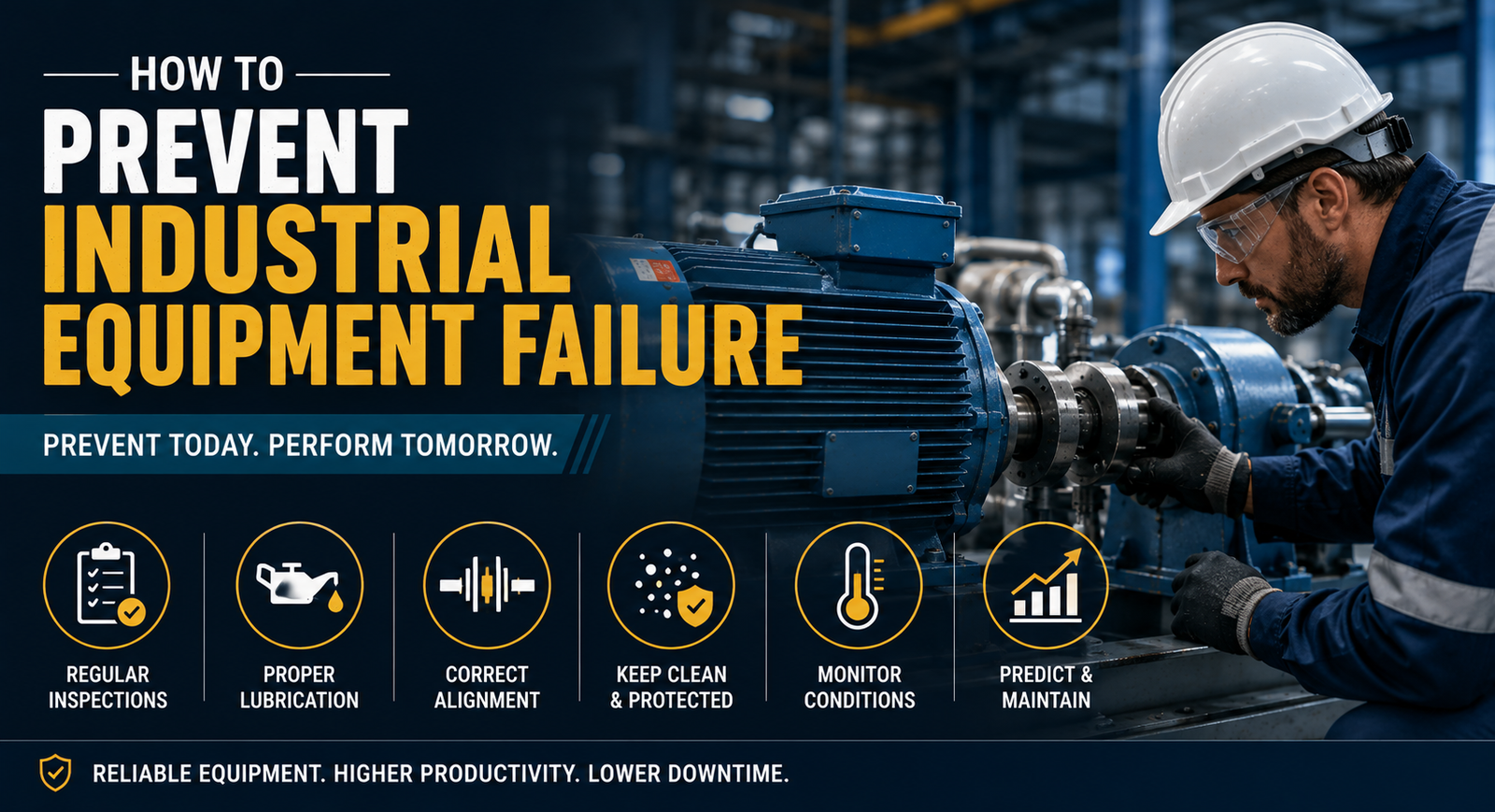
For maintenance and reliability teams, the objective should therefore be more than repairing equipment after it breaks. Effective Industrial Equipment Maintenance focuses on identifying developing problems, understanding why they occurred, and taking corrective action before the same failure returns.

The most reliable approach combines appropriate equipment selection, preventive maintenance, condition monitoring, proper lubrication, correct alignment, controlled loading, operator training, and systematic failure analysis.

What Is Industrial Equipment Failure?

Industrial equipment failure occurs when a machine, assembly, or component can no longer perform its intended function safely, reliably, or within specified operating conditions.

Failure does not always mean that a machine completely stops.

A bearing operating at an abnormal temperature, a gearbox producing excessive vibration, or a conveyor pulley developing excessive wear may represent a developing failure even when the equipment is still running.

Industrial equipment failure can be classified in several ways:

  • Mechanical failure: Failure of bearings, gears, shafts, couplings, belts, pulleys, or other mechanical components.
  • Electrical failure: Problems involving motors, wiring, controls, sensors, insulation, or electrical protection.
  • Structural failure: Cracking, deformation, fatigue, or loss of structural integrity.
  • Component failure: Failure of an individual part that affects machine performance.
  • Operational failure: Equipment cannot achieve its required output because of incorrect operating conditions, excessive loads, or improper use.
  • Progressive failure: Performance deteriorates gradually through wear, fatigue, contamination, or lubrication degradation.
  • Sudden failure: A component fails rapidly because of severe overload, fracture, seizure, impact, or another acute event.
  • Partial failure: The machine continues operating but at reduced speed, capacity, efficiency, or reliability.
  • Complete failure: The equipment can no longer perform its intended function.

The consequences can include production downtime, increased maintenance labour, poor product quality, energy inefficiency, safety exposure, and shortened equipment life.

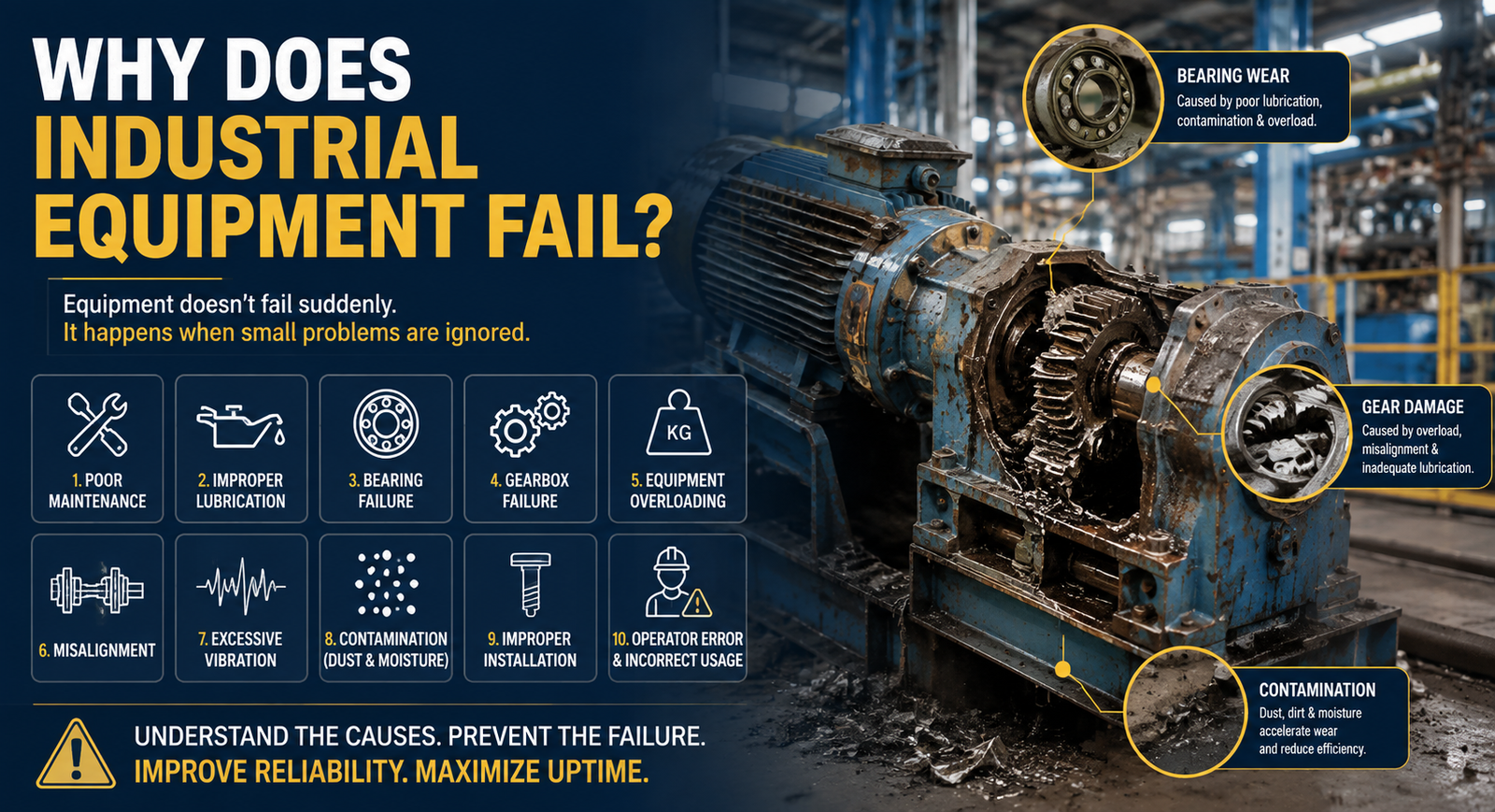
Why Does Industrial Equipment Fail?

Why Does Industrial Equipment Fail?

Industrial machinery rarely fails for only one reason. In many cases, several contributing conditions combine.

The most common categories include:

  1. Poor preventive maintenance
  2. Improper lubrication
  3. Bearing problems
  4. Gearbox problems
  5. Equipment overloading
  6. Misalignment
  7. Excessive vibration
  8. Contamination, dust, and moisture
  9. Improper installation
  10. Operator error or incorrect equipment usage

For example, repeated bearing failure may initially appear to be a bearing-quality issue. However, investigation may reveal excessive belt tension, shaft misalignment, contamination, incorrect bearing mounting, or insufficient lubrication.

This distinction is important. Replacing a failed component without identifying the failure mechanism can allow the same problem to happen again.

Effective maintenance engineering therefore asks two questions:

What failed?

and

Why did it fail?

Here are 10 Causes of Industrial Equipment Failure:

1. Poor Preventive Maintenance

What causes the problem?

One of the most common contributors to industrial machinery failure is an inadequate maintenance program.

Problems occur when inspections are skipped, lubrication is delayed, abnormal conditions are not documented, or servicing is performed only after equipment stops working.

A reactive maintenance culture can be particularly problematic for critical assets such as conveyor gearboxes, bearings, motors, pumps, compressors, crushers, and material-handling systems.

Common warning signs

Maintenance teams may observe:

  • Increasing vibration
  • Unusual noise
  • Oil leakage
  • Temperature increases
  • Loose fasteners
  • Repeated component failures
  • Reduced operating performance
  • Deteriorating conveyor tracking
  • Increasing lubrication requirements
Impact on industrial equipment

Small defects can progressively affect connected components. A loose mounting arrangement, for example, can contribute to vibration and alignment problems. A neglected lubricant leak can eventually result in insufficient lubrication.

The result may be an avoidable breakdown rather than a planned maintenance intervention.

How to prevent it

Establish an asset-specific preventive maintenance program covering:

  • Inspection requirements
  • Lubrication requirements
  • Alignment checks
  • Bearing inspections
  • Gearbox inspections
  • Conveyor inspections
  • Safety checks
  • Component replacement criteria
  • Maintenance documentation
Maintenance recommendation

Do not use one generic schedule for every machine. Maintenance intervals should consider manufacturer recommendations, duty cycle, operating environment, equipment criticality, load, speed, contamination, and previous failure history.

A strong Industrial Machinery Maintenance program should also record recurring failures so engineers can identify patterns rather than treating each breakdown as an isolated event.

2. Improper Lubrication

What causes the problem?

Lubrication is fundamental to the reliability of bearings, gears, shafts, and other moving components.

Lubrication-related failures can result from:

  • Insufficient lubricant
  • Excessive lubricant
  • Incorrect lubricant type
  • Incorrect viscosity
  • Contaminated lubricant
  • Incorrect lubrication interval
  • Lubricant degradation
  • Poor storage or handling
  • Mixing incompatible lubricants

Too little lubricant can increase friction and wear. However, more lubricant is not automatically better; excessive lubrication can also create heat and operating problems in some applications.

Common warning signs

Look for:

  • Abnormal bearing temperature
  • Gearbox overheating
  • Discoloured lubricant
  • Metal particles in lubricant
  • Oil leakage
  • Unusual gear or bearing noise
  • Increased friction
  • Accelerated component wear
Impact on industrial equipment

Poor lubrication can damage bearing raceways, rolling elements, gears, seals, and other surfaces. In gearboxes, lubricant condition directly affects the operating environment of gears and bearings.

How to prevent it

Create a documented lubrication management system that specifies:

  • Correct lubricant
  • Correct quantity
  • Application method
  • Lubrication interval
  • Storage requirements
  • Contamination-control procedures
  • Inspection requirements

Lubricants should be selected according to the equipment manufacturer’s specifications and operating conditions.

Maintenance recommendation

Avoid treating lubrication as simply a routine greasing activity. It should be considered part of Industrial Equipment Reliability.

For critical assets, lubricant inspection or oil analysis may help identify contamination, wear debris, oxidation, or other developing problems.

3. Bearing Failure

Bearing Failure
What causes the problem?

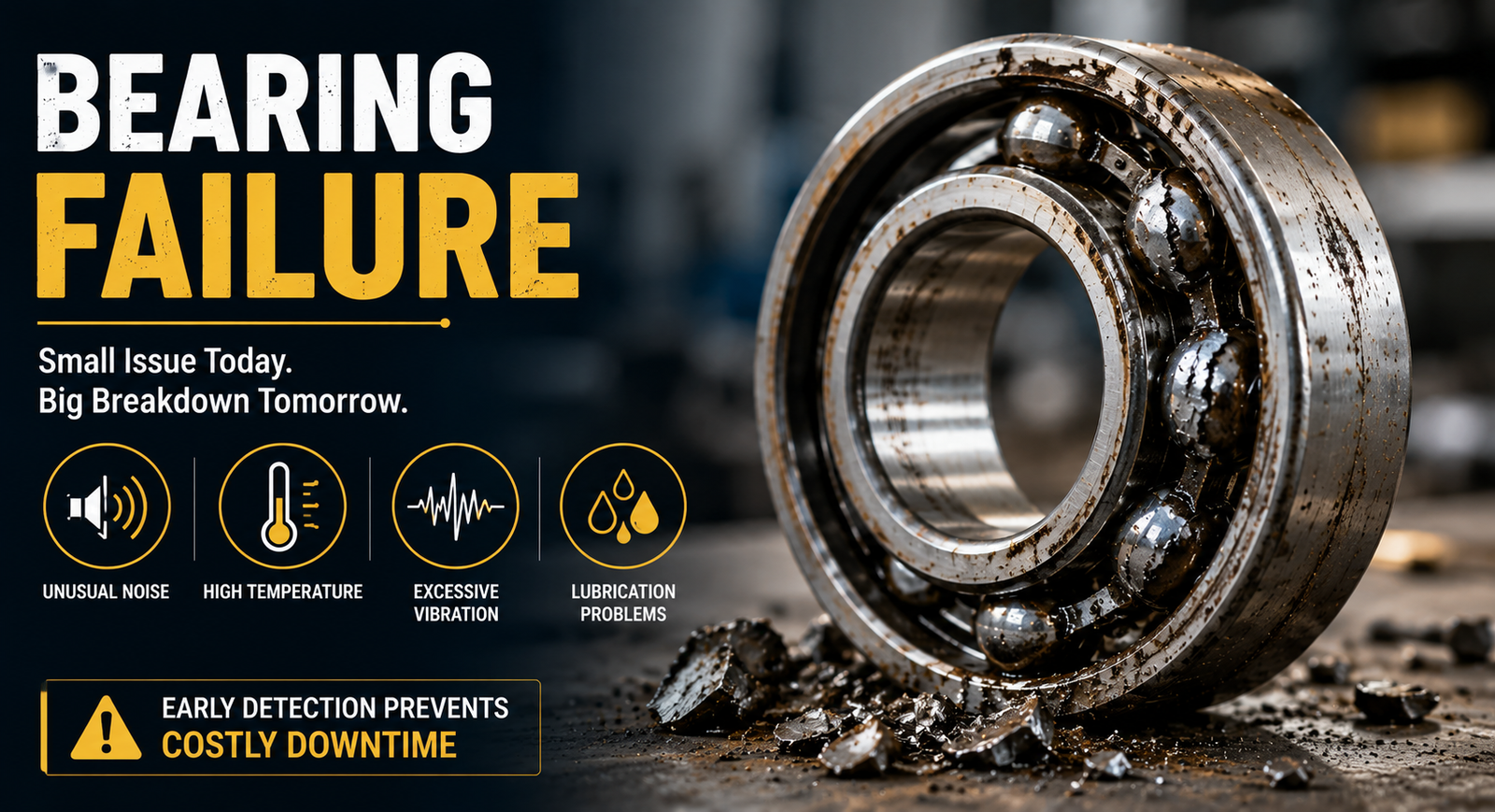
Bearings are critical components in rotating equipment, but they can fail because of several interacting factors.

Common causes include:

  • Poor lubrication
  • Contamination
  • Misalignment
  • Excessive load
  • Incorrect installation
  • Improper shaft fit
  • Excessive vibration
  • Incorrect bearing selection
  • Inadequate sealing
  • Operating conditions outside design requirements

In conveyor systems, bearings supporting pulleys, shafts, and rollers may be exposed to dust, moisture, vibration, impact loading, and continuous operation.

Common warning signs

Typical warning signs include:

  • Grinding or rumbling noise
  • Increased temperature
  • Excessive vibration
  • Shaft movement
  • Lubricant leakage
  • Repeated bearing replacement
  • Reduced rotating smoothness
Impact on industrial equipment

A damaged bearing can create secondary problems. Increased vibration can affect couplings, shafts, seals, gearboxes, and mounting structures.

If a bearing seizes, the consequences can be considerably more severe.

How to prevent it

Bearing reliability starts before installation.

Engineers should verify:

  • Correct bearing type
  • Correct load capacity
  • Appropriate housing
  • Shaft compatibility
  • Proper mounting method
  • Correct lubrication
  • Adequate sealing
  • Correct alignment

Pillow blocks, plummer blocks, and bearing housings should be selected according to the actual application rather than simply by matching a nominal shaft dimension.

For maintenance and procurement teams comparing heavy-duty bearing housing solutions, Top 10 Plummer Block Manufacturers in Hyderabad is a relevant reference when evaluating manufacturers and industrial bearing-support options. 

Maintenance recommendation

When a bearing fails repeatedly, investigate the operating environment and installation conditions before simply replacing it.

Useful diagnostic questions include:

Was the bearing overloaded? Was it correctly aligned? Was contamination present? Was the lubricant appropriate? Was the shaft or housing fit correct?

4. Gearbox Failure

What causes the problem?

Gearboxes transfer torque and control speed, making them critical to many industrial machines.

Common gearbox failure mechanisms include:

  • Gear tooth wear
  • Lubrication problems
  • Excessive load
  • Misalignment
  • Bearing damage
  • Excessive operating temperature
  • Contamination
  • Incorrect gearbox selection
  • Improper installation
  • Shock loading

A gearbox may continue running while internal damage is developing, which is why condition monitoring is valuable.

Common warning signs

Maintenance teams should investigate:

  • Unusual gear noise
  • Rising temperature
  • Oil leakage
  • Increased vibration
  • Metal particles in lubricant
  • Abnormal speed
  • Repeated seal failure
  • Reduced torque transmission
Impact on industrial equipment

A gearbox failure can stop conveyors, crushers, material-handling systems, mixers, and production lines.

The correct gearbox must be selected according to speed, torque, duty cycle, load characteristics, mounting arrangement, environmental conditions, and application requirements.

Nisuka Industries manufactures SMSR Gearbox solutions used in conveyor, crusher, and material-handling applications. Its website describes its shaft-mounted gearbox range as designed for heavy-duty industrial applications and notes the use of features such as case-hardened gears, selected anti-friction bearings, sealing arrangements, and tapper-bush mounting systems.

For procurement teams researching SMSR Gearbox Manufacturer in Ahmedabad, the important evaluation criteria should extend beyond purchase price to application suitability, engineering support, installation requirements, serviceability, and spare-parts availability.

Maintenance recommendation

Check gearbox oil condition, temperature, vibration, seals, mounting, and load regularly.

If a gearbox repeatedly fails, investigate the driven machine as well. The gearbox may be experiencing a load, alignment, or torque condition that was not present in the original design assumptions.

LET’S DISCUSS YOUR REQUIREMENT

Need a Reliable Gearbox Solution?

Share your application requirements with our technical team and get the right gearbox solution for your industrial needs.

CONTACT DETAILS

Speak With Our Technical Team

Get expert assistance for product selection, specifications and industrial applications.

VISIT OUR FACTORY

4304, 4321 C/1-B Phase IV, Near Sethi Ind. Gases, G.I.D.C., Vatva, Ahmedabad – 382445, Gujarat, India.

GET A FREE QUOTE

Tell Us What You Need

Complete the form and our team will connect with you shortly.

    5. Equipment Overloading

    What causes the problem?

    Equipment designed for a particular load range can experience accelerated wear when operated beyond its intended capacity.

    Overloading can result from:

    • Excessive material quantity
    • Incorrect equipment sizing
    • Increased conveyor loading
    • High starting torque
    • Shock loads
    • Process modifications
    • Blockages
    • Frequent starts and stops
    • Incorrect speed or operating conditions
    Common warning signs

    Indicators may include:

    • Motor current increases
    • Gearbox temperature rises
    • Bearing temperature increases
    • Belt slippage
    • Excessive vibration
    • Reduced speed
    • Frequent coupling failures
    • Repeated gearbox or shaft damage
    Impact on industrial equipment

    Excessive loading can transfer abnormal forces to bearings, shafts, gears, couplings, motors, pulleys, and gearboxes.

    Repeated overload conditions are particularly harmful because the equipment may appear to operate normally while fatigue and wear accumulate.

    How to prevent it

    Before selecting equipment, calculate:

    • Required torque
    • Operating speed
    • Load
    • Duty cycle
    • Starting conditions
    • Shock loading
    • Conveyor capacity
    • Environmental conditions
    Maintenance recommendation

    Do not compensate for chronic overload simply by replacing components with heavier ones. First determine whether the equipment is correctly sized for the application.

    Correct equipment selection is one of the most important stages of Industrial Equipment Maintenance because maintenance cannot fully compensate for fundamentally unsuitable equipment.

    6. Misalignment

    Misalignment
    What causes the problem?

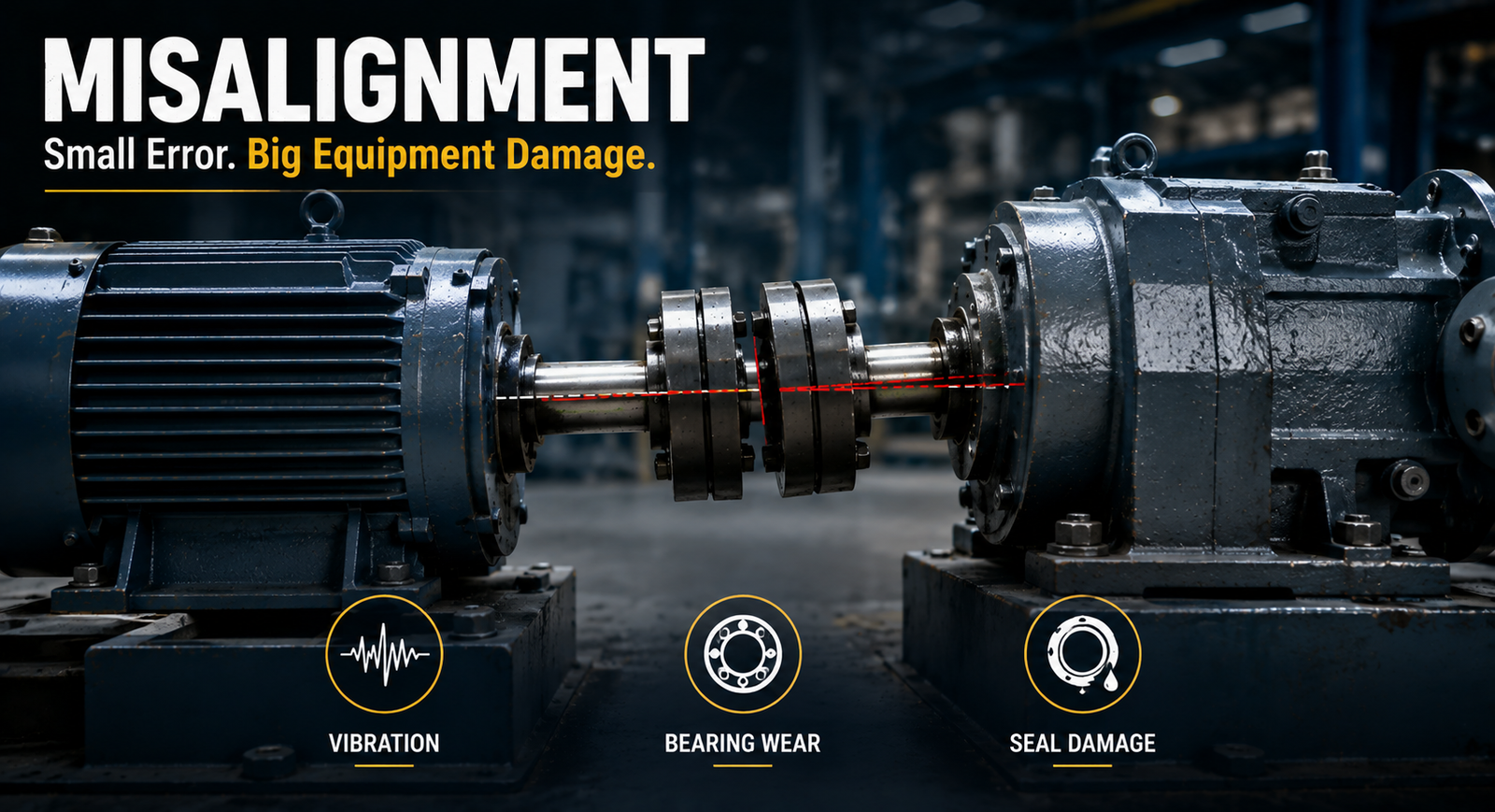
    Misalignment occurs when connected rotating components do not operate within the required geometric relationship.

    Common examples include:

    • Shaft misalignment
    • Coupling misalignment
    • Pulley misalignment
    • Bearing alignment problems
    • Conveyor pulley misalignment
    • Incorrect mounting
    • Installation errors
    Common warning signs

    Misalignment can contribute to:

    • Excessive vibration
    • Bearing wear
    • Seal damage
    • Coupling wear
    • Gear wear
    • Increased temperature
    • Increased energy demand
    • Uneven belt tracking
    Impact on industrial equipment

    Misalignment introduces additional forces into rotating systems.

    For conveyor equipment, pulley alignment and belt tracking are particularly important. Poor alignment can increase belt wear, create tracking problems, and place additional loading on bearings and shafts.

    How to prevent it

    Use appropriate alignment procedures during installation and maintenance.

    Depending on the equipment, this may involve:

    • Shaft alignment
    • Coupling alignment
    • Pulley alignment
    • Bearing housing inspection
    • Base inspection
    • Conveyor tracking checks
    Maintenance recommendation

    Alignment should be checked after major installation work, component replacement, structural changes, or whenever vibration or abnormal wear suggests a problem.

    For anyone researching What is a Shaft Mounted Speed Reducer Gearbox?, it is equally important to understand that gearbox selection and mounting arrangement must be evaluated together with shaft, pulley, and conveyor geometry.

    7. Excessive Vibration

    What causes the problem?

    Vibration is not necessarily a failure itself. It is often a symptom of an underlying mechanical condition.

    Possible causes include:

    • Imbalance
    • Misalignment
    • Bearing damage
    • Gear damage
    • Loose components
    • Bent shafts
    • Structural problems
    • Resonance
    • Mechanical looseness
    Common warning signs

    A change in vibration level, frequency pattern, or operating behaviour can indicate developing machinery problems.

    Maintenance teams should pay attention to:

    • Increasing vibration
    • New vibration frequencies
    • Machine movement
    • Loose foundations
    • Abnormal bearing noise
    • Increasing gearbox vibration
    Impact on industrial equipment

    Excessive vibration can accelerate wear and may transfer mechanical forces to neighbouring components.

    For critical rotating assets, vibration monitoring can form an important part of predictive maintenance.

    How to prevent it

    Establish baseline vibration measurements where appropriate and investigate significant deviations.

    The monitoring method should be selected according to equipment criticality and the type of failure being investigated.

    Maintenance recommendation

    Use vibration monitoring as part of Industrial Equipment Troubleshooting, not as a replacement for physical inspection.

    A vibration reading should be interpreted in context with machine speed, load, temperature, operating history, and previous measurements.

    8. Contamination, Dust & Moisture

    Contamination, Dust & Moisture
    What causes the problem?

    Industrial equipment frequently operates in harsh environments.

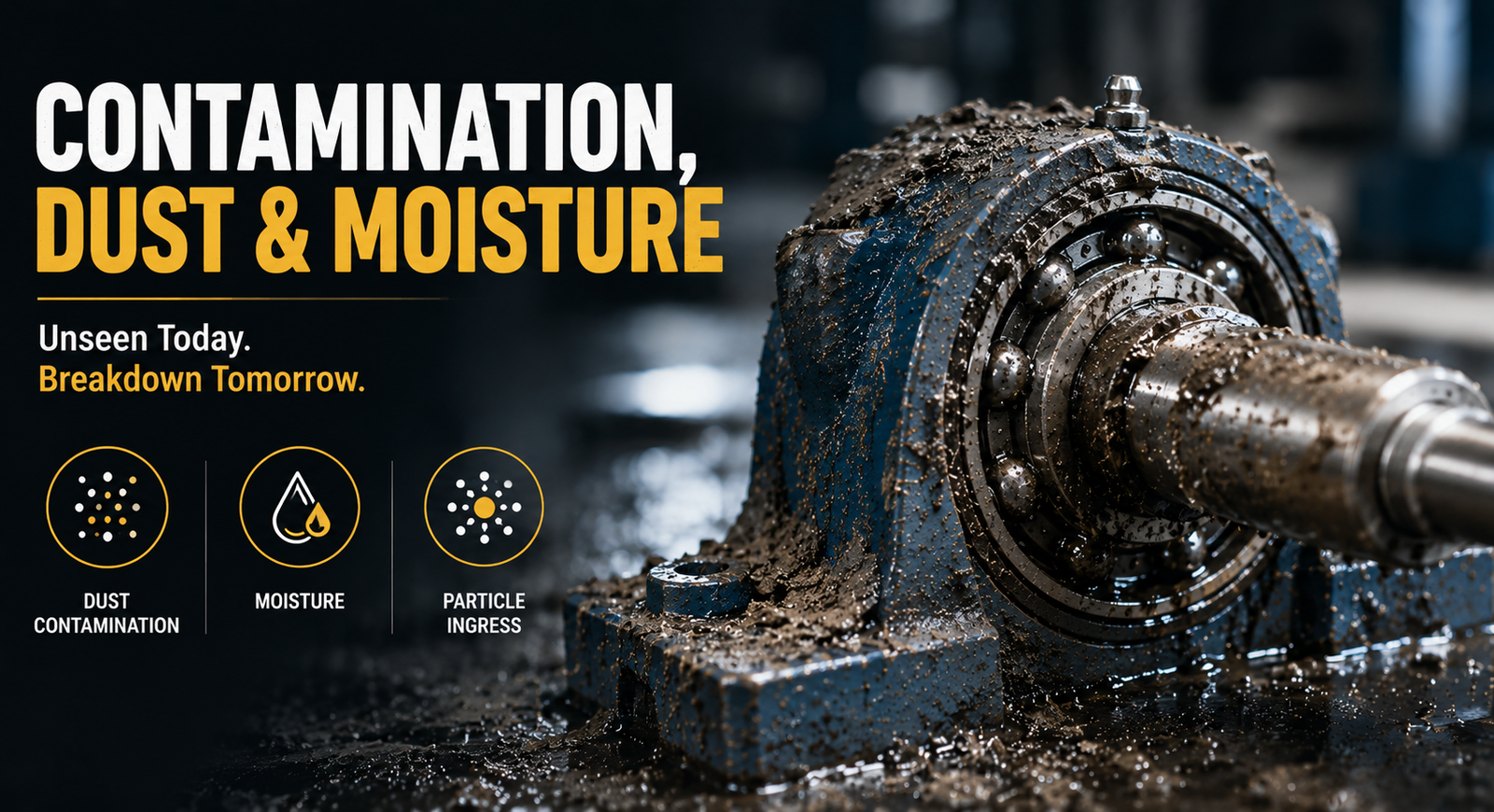
    Dust, dirt, water, chemicals, abrasive particles, and other contaminants can enter bearings, gearboxes, seals, and lubrication systems.

    This is particularly challenging in:

    • Cement plants
    • Mining operations
    • Steel plants
    • Food-processing facilities
    • Chemical plants
    • Power-generation facilities
    • Aggregate handling
    • Recycling plants
    Common warning signs

    Potential indicators include:

    • Contaminated lubricant
    • Premature bearing wear
    • Seal damage
    • Corrosion
    • Gear wear
    • Increased vibration
    • Abnormal temperature
    • Frequent lubrication problems
    Impact on industrial equipment

    Contamination can reduce lubricant effectiveness and accelerate surface wear.

    In conveyor systems, environmental contamination can also affect bearings, rollers, pulleys, tensioning equipment, and other components.

    How to prevent it

    Use appropriate:

    • Seals
    • Guards
    • Covers
    • Breathers
    • Lubrication practices
    • Cleaning procedures
    • Storage practices

    Maintenance teams should also consider the environment when selecting components.

    A component suitable for a clean indoor application may not be suitable for a dusty mining or cement environment without appropriate protection.

    Maintenance recommendation

    Do not wait for contamination to cause visible damage. Establish contamination-control procedures at the equipment design and installation stage.

    9. Improper Installation

    What causes the problem?

    A high-quality component can still fail prematurely if it is installed incorrectly.

    Common installation problems include:

    • Incorrect shaft fit
    • Improper bearing mounting
    • Incorrect tightening
    • Poor alignment
    • Incorrect lubrication
    • Improper mounting
    • Incorrect component selection
    • Damaged seals
    • Incorrect coupling installation
    Common warning signs

    Installation-related problems may appear as:

    • Immediate vibration
    • Premature bearing failure
    • Oil leakage
    • Excessive temperature
    • Abnormal noise
    • Shaft movement
    • Fastener loosening
    Impact on industrial equipment

    Installation errors can create forces that were never considered in the original equipment design.

    This is why manufacturer installation specifications are important.

    How to prevent it

    Maintenance and installation teams should follow:

    • Manufacturer instructions
    • Correct torque values
    • Shaft and housing requirements
    • Alignment procedures
    • Lubrication requirements
    • Recommended mounting methods
    Maintenance recommendation

    Document critical installation checks for important equipment.

    When a new component fails shortly after installation, do not automatically assume the replacement component was defective. Review installation conditions, alignment, load, lubrication, and operating environment.

    10. Operator Error & Incorrect Equipment Usage

    What causes the problem?

    Machines are designed around specific operating procedures. Incorrect use can cause accelerated wear or immediate damage.

    Examples include:

    • Exceeding rated capacity
    • Incorrect startup procedures
    • Incorrect shutdown
    • Ignoring warning signs
    • Poor operator training
    • Incorrect adjustments
    • Bypassing safety procedures
    • Continuing operation after abnormal noise or vibration
    Common warning signs

    Recurring failures that correlate with specific operating shifts, processes, or operating conditions can indicate an operational issue.

    Impact on industrial equipment

    Incorrect operation can cause:

    • Shock loading
    • Overheating
    • Belt slippage
    • Gearbox overload
    • Bearing damage
    • Motor stress
    • Increased wear
    How to prevent it

    Develop clear standard operating procedures covering:

    • Startup
    • Shutdown
    • Loading
    • Inspection
    • Emergency response
    • Equipment limits
    • Abnormal-condition reporting
    Maintenance recommendation

    Operators should not be expected to diagnose every mechanical problem. However, they should know which abnormal conditions require immediate escalation.

    A well-trained operator can become an important part of the plant’s early-warning system.

    How to Prevent Industrial Equipment Failure

    How to Prevent Industrial Equipment Failure

    A practical reliability program should combine several maintenance strategies instead of relying on one approach.

    1. Establish preventive maintenance

    Schedule inspections and servicing according to equipment requirements and operating conditions.

    2. Use predictive maintenance where justified

    Critical rotating equipment may benefit from vibration, temperature, oil, or other condition-monitoring techniques.

    3. Inspect equipment regularly

    Look for changes in noise, vibration, leakage, temperature, wear, and alignment.

    4. Control lubrication

    Specify the right lubricant, quantity, interval, storage procedure, and contamination controls.

    5. Monitor vibration

    Establish suitable baselines and investigate significant changes.

    6. Monitor temperature

    Temperature trends can provide useful evidence of developing mechanical problems.

    7. Check alignment

    Inspect shafts, couplings, pulleys, bearings, and conveyor arrangements where applicable.

    8. Control equipment loading

    Confirm that actual operating loads remain within the design requirements.

    9. Inspect bearings and gearboxes

    Look for wear, leakage, temperature changes, vibration, and lubricant problems.

    10. Train operators

    Make operating limits and abnormal-condition reporting procedures clear.

    11. Maintain critical spare parts

    Identify components where long procurement lead times could significantly extend downtime.

    12. Document failures

    Record what failed, operating conditions, symptoms, root causes, corrective actions, and recurrence.

    This transforms maintenance from a reactive activity into a continuous reliability-improvement process.

    How to Improve Industrial Equipment Reliability

    Industrial reliability improves when maintenance, engineering, operations, and procurement work together.

    1. Select correctly sized equipment.
      Evaluate load, speed, torque, duty cycle, environment, and application requirements.
    2. Follow manufacturer specifications.
      Installation, lubrication, alignment, and operating requirements should not be treated as optional.
    3. Establish preventive maintenance schedules.
      Use equipment-specific maintenance plans rather than generic calendars.
    4. Monitor critical equipment condition.
      Use vibration, temperature, oil analysis, or other appropriate methods.
    5. Maintain correct lubrication.
      Control lubricant selection, quantity, cleanliness, and frequency.
    6. Check alignment regularly.
      Investigate recurring vibration and wear for potential alignment problems.
    7. Monitor vibration and temperature.
      Trends can help identify developing mechanical conditions.
    8. Train operators.
      Operators should understand equipment limits and abnormal-condition reporting.
    9. Maintain critical spare parts.
      Balance inventory cost against equipment criticality and lead time.
    10. Analyze recurring failures.
      Use root-cause analysis to prevent repetition rather than repeatedly replacing the same component.

    Key Factors to Consider When Selecting Industrial Equipment

    Equipment selection is one of the earliest opportunities to prevent future reliability problems.

    Before purchasing or specifying industrial machinery, evaluate:

    • Load requirements
    • Operating speed
    • Torque requirements
    • Duty cycle
    • Starting conditions
    • Shock loading
    • Operating environment
    • Temperature
    • Dust and contamination
    • Corrosion exposure
    • Equipment compatibility
    • Maintenance requirements
    • Spare-parts availability
    • Manufacturer support
    • Installation requirements
    • Total cost of ownership
    • Expected operating conditions

    Procurement teams should provide manufacturers with accurate application information.

    For example, specifying only the required motor power may not be sufficient when selecting a gearbox. Engineers may also need information about speed, torque, service conditions, duty cycle, driven load, mounting arrangement, and environmental conditions.

    For teams comparing Top 10 Pillow Block Manufacturers in India, the evaluation should therefore focus on more than product availability. Engineering capability, application support, dimensional consistency, material quality, customization, delivery reliability, and technical assistance can all influence long-term equipment performance. 

    The better the application data, the better the opportunity for correct equipment selection..

    Conclusion

    Industrial Equipment Failure is often preventable when maintenance teams identify deterioration early and address the underlying cause rather than repeatedly replacing failed components.

    Effective reliability begins with correct equipment selection and continues through proper installation, lubrication, alignment, load management, inspection, condition monitoring, and operator training.

    Bearings and gearboxes require particular attention because their condition can strongly influence the performance of connected machinery. Conveyor systems also require coordinated maintenance of gearboxes, shafts, bearings, pulleys, belts, tensioning systems, and rollers.

    Preventive maintenance provides a structured foundation, while predictive maintenance can provide additional insight into the condition of critical assets. Neither approach should be applied blindly; maintenance strategy should reflect equipment criticality, failure modes, operating environment, manufacturer recommendations, and plant requirements.

    For industrial procurement teams, reliability should also be considered during equipment selection. Component compatibility, operating conditions, maintenance requirements, spare-parts availability, manufacturer support, and total cost of ownership can be as important as the initial purchase price.

    Working with experienced industrial equipment manufacturers such as Nisuka Industries can help procurement and engineering teams evaluate relevant power-transmission, bearing, conveyor, and material-handling components according to their application requirements. Ultimately, reliable equipment performance comes from the combination of suitable components, correct engineering, disciplined maintenance, and responsible operation.

    FAQS

    The most common causes include poor maintenance, improper lubrication, bearing problems, gearbox damage, overloading, misalignment, excessive vibration, contamination, improper installation, and operator error. In practice, failures often result from multiple contributing factors. For example, a bearing may fail because of a combination of incorrect lubrication, misalignment, contamination, and excessive loading rather than one isolated problem.

    Industrial equipment failure can be reduced through correct equipment selection, preventive maintenance, condition monitoring, proper lubrication, alignment checks, load control, contamination management, operator training, and systematic failure analysis. Critical assets may also benefit from predictive maintenance techniques such as vibration, temperature, or lubricant-condition monitoring. Maintenance practices should always be adapted to equipment manufacturer recommendations and actual operating conditions.

    Equipment failure means that a machine or component can no longer perform its intended function within acceptable conditions. A breakdown generally refers to a failure severe enough to interrupt operation. Therefore, a machine can experience a developing failure without immediately breaking down. Detecting abnormal temperature, vibration, noise, or wear can provide an opportunity to correct the failure before it results in an unplanned shutdown.

    Preventive maintenance reduces risk by identifying and addressing known deterioration mechanisms before they develop into severe failures. Activities may include inspection, lubrication, alignment checks, cleaning, tightening, and condition-based component servicing. The objective is not simply to replace parts at fixed intervals but to maintain equipment according to manufacturer recommendations, operating conditions, criticality, and known failure modes.

    Industrial machinery can overheat because of excessive loading, insufficient or excessive lubrication, bearing damage, gear problems, misalignment, inadequate cooling, restricted airflow, electrical problems, or operation outside design conditions. Temperature trends are more useful when interpreted alongside load, speed, vibration, lubricant condition, and historical operating data. A temperature increase should therefore trigger investigation rather than an automatic component replacement.

    Top 10 Pillow Block Manufacturers in India

    India has emerged as one of the world’s fastest-growing manufacturing economies, supported by rapid industrialization, expanding infrastructure, and government initiatives that encourage domestic production. Industries such as steel, cement, mining, power generation, food processing, textiles, paper manufacturing, and material handling rely heavily on robust mechanical power transmission systems, where pillow blocks play a critical role in ensuring reliable shaft support and uninterrupted machine operation.

    Selecting the right Pillow Block Manufacturers in India is no longer just about product availability—it is about securing long-term equipment reliability, minimizing maintenance costs, improving production efficiency, and partnering with manufacturers capable of delivering consistent quality and technical support.

    Today, India is home to numerous companies offering industrial bearing housings for both domestic and export markets. However, differences in manufacturing infrastructure, machining accuracy, material quality, testing standards, and after-sales support make supplier selection an important procurement decision.

    As industries continue to modernize their power transmission systems, many buyers researching Pillow Block Manufacturers in India also explore SMSR Gearbox Manufacturers in Ahmedabad to source reliable drivetrain components from a single trusted supplier. 

    This comprehensive guide highlights the Top 10 Pillow Block Manufacturers in India, helping industrial buyers, procurement professionals, OEMs, exporters, and maintenance engineers compare leading manufacturers based on product quality, manufacturing capabilities, industry experience, customization options, and supply chain strength.

    What is a Pillow Block?

    A pillow block is a mounted bearing housing designed to support rotating shafts while maintaining precise alignment and reducing operational friction. It consists of a bearing enclosed within a robust housing, typically manufactured from high-grade cast iron or ductile iron, providing exceptional mechanical strength and stability under varying operating conditions.

    Unlike standalone bearings, pillow blocks simplify installation, maintenance, and shaft alignment by integrating the bearing and housing into a single assembly. This design enables smooth shaft rotation while effectively distributing radial loads and minimizing stress on connected machinery.

    In industrial environments, pillow blocks perform several critical functions:

    • Support rotating shafts with high dimensional accuracy
    • Maintain proper shaft alignment during continuous operation
    • Reduce machine vibration and operational noise
    • Protect bearings against dust, contaminants, and mechanical damage
    • Improve load distribution across rotating equipment
    • Simplify bearing replacement and preventive maintenance
    • Extend equipment service life by reducing wear

    Modern pillow blocks are available in cast iron and ductile iron housings, allowing engineers to select products based on application requirements, operating loads, environmental conditions, and maintenance strategies.

    Pillow blocks are frequently used alongside shaft-mounted drive systems in conveyor applications. To better understand how these systems work together, you can also read our guide on What is a Shaft Mounted Speed Reducer Gearbox? 

    Because of their rugged construction and dependable performance, pillow blocks are widely used in conveyor systems, crushers, pumps, fans, mixers, compressors, agricultural machinery, packaging equipment, and heavy industrial plants where operational reliability is essential.

    Why India is a Global Manufacturing Hub for Pillow Blocks

    India has become a preferred destination for sourcing industrial bearing housings due to its mature engineering ecosystem, competitive manufacturing costs, skilled workforce, and strong export infrastructure.

    Over the past decade, significant investments in manufacturing technology have enabled many Pillow Block Manufacturers in India to adopt advanced CNC machining, automated casting processes, precision inspection systems, and internationally recognized quality management practices.

    Several factors contribute to India’s leadership in pillow block manufacturing:

    1. Strong Engineering Ecosystem

    India has thousands of precision engineering companies specializing in machining, casting, forging, heat treatment, and industrial component manufacturing. This integrated ecosystem supports high-quality pillow block production with shorter lead times.

    2. Growing Heavy Industries

    Steel plants, cement factories, mining operations, thermal power stations, and heavy engineering companies generate continuous demand for durable bearing housings capable of operating under harsh industrial conditions.

    3. Skilled Manufacturing Workforce

    India’s experienced engineers, machinists, foundry specialists, and quality professionals enable manufacturers to produce precision-engineered pillow blocks meeting global industrial standards.

    4. Advanced Manufacturing Infrastructure

    Leading manufacturers invest in:

    • CNC machining centers
    • Automated foundries
    • Coordinate Measuring Machines (CMM)
    • Metallurgical testing laboratories
    • Surface finishing equipment
    • Precision inspection systems

    These capabilities ensure consistent dimensional accuracy and product reliability.

    5. Strong OEM Supply Chain

    India supplies pillow blocks to OEM machinery manufacturers producing:

    • Material handling systems
    • Industrial conveyors
    • Crushers
    • Agricultural equipment
    • Textile machinery
    • Packaging systems
    • Food processing equipment

    6. Export Competitiveness

    Indian manufacturers export industrial bearing housings to Asia, the Middle East, Africa, Europe, and several other international markets by combining competitive pricing with reliable product quality and efficient logistics.

    7. Government Manufacturing Initiatives

    Programs promoting domestic manufacturing, industrial corridors, infrastructure development, and export growth have further strengthened India’s position as a global engineering manufacturing hub.

    For industrial buyers seeking dependable products with competitive procurement costs, India’s manufacturing ecosystem offers an excellent combination of quality, scalability, and supply chain reliability.

    Pillow Block Manufacturer In Ahmedabad, India

    Pillow Block Manufacturers

      Here are top 10 Pillow Block Manufacturers in India

      1. Nisuka Industries

      Pillow Block Manufacturers in India

      Among the leading Pillow Block Manufacturers in India, Nisuka Industries has established itself as a trusted name by delivering precision-engineered bearing housings that meet the demanding requirements of heavy industries. With a strong focus on engineering excellence, manufacturing innovation, and customer-centric solutions, the company has earned the confidence of industrial buyers across India and international markets.

      Nisuka Industries offers a comprehensive portfolio of pillow block solutions, including UCP, UCF, UCFL, UCT, UCPA, UCPH, and customized bearing housing configurations designed for diverse industrial applications. Every product is manufactured using premium-grade cast iron and ductile iron materials to ensure exceptional strength, dimensional stability, and long operational life under heavy-duty working conditions.

      A key strength of Nisuka Industries lies in its modern manufacturing infrastructure. The company utilizes advanced CNC machining centers, precision boring machines, automated inspection equipment, and stringent quality control procedures to maintain consistent dimensional accuracy across every production batch. Each pillow block undergoes rigorous quality inspections to ensure reliable performance in demanding environments.

      Industrial buyers choose Nisuka Industries because of its ability to provide customized engineering solutions tailored to specific machinery requirements. Whether the application involves heavy conveyors, crushers, mining equipment, steel plants, cement manufacturing, food processing systems, textile machinery, agricultural equipment, or power generation facilities, the company delivers products engineered for durability and operational efficiency.

      The company’s strong supply chain enables timely deliveries across India through an extensive distribution network while also serving export markets with reliable packaging and logistics support. This combination of manufacturing capacity and supply reliability makes procurement planning easier for OEMs, EPC contractors, industrial distributors, and maintenance teams.

      Nisuka Industries also emphasizes continuous product development, process improvement, and adherence to recognized quality standards, ensuring customers receive dependable products capable of performing in challenging operating conditions.

      For procurement professionals seeking a long-term supply partner rather than simply a component supplier, Nisuka Industries stands out through its manufacturing expertise, responsive technical support, consistent product quality, customization capabilities, and commitment to customer satisfaction. These strengths position the company as one of the most trusted and preferred Pillow Block Manufacturers in India for industrial buyers looking to maximize equipment reliability and minimize lifecycle maintenance costs.

      If you’re evaluating different bearing housing manufacturers across India, you may also find our comprehensive guide on the Top 10 Plummer Block Manufacturers in Hyderabad helpful for comparing suppliers and their manufacturing capabilities

      2. SKF India

      SKF India is one of the most recognized names in the bearing industry and a well-established Pillow Block Manufacturer in India serving a wide range of industrial sectors. The company offers precision-engineered mounted bearing units and pillow block housings designed for demanding operating conditions. Its product portfolio supports industries such as steel, mining, cement, paper, food processing, and material handling.

      SKF India focuses on advanced engineering, rigorous quality assurance, and reliable technical support. Buyers value the company for its global manufacturing expertise, extensive product availability, and strong distribution network. For organizations prioritizing premium performance, proven reliability, and long service life, SKF India remains a preferred sourcing partner.

      3. NTN India

      NTN India has built a strong reputation by supplying high-quality bearing solutions for industrial and automotive applications. As a trusted Pillow Block Supplier in India, the company manufactures mounted bearing units that emphasize precision, durability, and operational efficiency. Its products are widely used in conveyor systems, pumps, fans, packaging machinery, agricultural equipment, and manufacturing plants.

      The company invests in advanced production technologies and stringent quality control processes to maintain consistent product performance. Industrial procurement teams appreciate NTN India for its dependable product quality, engineering expertise, and responsive customer support. Its ability to meet diverse industrial requirements while maintaining global quality standards makes NTN India a reliable choice for OEMs, distributors, and maintenance professionals.

      4. Timken India

      Timken India is a leading engineering company known for manufacturing high-performance bearings and mounted bearing solutions for heavy industrial applications. As a trusted Pillow Block Manufacturer in India, the company offers robust pillow block housings designed to withstand high radial loads, shock loads, and continuous industrial operations. Its products are widely used in mining, cement manufacturing, steel plants, power generation, pulp and paper, and bulk material handling systems.

      Timken India places strong emphasis on engineering innovation, precision manufacturing, and advanced metallurgical practices. The company utilizes modern machining facilities and rigorous testing procedures to ensure consistent product performance and long service life. Industrial buyers prefer Timken India for its global technical expertise, dependable supply chain, and comprehensive engineering support, making it a reliable partner for mission-critical industrial equipment.

      5. NBC Bearings

      NBC Bearings, a division of India’s renowned engineering group, has earned a strong reputation for manufacturing high-quality bearing solutions across multiple industrial sectors. As an established Pillow Block Supplier in India, the company offers durable mounted bearing units designed to operate efficiently in demanding environments such as railways, steel plants, heavy engineering, agriculture, and industrial machinery.

      NBC Bearings combines advanced manufacturing technology with strict quality assurance systems to deliver precision-engineered products that meet international standards. The company’s strong research capabilities and extensive manufacturing experience enable it to provide reliable solutions for OEMs and industrial maintenance teams. Buyers appreciate NBC Bearings for its consistent product quality, nationwide availability, and long-term operational reliability, making it a preferred procurement choice for industrial applications.

      6. JK Pioneer Industries

      JK Pioneer Industries has developed a solid presence in the Indian bearing housing market by supplying reliable pillow block solutions for industrial machinery and power transmission systems. Recognized as a dependable Pillow Block Dealer in India, the company manufactures a broad range of bearing housings suitable for conveyors, crushers, textile machinery, food processing equipment, agricultural machinery, and material handling systems.

      The company focuses on precision machining, robust housing construction, and stringent quality inspections to ensure dependable performance under continuous operating conditions. Its ability to provide customized product configurations and responsive customer service makes JK Pioneer Industries an attractive sourcing partner for OEM manufacturers, machinery builders, and industrial distributors seeking quality products with competitive pricing.

      7. Shreeji Bearing Industries

      Shreeji Bearing Industries is a well-established manufacturer specializing in mounted bearing units and industrial bearing housings for a diverse range of industries. As an experienced Pillow Block Exporter in India, the company supplies products to both domestic customers and international markets, supporting industries such as packaging, pharmaceuticals, food processing, textile manufacturing, agricultural equipment, and light engineering.

      The company emphasizes high-quality casting, precision machining, and thorough inspection procedures to deliver consistent dimensional accuracy and reliable field performance. Industrial buyers value Shreeji Bearing Industries for its flexible production capabilities, competitive lead times, and commitment to customer satisfaction. Its export-oriented manufacturing approach further strengthens its reputation among overseas procurement professionals.

      8. Rajendra Industrial Corporation

      Rajendra Industrial Corporation has established itself as a reliable supplier of industrial bearings, mounted bearing units, and engineering components for heavy industrial applications. As a trusted Pillow Block Supplier in India, the company serves sectors including mining, cement, sugar, paper, chemical processing, and heavy engineering.

      Its pillow block product range is designed to deliver excellent shaft support, reliable load distribution, and long operational life under demanding industrial conditions. The company focuses on maintaining product availability, prompt deliveries, and technical assistance, helping maintenance engineers reduce downtime and simplify procurement. Buyers choose Rajendra Industrial Corporation for its practical engineering solutions, responsive service, and dependable industrial supply capabilities.

      9. Bearing & Tool Centre

      Bearing & Tool Centre is a respected industrial supplier offering an extensive range of mounted bearing units, bearing housings, and power transmission products. As an experienced Pillow Block Dealer in India, the company serves OEM manufacturers, maintenance contractors, industrial distributors, and heavy engineering companies across multiple industrial sectors.

      The company is recognized for maintaining a comprehensive inventory, enabling customers to source products quickly and reduce procurement delays. Its technical product knowledge and customer-focused support assist buyers in selecting the most appropriate pillow block solutions based on shaft size, load capacity, and operating conditions. This combination of inventory strength and technical expertise makes Bearing & Tool Centre a dependable procurement partner.

      10. Vikas Bearing House

      Vikas Bearing House has built a strong reputation as an industrial bearing distributor and mounted bearing supplier serving customers throughout India. As a recognized Pillow Block Exporter in India, the company offers quality pillow block units suitable for industrial machinery, conveyors, pumps, agricultural equipment, packaging machinery, and manufacturing plants.

      The company emphasizes dependable product sourcing, competitive pricing, and efficient customer support to meet the requirements of industrial procurement teams. Its wide product availability and strong relationships within the engineering supply chain allow customers to obtain suitable bearing housing solutions with shorter lead times. Buyers appreciate Vikas Bearing House for its consistent service, flexible procurement support, and commitment to delivering reliable industrial products.

      Key Factors to Consider Before Choosing a Pillow Block Manufacturer in India

      Selecting the right Pillow Block Manufacturers in India is a strategic procurement decision that directly affects equipment reliability, maintenance costs, production efficiency, and the overall lifecycle performance of industrial machinery. Beyond product pricing, buyers should evaluate manufacturers based on engineering capabilities, quality systems, manufacturing infrastructure, and long-term technical support.

      1. Material Quality

      The durability of a pillow block largely depends on the quality of its housing material. Reputable manufacturers use high-grade cast iron or ductile iron with controlled metallurgical properties to provide excellent mechanical strength, wear resistance, and dimensional stability.

      Superior materials ensure reliable performance in heavy-duty industrial environments.

      2. Housing Strength

      Industrial applications often expose pillow blocks to continuous vibration, shock loads, and fluctuating operating conditions. A robust housing design minimizes structural deformation, protects the bearing assembly, and extends equipment service life. Buyers should verify housing design specifications before procurement.

      3. Precision Machining

      Accurate machining is essential for maintaining proper bearing alignment and smooth shaft rotation. Leading manufacturers invest in advanced CNC machining centers to achieve tight dimensional tolerances, consistent bore accuracy, and high-quality surface finishes that improve operational performance.

      4. Bearing Compatibility

      Not every pillow block is suitable for every bearing type. Procurement professionals should confirm compatibility with shaft dimensions, bearing inserts, locking mechanisms, lubrication systems, and application-specific operating conditions to avoid installation issues and premature failures.

      5. Load Capacity

      Industrial equipment operating in mining, steel production, cement manufacturing, and bulk material handling requires pillow blocks capable of handling significant radial and axial loads. Manufacturers should provide verified load ratings supported by engineering data and testing.

      6. Corrosion Resistance

      Applications in food processing, chemical plants, fertilizer manufacturing, coastal installations, and outdoor environments require enhanced resistance to corrosion. Proper material selection, protective coatings, and surface treatments significantly improve long-term durability.

      7. Industrial Durability

      High-quality pillow blocks are engineered for continuous operation under harsh industrial conditions. Buyers should evaluate fatigue strength, wear resistance, vibration tolerance, lubrication efficiency, and operational lifespan before selecting a supplier.

      8. Manufacturing Standards

      Reliable manufacturers follow documented production procedures, process controls, and quality assurance systems throughout casting, machining, assembly, and inspection. Consistent manufacturing practices reduce product variability and improve field reliability.

      9. Quality Certifications

      Procurement teams should prioritize manufacturers that maintain internationally recognized quality management certifications and rigorous inspection processes. These certifications demonstrate a commitment to consistent manufacturing quality and customer satisfaction.

      10. Technical Support

      Engineering assistance before and after purchase is an important factor in industrial procurement. Manufacturers offering application guidance, installation recommendations, maintenance support, and troubleshooting services help customers maximize equipment performance.

      11. Product Availability

      A strong inventory and production capacity enable manufacturers to meet urgent maintenance requirements and OEM production schedules. Consistent product availability minimizes procurement delays and reduces costly machine downtime.

      12. Delivery Timelines

      Timely deliveries are essential for maintaining industrial operations. Manufacturers with efficient production planning, logistics capabilities, and nationwide distribution networks provide greater supply chain reliability.

      13. Customization Options

      Many industrial applications require non-standard shaft sizes, housing dimensions, mounting configurations, or material specifications. Manufacturers capable of providing customized pillow block solutions offer greater flexibility for specialized machinery and OEM requirements.

      14. Export Standards

      International buyers should assess a manufacturer’s export experience, packaging standards, documentation capabilities, and compliance with international quality requirements. Experienced exporters ensure smoother cross-border procurement and reliable product delivery.

      15. Cost-Effectiveness

      The lowest purchase price does not always represent the best value. Procurement decisions should consider total lifecycle costs, including maintenance expenses, equipment downtime, bearing replacement frequency, and overall operational efficiency. Investing in high-quality pillow blocks from trusted manufacturers often results in significant long-term savings.

      Industrial Applications of Pillow Blocks

      Pillow blocks are among the most widely used mounted bearing units in industrial machinery. Their ability to support rotating shafts, maintain accurate shaft alignment, distribute loads efficiently, and simplify maintenance makes them an essential component across numerous sectors. For industrial buyers evaluating Pillow Block Manufacturers in India, understanding application-specific requirements is crucial for selecting the right product.

      1. Steel Plants

      Steel manufacturing facilities operate under extreme temperatures, heavy loads, and continuous production cycles. Pillow blocks support conveyor rollers, cooling beds, rolling mills, transfer systems, and auxiliary equipment where reliable shaft support is essential.

      High-quality housings reduce vibration, improve equipment stability, and help minimize costly production downtime.

      2. Cement Plants

      Cement manufacturing involves abrasive materials, heavy conveyors, crushers, bucket elevators, clinker handling systems, and rotary equipment.

      Durable pillow blocks with superior sealing and precision machining withstand dust, shock loads, and continuous operation, ensuring dependable performance throughout the production process.

      3. Mining Industry

      Mining operations expose machinery to harsh environments, heavy impact loads, moisture, and contamination. Conveyor systems, crushers, screening equipment, feeders, and material handling machinery depend on robust pillow blocks to maintain equipment reliability.

      Selecting experienced Pillow Block Manufacturers in India ensures products capable of performing in these demanding applications.

      4. Thermal Power Plants

      Power generation facilities require uninterrupted operation to maintain energy production. Pillow blocks are commonly installed in coal handling systems, ash handling equipment, cooling fans, pumps, conveyors, and auxiliary rotating machinery.

      Precision-engineered bearing housings contribute to lower maintenance frequency and improved plant availability.

      5. Sugar Mills

      Sugar processing plants rely on continuous mechanical systems throughout crushing, juice extraction, bagasse handling, and material transport. High-quality pillow blocks support rotating shafts while reducing vibration and extending bearing life during seasonal production cycles.

      6. Paper Mills

      Paper manufacturing involves continuous roll processing, high-speed conveyors, drying systems, and finishing equipment. Pillow blocks help maintain shaft alignment under continuous operation, reducing mechanical wear and improving production consistency.

      7. Textile Industry

      Textile machinery requires smooth shaft rotation and precise alignment for spinning, weaving, dyeing, and finishing operations. Precision pillow blocks minimize vibration, improve machine stability, and contribute to higher product quality while reducing maintenance interruptions.

      8. Food Processing Industry

      Food processing equipment demands reliable, hygienic, and efficient rotating systems. Conveyor lines, mixers, packaging machinery, and processing equipment depend on durable pillow blocks capable of delivering long service life with minimal maintenance. Corrosion-resistant housing options are particularly valuable in washdown environments.

      9. Conveyor Systems

      Conveyor systems are among the largest consumers of pillow blocks across industries. Whether transporting minerals, cement, agricultural products, packaged goods, or raw materials, conveyors require dependable bearing housings to ensure smooth shaft rotation, proper load distribution, and uninterrupted material flow.

      10. Crushers

      Crushers operating in mining, quarrying, and aggregate industries generate high shock loads and severe vibration. Heavy-duty pillow blocks provide structural support while protecting bearings from excessive stress, thereby extending equipment life.

      11. Material Handling Equipment

      Cranes, stackers, reclaimers, bucket elevators, pallet conveyors, and automated handling systems all depend on reliable pillow blocks to support rotating shafts under varying load conditions. Industrial buyers often prioritize manufacturers capable of supplying customized solutions for these demanding applications.

      12. Heavy Engineering Industries

      Heavy engineering companies manufacture equipment that must operate under substantial mechanical loads. Pillow blocks are used in fabrication machinery, industrial presses, rolling equipment, process machinery, and specialized production systems where dimensional accuracy and durability are essential.

      14. Packaging Machinery

      Modern packaging equipment operates at high production speeds and requires accurate shaft alignment to maintain product quality. Precision-engineered pillow blocks help reduce vibration, improve machine stability, and support consistent production performance.

      15. OEM Equipment Manufacturing

      Original Equipment Manufacturers (OEMs) integrate pillow blocks into machinery for agriculture, construction, industrial automation, pharmaceuticals, logistics, and manufacturing. Reliable Pillow Block Supplier in India partners provide consistent product quality, customization capabilities, and dependable delivery schedules that support OEM production timelines.

      16. Agricultural Machinery

      Agricultural equipment including harvesters, seed processing machines, irrigation systems, grain handling equipment, and conveyor assemblies relies on durable pillow blocks to withstand dust, moisture, and continuous field operation. Robust bearing housings improve machinery reliability while reducing maintenance requirements.

      For procurement professionals comparing mounted bearing solutions across different regions, our article on the Top 10 UCP Pillow Block Manufacturers in West Bengal offers additional insights into leading manufacturers and product offerings. 

      Conclusion

      India has firmly established itself as one of the world’s leading engineering and manufacturing destinations, supported by advanced production capabilities, a skilled workforce, modern infrastructure, and an increasingly competitive industrial supply chain. As industries continue to modernize, the demand for precision-engineered bearing housings is expected to grow across sectors including steel, mining, cement, power generation, food processing, textiles, paper manufacturing, heavy engineering, and material handling.

      Choosing the right Pillow Block Manufacturers in India is therefore a strategic procurement decision rather than simply a purchasing activity. Buyers should evaluate manufacturers based on material quality, precision machining, manufacturing infrastructure, quality assurance systems, customization capabilities, technical support, delivery reliability, and long-term value rather than price alone.

      Among the manufacturers featured in this guide, Nisuka Industries stands out as the leading choice for industrial buyers. Its comprehensive product portfolio, advanced CNC machining facilities, precision engineering capabilities, stringent quality standards, pan-India distribution network, export expertise, and customer-focused manufacturing approach make it a trusted partner for OEMs, EPC contractors, industrial distributors, and maintenance professionals.

      Whether you are sourcing mounted bearing solutions for conveyor systems, crushers, mining equipment, steel plants, cement manufacturing, agricultural machinery, packaging systems, or heavy industrial applications, partnering with a reliable Pillow Block Supplier in India ensures improved equipment reliability, reduced maintenance costs, enhanced operational efficiency, and greater long-term productivity.

      As your procurement strategy evolves, it is equally valuable to explore related industrial components and engineering resources. Many buyers researching SMSR Gearbox Manufacturers in Ahmedabad also evaluate bearing housings for complete power transmission solutions. Similarly, understanding What is a Shaft Mounted Speed Reducer Gearbox? can help engineers optimize conveyor drive systems. For businesses comparing mounted bearing solutions across regions, guides on the Top 10 Plummer Block Manufacturers in Hyderabad, Top 10 UCP Pillow Block Manufacturers in West Bengal, and Top 10 Plummer Block Manufacturers in West Bengal provide additional insights for supplier evaluation and strategic sourcing.

      If you’re expanding your supplier evaluation, don’t miss our detailed guide on the Top 10 Plummer Block Manufacturers in West Bengal, which highlights trusted manufacturers serving industrial buyers across eastern India. 

      By selecting a trusted manufacturing partner like Nisuka Industries, industrial buyers gain more than a quality product—they gain a dependable engineering partner committed to delivering precision, consistency, technical excellence, and reliable supply. This partnership supports higher machinery uptime, lower lifecycle costs, and sustainable industrial growth, making Nisuka Industries the preferred Pillow Block Manufacturer in India for organizations seeking long-term operational success.

      FAQS

      The best Pillow Block Manufacturer in India depends on your application, industry, and technical requirements. Factors such as manufacturing quality, precision machining, product range, certifications, customization capabilities, and after-sales support should be considered. For heavy industries including steel, cement, mining, power generation, and material handling, Nisuka Industries is widely recognized for its advanced manufacturing infrastructure, durable products, pan-India distribution network, and reliable engineering support.

      When selecting a Pillow Block Manufacturer in India, evaluate the quality of raw materials, precision machining capabilities, housing strength, bearing compatibility, load capacity, quality certifications, customization options, delivery timelines, technical support, and industry experience. Choosing a manufacturer with modern CNC machining facilities and a proven track record helps ensure better equipment reliability, reduced maintenance costs, and long-term operational performance.

      Pillow blocks are widely used across industries that require reliable shaft support and smooth power transmission. Major applications include steel plants, cement plants, mining operations, thermal power stations, paper mills, textile manufacturing, sugar mills, food processing units, conveyor systems, crushers, agricultural machinery, packaging equipment, material handling systems, and OEM industrial machinery. Their ability to reduce vibration and maintain shaft alignment makes them indispensable in heavy-duty industrial operations.

      Indian manufacturers have earned a strong global reputation for producing high-quality pillow blocks at competitive prices. Leading Pillow Block Exporters in India combine advanced CNC machining, premium-grade cast iron and ductile iron housings, strict quality control, and efficient supply chains to serve both domestic and international markets. Industrial buyers benefit from reliable product quality, customization options, faster delivery, technical support, and cost-effective procurement.

      The lifespan of a pillow block depends on several factors, including housing material quality, bearing quality, shaft alignment, lubrication practices, operating load, environmental conditions, installation accuracy, and regular maintenance. Purchasing products from trusted Pillow Block Suppliers in India ensures better dimensional accuracy, superior material strength, and consistent performance, helping reduce equipment downtime and extend the service life of both bearings and industrial machinery.