
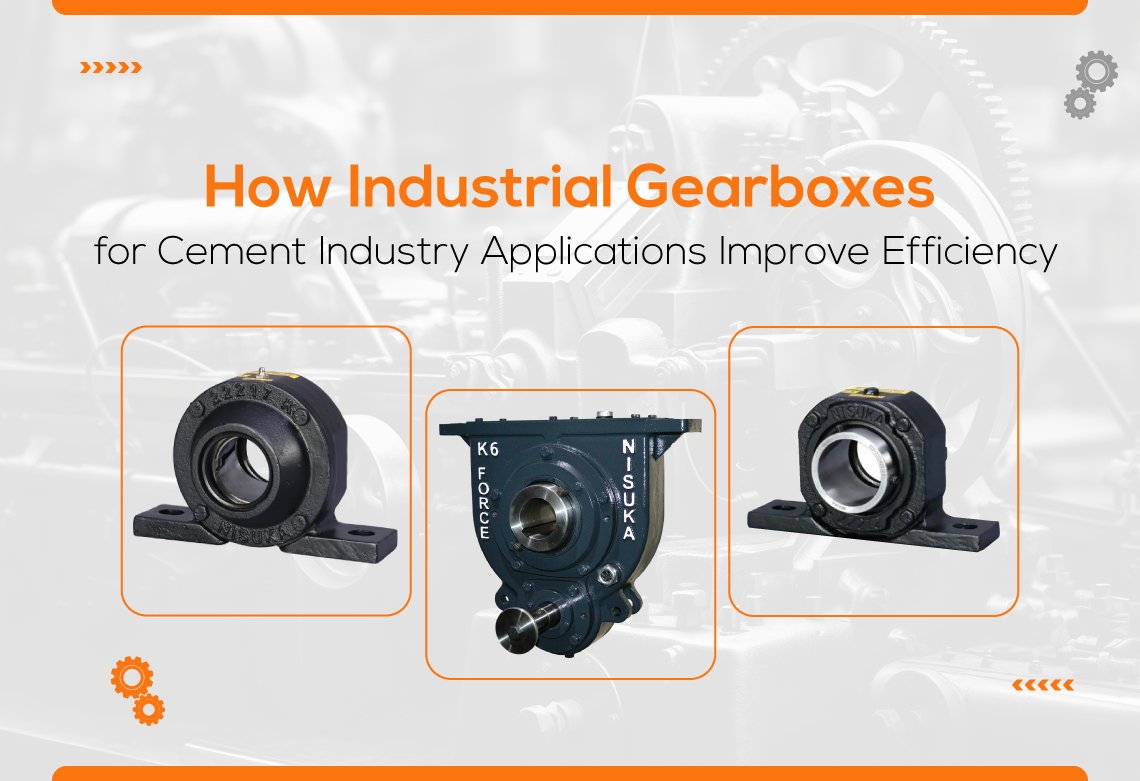
How Industrial Gearboxes for Cement Industry Applications Improve Efficiency
The cement manufacturing industry depends on heavy-duty machinery that must operate reliably under high loads, continuous production schedules, and demanding environmental conditions. From crushing raw materials to grinding clinker and transporting cement, every stage requires efficient mechanical power transmission. Even small improvements in equipment performance can help reduce energy waste, minimize unplanned downtime, and improve overall plant productivity.
One of the key components supporting these operations is the industrial gearbox. It transfers power from an electric motor to driven equipment while adjusting rotational speed and torque to meet specific operating requirements.
Choosing the right industrial gearboxes for cement industry applications can help cement plants maintain consistent production, manage heavy loads, and improve the reliability of critical machinery.
In this guide, we explain how industrial gearboxes contribute to cement manufacturing efficiency, where they are used, which factors affect their performance, and how to select the right gearbox for different plant applications.
What Are Industrial Gearboxes for the Cement Industry?
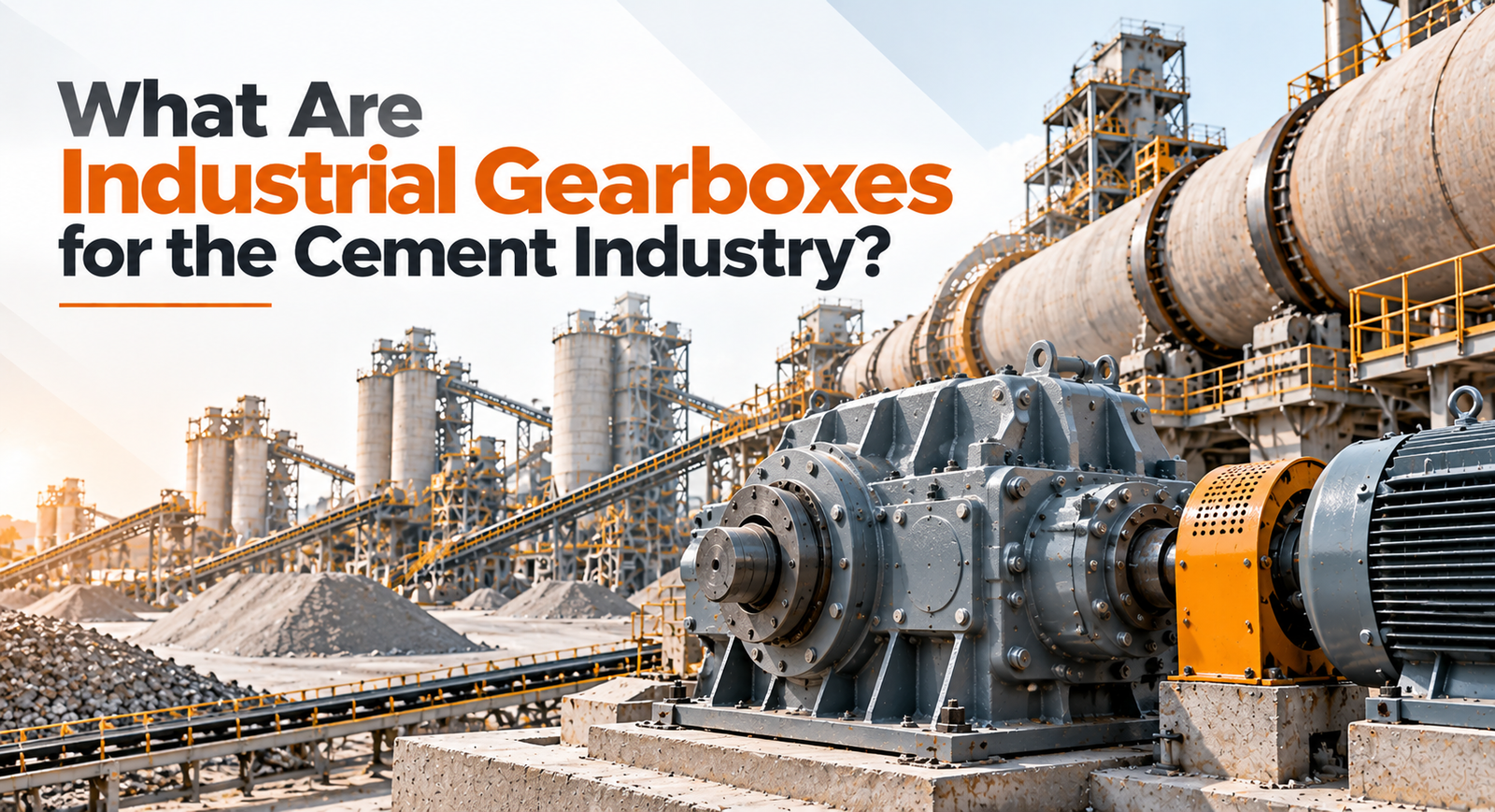
An industrial gearbox is a mechanical power transmission device that transfers rotational power between a motor and a machine. Its primary functions include reducing speed, increasing torque, and matching the motor’s output characteristics to the requirements of the driven equipment.
In cement plants, machinery often needs high torque at relatively low operating speeds. A motor may rotate too quickly to drive a conveyor, crusher, or other heavy-duty machine directly. A gearbox provides the necessary speed reduction and torque multiplication.
For example, a conveyor system transporting limestone requires controlled movement and sufficient torque to handle the material load. A suitably selected gearbox helps the conveyor start, operate, and maintain movement under the expected working conditions.
The performance of industrial gearboxes for cement industry applications depends on several factors, including:
- Gearbox type and gear ratio
- Required output torque and operating speed
- Load characteristics and starting conditions
- Operating hours and duty cycle
- Lubrication and cooling arrangements
- Dust, temperature, and vibration levels
- Installation quality and maintenance practices
A gearbox must be selected according to the machine’s actual operating requirements rather than motor power alone.
For a broader introduction to gearbox technology, read Nisuka Industries’ Ultimate Guide to Industrial Gearboxes.
Why Are Industrial Gearboxes Important in Cement Manufacturing?
Cement production involves several interconnected processes. A problem in one critical machine can affect upstream and downstream operations, potentially reducing plant output.
Gearboxes support these processes by delivering controlled mechanical power to equipment that handles heavy materials and operates for extended periods.
1.Supporting Heavy-Duty Operations
Cement plants handle limestone, clay, gypsum, coal, clinker, and finished cement. Moving and processing these materials requires machinery capable of handling substantial loads.
Heavy-duty industrial gearboxes help transmit the torque required by conveyors, crushers, feeders, and other equipment. Selecting a gearbox with suitable torque capacity and service factor helps it accommodate expected operating loads and foreseeable load variations.
2. Controlling Machine Speed
Different machines require different operating speeds. A conveyor belt needs controlled movement, while a crusher or grinding system operates according to its own process requirements.
A gearbox adjusts motor speed to match the needs of the driven machine. Correct speed selection helps maintain material flow, supports consistent processing, and reduces the risk of operating equipment outside its intended range.
3. Improving Power Transmission
A properly selected and maintained gearbox transfers power efficiently from the motor to the driven equipment. However, no gearbox is completely loss-free: friction, gear meshing, bearings, seals, and lubrication all contribute to power losses.
Using an appropriate gearbox design, maintaining proper lubrication, and avoiding excessive loading can help reduce these losses.
4. Supporting Reliable Production
Unexpected equipment failure can interrupt cement production and increase maintenance costs. A correctly specified gearbox, installed according to manufacturer recommendations, helps reduce avoidable mechanical problems.
Reliability also depends on the complete drive system, including the motor, couplings, shafts, bearings, foundation, lubrication, and control equipment.
Key Applications of Industrial Gearboxes in Cement Plants
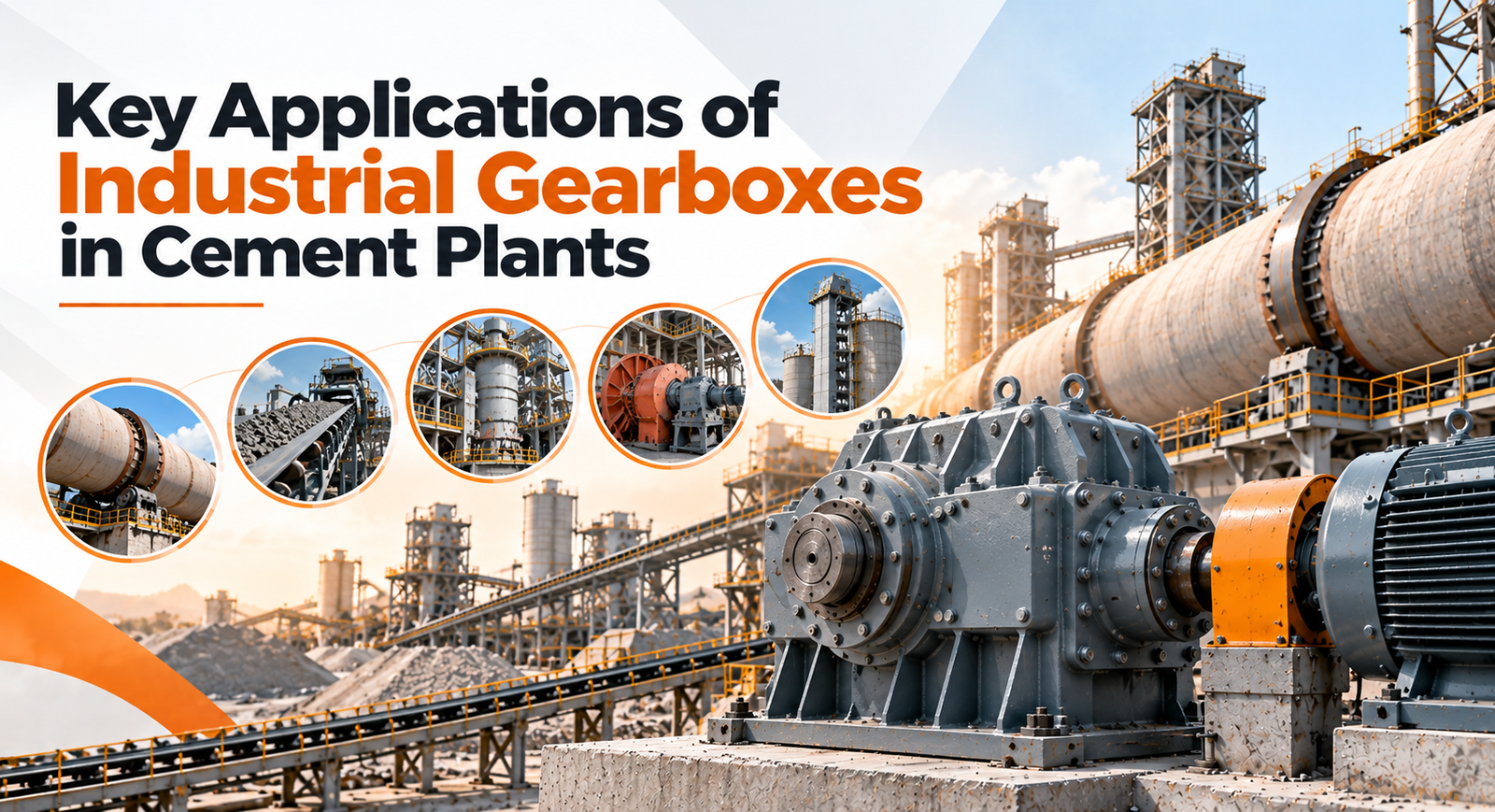
Industrial gearboxes for cement industry applications are used across several stages of manufacturing. Each application has different torque, speed, load, and environmental requirements.
1. Limestone and Raw Material Conveyors
Conveyors transport raw materials between storage areas, crushers, processing units, and production sections. They are essential to maintaining a steady flow of materials throughout the plant.
Conveyor gearboxes reduce motor speed and provide the torque needed to move loaded belts. They must be selected with consideration for belt speed, material weight, conveyor length, incline, starting frequency, and the possibility of shock loading.
A suitable conveyor gearbox can support:
- Controlled belt movement
- Reliable material transportation
- Appropriate torque delivery
- Reduced risk of drive-system overload
- Consistent operation during production
2. Crushers and Material Processing Equipment
Crushers reduce large pieces of limestone and other raw materials to a size suitable for further processing. These machines can experience significant load variations as material enters the crushing chamber.
The gearbox and drive arrangement must accommodate the required operating speed, torque, starting conditions, and potential transient loads.
Choosing a gearbox without sufficient capacity can increase the risk of overheating, excessive wear, and mechanical failure. Conversely, an unnecessarily oversized unit may increase initial costs and occupy more installation space than required.
Correct engineering assessment helps balance performance, reliability, and cost.
3. Raw Material Grinding Systems
Grinding systems reduce raw materials to the fineness required for cement production. These systems can involve high power demands and continuous operating schedules.
The gearbox must match the grinding equipment’s required speed and torque while accommodating the operating conditions specified by the equipment manufacturer.
Gearbox selection should consider:
- Required power and output torque
- Starting and operating loads
- Continuous-duty requirements
- Lubrication and cooling needs
- Alignment and installation requirements
- Inspection and maintenance accessibility
Because grinding systems differ substantially in design, the gearbox arrangement must be chosen for the specific machine rather than based on a generic cement-plant specification.
4. Clinker Handling and Conveying
Grinding systems reduce raw materials to the fineness required for cement production. These systems can involve high power demands and continuous operating schedules.
The gearbox must match the grinding equipment’s required speed and torque while accommodating the operating conditions specified by the equipment manufacturer.
Gearbox selection should consider:
- Required power and output torque
- Starting and operating loads
- Continuous-duty requirements
- Lubrication and cooling needs
- Alignment and installation requirements
- Inspection and maintenance accessibility
Because grinding systems differ substantially in design, the gearbox arrangement must be chosen for the specific machine rather than based on a generic cement-plant specification.
5. Cement Grinding and Finished Product Handling
After clinker is combined with other constituents, grinding produces the finished cement. Conveyors and other material-handling systems then transport the product to storage and packaging areas.
Industrial gear reducers help these systems operate at the required speed and torque. Correctly matched drive components can support smooth material flow and help avoid unnecessary stress on belts, shafts, bearings, and connected equipment.
How Industrial Gearboxes Improve Efficiency in Cement Manufacturing
Gearboxes improve manufacturing efficiency by helping machines operate at the required speed and torque. Their contribution is not limited to mechanical power transmission; correct selection and maintenance can also support energy management and production reliability.
1. Reducing Unnecessary Energy Losses
Gearbox efficiency is the ratio of mechanical power delivered at the output to mechanical power supplied at the input. Some power is lost through friction, gear meshing, bearings, seals, and other mechanisms.
The actual efficiency depends on gearbox design, gear type, size, operating speed, load, lubrication, and maintenance condition.
To improve efficiency, plant operators should:
- Select a gearbox appropriate for the application.
- Operate within the manufacturer’s specified limits.
- Use the recommended lubricant and lubrication interval.
- Maintain correct alignment and mounting.
- Investigate abnormal temperatures, noise, and vibration.
- Avoid prolonged operation under unsuitable loads.
It is important to remember that gearbox efficiency alone does not determine the total energy consumption of a machine. Motor efficiency, load profile, controls, and the driven equipment also affect overall system performance.
2. Delivering the Required Torque
Torque is the turning force that allows a machine to overcome resistance and move a load. Many cement-plant applications require high torque at relatively low output speeds.
A gearbox reduces speed while increasing available torque, subject to transmission losses. This enables a motor and driven machine to operate within their intended performance ranges.
Insufficient torque capacity may lead to poor starting performance, overloads, or premature component wear. Correct torque calculation is therefore essential when choosing industrial gearboxes for cement industry operations.
3. Supporting Consistent Production
Consistent material movement is essential for coordinating different stages of cement manufacturing. An unreliable drive can interrupt material supply and affect the performance of connected equipment.
Gearboxes selected for the correct operating conditions help machinery maintain the required speed and load capacity.
Regular inspection and timely maintenance further support production continuity by identifying problems before they develop into major failures.
4. Minimizing Unplanned Downtime
A gearbox failure can require equipment shutdown, repair work, replacement parts, and production rescheduling.
Preventive maintenance helps identify warning signs such as:
- Unusual noise or vibration
- Abnormal operating temperatures
- Lubricant leakage
- Contaminated or degraded lubricant
- Loose mounting hardware
- Shaft misalignment
- Unexpected changes in operating performance
The maintenance team should investigate these symptoms promptly and follow the gearbox manufacturer’s service instructions.
5. Improving Equipment Service Life
Gear teeth, bearings, seals, shafts, and housings experience mechanical stresses during operation. Overloading, poor lubrication, contamination, and misalignment can accelerate deterioration.
Correct gearbox sizing, suitable lubrication, appropriate installation, and regular condition checks help reduce avoidable wear.
This can improve equipment availability and help control lifecycle costs. Actual service life depends on operating conditions, design, maintenance, and installation quality.
6. Helping Control Maintenance Costs
The purchase price is only one part of a gearbox’s total cost. Maintenance labour, lubricant, spare parts, energy consumption, downtime, and replacement requirements also influence long-term cost.
A gearbox that suits the application and receives proper maintenance can help avoid unnecessary expenses.
Plant managers should evaluate the total cost of ownership instead of selecting equipment based on purchase price alone.
Factors to Consider When Selecting Industrial Gearboxes for the Cement Industry
Selecting the correct gearbox begins with understanding the machine’s operating requirements. The following factors help engineers and maintenance teams make a more informed decision.
1. Calculate the Required Power and Torque
Start with the driven machine’s power, operating speed, load characteristics, and starting conditions.
For a rotating system, the relationship between power, torque, and rotational speed is important. In practical terms, reducing output speed through a gearbox generally increases available output torque, allowing for transmission losses.
The gearbox should be rated for the required operating load and foreseeable load variations.
2. Select the Correct Gear Ratio
The gear ratio determines how the input speed relates to the output speed.
An incorrect ratio can cause a machine to operate too quickly or too slowly, potentially affecting production performance and mechanical loading.
Confirm the motor speed and required output speed before finalizing the gearbox specification.
3. Evaluate the Duty Cycle
Some machines operate intermittently, while others run continuously for long shifts or around the clock.
The gearbox specification should account for operating hours, starting frequency, load variations, and the severity of service.
A suitable service factor should be determined according to the gearbox manufacturer’s guidance and the actual application.
4. Consider Dust and Temperature
Cement plants can expose machinery to airborne dust, contamination, vibration, and challenging ambient conditions.
Gearbox housing, seals, lubricant, cooling arrangements, and installation location should be appropriate for the environment.
Where surrounding temperatures are elevated, the designer should confirm that the gearbox can maintain acceptable operating temperatures under the expected load.
5. Check Mounting and Alignment Requirements
Correct mounting helps ensure that the gearbox operates as intended. Misalignment, inadequate support, or unsuitable shaft connections can increase vibration and stress on bearings and connected components.
Verify mounting orientation, shaft dimensions, torque-arm arrangements where applicable, coupling requirements, and installation clearances before commissioning.
6. Review Lubrication Requirements
Lubrication reduces friction and wear between moving components and helps manage heat.
The correct lubricant type, viscosity, quantity, and change interval depend on the gearbox design and operating conditions.
Follow the manufacturer’s recommendations rather than assuming that one lubricant is suitable for every industrial gearbox.
7. Assess Maintenance and Spare-Part Availability
Maintenance teams should be able to inspect the gearbox, monitor its condition, and obtain suitable replacement components when required.
Before purchasing, clarify the maintenance schedule, available technical support, spare-part availability, warranty conditions, and documentation provided by the manufacturer.
For additional selection guidance, read Key Factors to Choosing the Right Conveyor Gearbox.
Best Practices for Maintaining Industrial Gearboxes in Cement Plants
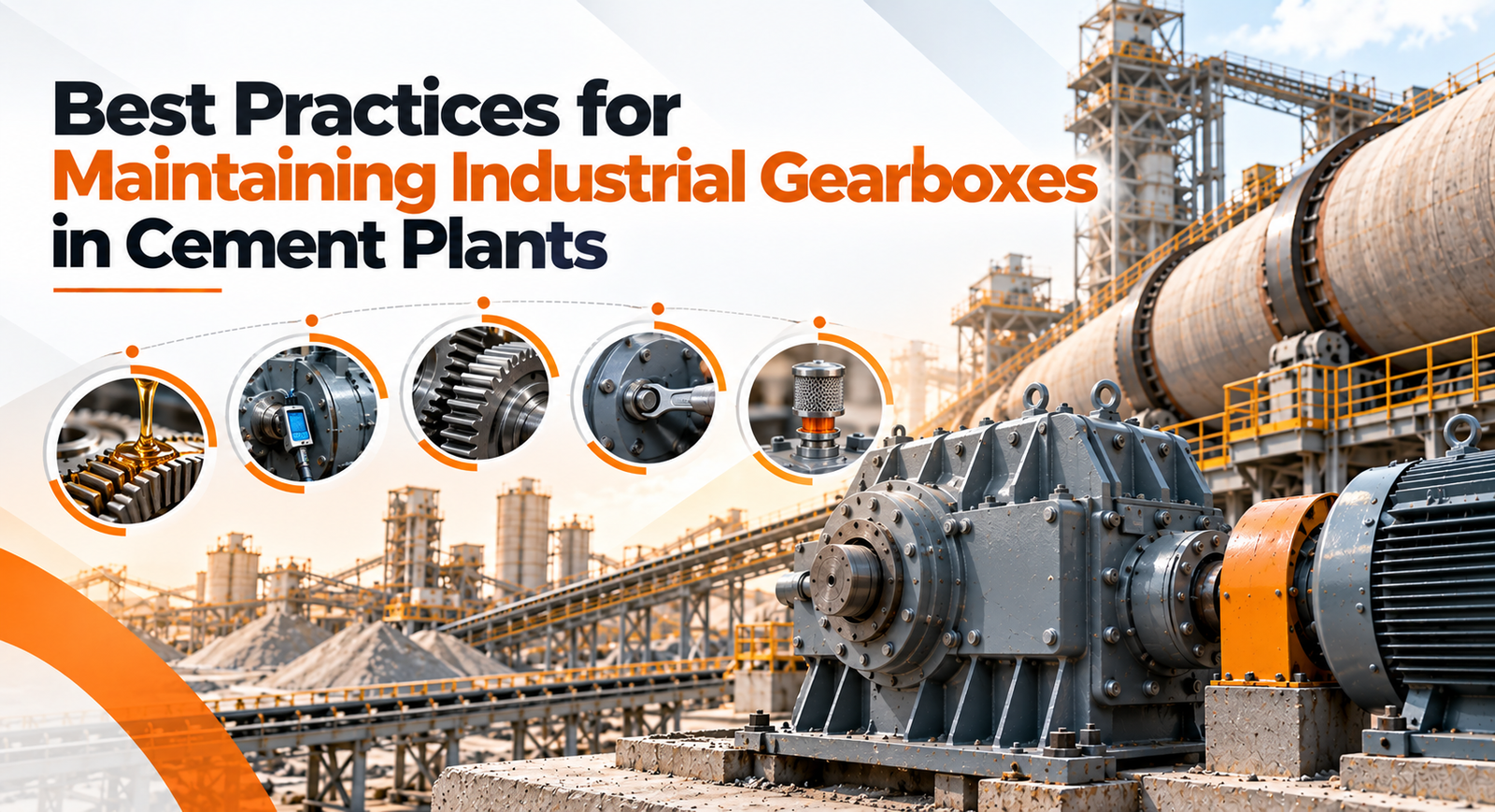
Even a well-designed gearbox requires appropriate maintenance. A structured maintenance program helps plant teams detect problems early and maintain reliable operation.
1. Conduct Regular Visual Inspections
Inspect the housing, mounting points, seals, fasteners, and surrounding area. Look for oil leakage, physical damage, loose components, or signs of contamination.
Record findings so that changes can be identified over time.
2. Monitor Noise and Vibration
Unusual noise or increased vibration can indicate problems with gears, bearings, alignment, mounting, or connected machinery.
Establish a baseline during normal operation and investigate significant changes. Condition monitoring may be useful for critical drives.
3. Maintain Proper Lubrication
Check lubricant levels and condition according to the manufacturer’s instructions. Use the specified lubricant and replace it at the recommended intervals.
If contamination or lubricant deterioration is suspected, investigate the cause instead of simply topping up the oil.
4. Verify Alignment and Mounting
Check lubricant levels and condition according to the manufacturer’s instructions. Use the specified lubricant and replace it at the recommended intervals.
If contamination or lubricant deterioration is suspected, investigate the cause instead of simply topping up the oil.
5. Follow a Preventive Maintenance Schedule
A practical maintenance plan should include inspections, lubrication checks, temperature monitoring, vibration checks where appropriate, and scheduled servicing.
The frequency should reflect the equipment manufacturer’s instructions, operating conditions, and the criticality of the application.
6. Train Maintenance Personnel
Maintenance staff should understand the gearbox’s operating limits, lubrication requirements, warning signs, and safe maintenance procedures.
Proper training can help ensure that issues are identified and addressed consistently.
Conclusion
Industrial gearboxes play an important role in cement manufacturing by controlling speed, transmitting torque, and supporting the operation of heavy-duty machinery. They are used in conveyor systems, crushers, grinding equipment, clinker handling, and other applications that require dependable mechanical power transmission.
Choosing the right industrial gearboxes for cement industry applications involves more than matching motor power. Engineers must also consider torque, speed ratio, duty cycle, environmental conditions, mounting arrangements, lubrication, and maintenance requirements.
A correctly selected gearbox, combined with proper installation and a preventive maintenance programme, can help improve operational reliability, reduce avoidable downtime, and manage long-term equipment costs.
For cement manufacturers looking for industrial power transmission solutions, exploring the Nisuka Industries gearbox range is a useful starting point. Share your application requirements with the manufacturer to identify a gearbox solution suited to your plant’s operating conditions.
FAQS
1. How do industrial gearboxes improve efficiency in cement manufacturing?
They help machinery operate at the required speed and torque. Correct selection, proper lubrication, suitable installation, and preventive maintenance can reduce avoidable power losses, support reliable operation, and minimize unplanned downtime.
2. Which gearbox is suitable for cement plant conveyors?
The correct gearbox depends on conveyor speed, load, torque, starting conditions, mounting arrangement, and environmental factors. An SMSR gearbox may be suitable for certain conveyor applications, but the final choice should be confirmed against the system’s engineering requirements.
3. What factors affect industrial gearbox performance?
Important factors include gearbox design, gear ratio, load, operating speed, lubrication, alignment, temperature, contamination, mounting quality, and maintenance practices.
4. How can gearbox maintenance reduce downtime?
Routine inspections, lubricant checks, temperature and vibration monitoring, and timely investigation of abnormal noise or leakage can help identify developing problems before they cause major failures.