
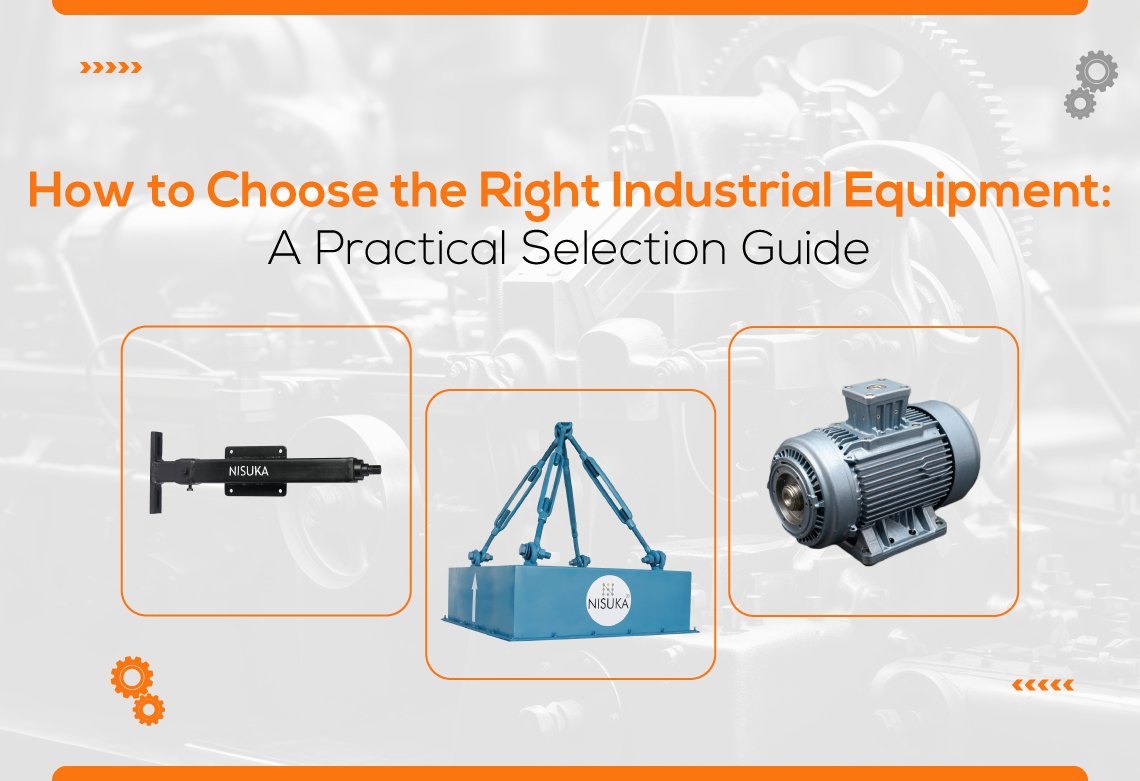
How to Choose the Right Industrial Equipment: A Practical Selection Guide
Selecting the right Industrial Equipment is an engineering and procurement decision, not simply a purchasing exercise. The equipment used in a manufacturing plant, mining operation, cement facility, quarry, steel plant, power station, or material-handling system directly influences production performance, reliability, maintenance requirements, safety, energy use, and long-term operating cost.
An inexpensive machine or component may appear attractive at the quotation stage, but the lowest purchase price does not necessarily mean the lowest lifecycle cost. Equipment that is poorly matched to its application can experience excessive wear, repeated maintenance, inefficient operation, compatibility problems, or unplanned downtime.
Effective Industrial Equipment Selection begins with the application. Engineers and buyers need to understand the load, capacity, speed, duty cycle, material characteristics, operating environment, available power, installation space, maintenance requirements, and relationship between the selected equipment and the rest of the system.
For example, Industrial Equipment for Manufacturing may operate in a relatively controlled environment, while equipment used in mining, quarrying, cement, coal handling, or aggregate processing may encounter dust, abrasion, shock loads, moisture, and long operating cycles.
The objective is therefore not to find the most expensive or most powerful machine. It is to identify equipment whose specifications, construction, compatibility, maintainability, and lifecycle economics match the actual application.
What Should You Consider When Choosing Industrial Equipment?
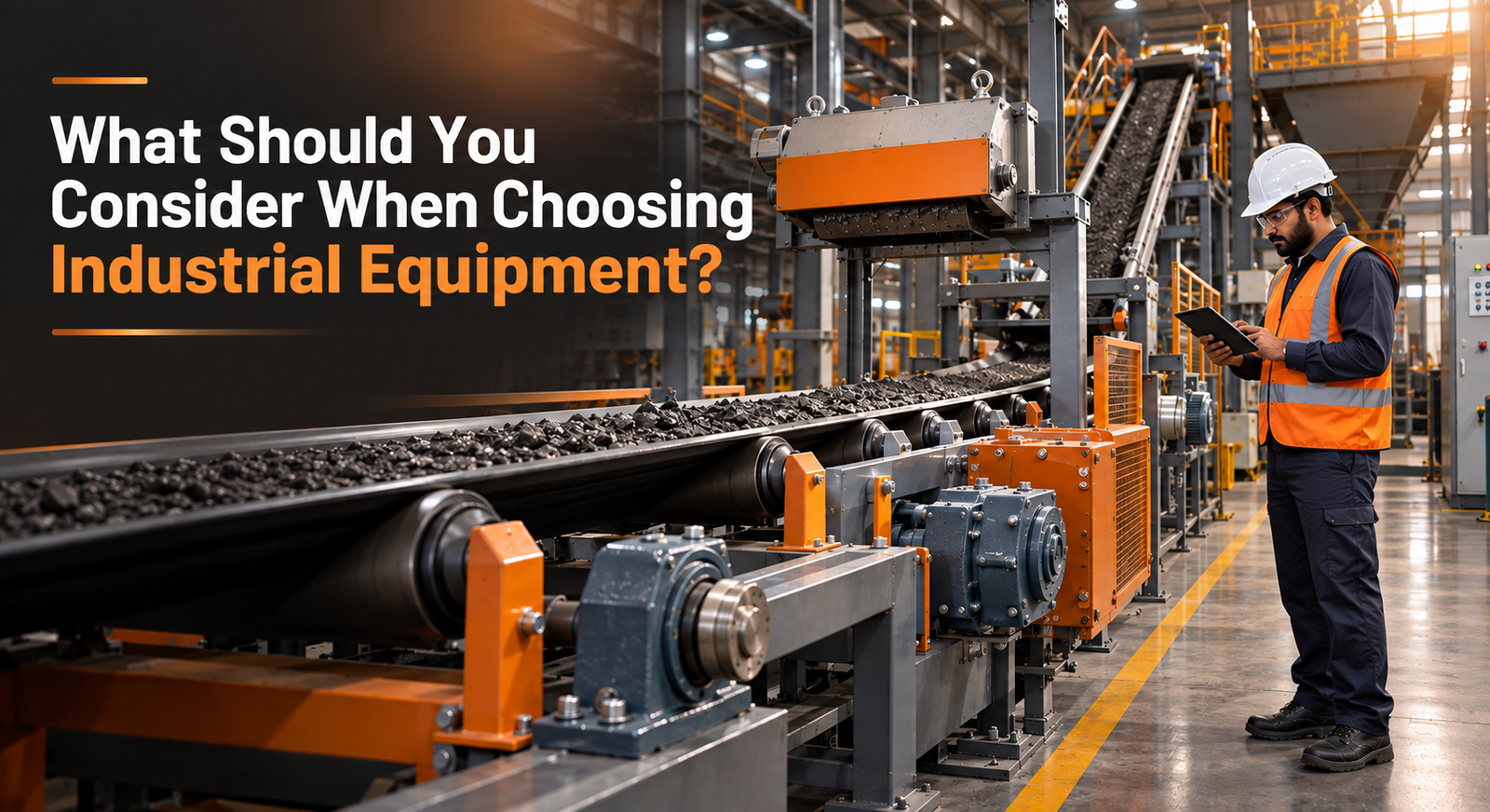
The right industrial equipment should be selected by matching its technical capabilities with the actual operating requirements of the application.
1. Understand Your Application Requirements
The first step in How to Choose Industrial Equipment is to define the application before comparing products.
Ask a simple question: What exactly does the equipment need to accomplish?
A procurement specification should normally identify:
- Required function
- Material or product being processed
- Required throughput
- Load characteristics
- Operating speed
- Number of operating hours
- Production cycle
- Available installation space
- Existing machinery
- Available power
- Environmental conditions
- Maintenance limitations
Buying equipment before establishing these requirements creates unnecessary selection risk. An undersized machine may struggle with the workload, while an unnecessarily oversized machine can increase purchase cost, energy requirements, installation complexity, and maintenance requirements.
Define the Equipment's Primary Function
Industrial machinery can perform very different functions. Depending on the application, the requirement may involve:
- Material handling
- Conveying
- Power transmission
- Separation
- Motion control
- Shaft support
- Driving machinery
- Product processing
- Supporting rotating components
The function determines which technical parameters need the most attention.
For example, selecting a gearbox is fundamentally different from selecting an idler roller, bearing housing, conveyor belt, magnetic separator, or electric motor.
Identify the Operating Conditions
Determine whether the equipment will operate:
- Continuously
- Intermittently
- With frequent starts and stops
- Under variable loads
- Under heavy-duty conditions
- With significant peak loading
A component that performs adequately in occasional service may not be appropriate for a continuous-duty production line.
2. Determine Load, Capacity and Performance Requirements
Load and capacity are among the most important Industrial Equipment Selection Criteria.
The equipment should be evaluated against the actual operating requirement rather than a nominal description such as “heavy duty” or “high capacity.”
Consider:
- Average load
- Maximum load
- Peak or shock loads
- Required throughput
- Material flow
- Operating speed
- Torque requirements
- Production cycle
- Expected future loading
Why Equipment Capacity Matters
Capacity determines whether equipment can perform its intended function without operating outside its appropriate range. Undersized equipment may experience excessive stress, overheating, accelerated wear, poor performance, or premature failure.
How to Avoid Undersizing Equipment
Capacity determines whether equipment can perform its intended function without operating outside its appropriate range.
Undersized equipment may experience excessive stress, overheating, accelerated wear, poor performance, or premature failure.
How to Avoid Unnecessary Oversizing
Oversizing is not automatically safer or better.
Excess capacity can increase:
- Initial equipment cost
- Energy consumption
- Physical size
- Installation requirements
- Replacement-part cost
- Maintenance complexity
The objective of Industrial Machinery Selection should be an appropriate technical match.
3. Consider the Operating Environment
The same equipment can behave very differently in different environments.
Important conditions include:
- Dust
- Moisture
- Water exposure
- Humidity
- Corrosive substances
- High temperatures
- Low temperatures
- Outdoor installation
- Abrasive materials
- Chemical exposure
- Vibration
For example, equipment installed in a controlled manufacturing environment may face very different contamination and temperature conditions from equipment installed in a quarry, cement plant, or mining operation.
Industrial Equipment for Dusty Environments
Dust can affect bearings, seals, moving components, electrical equipment, lubrication systems, and other machine elements.
The selection should therefore consider how contamination could enter the equipment and how easily the equipment can be inspected and cleaned.
Equipment Selection for Wet or Corrosive Conditions
Moisture and corrosive environments may influence material selection, sealing arrangements, surface protection, lubrication, and maintenance intervals.
The supplier should be given accurate environmental information rather than being told only that the application is “outdoor.”
Temperature and Environmental Considerations
Operating temperature can influence lubrication, materials, seals, electrical components, and equipment performance.
For demanding applications, environmental conditions should form part of the technical specification supplied to the manufacturer.
4. Check Power, Speed and Compatibility
Industrial equipment rarely operates alone. Most equipment is part of a larger mechanical or electrical system.
Compatibility may involve:
- Motor power
- Input and output speed
- Torque
- Shaft dimensions
- Mounting arrangement
- Drive configuration
- Electrical requirements
- Conveyor speed
- Bearing arrangement
- Pulley dimensions
Consider a conveyor drive. The electric motor, SMSR gearbox, shaft, pulley, bearings, belt, and supporting structure must work together.
Nisuka Industries currently publishes a portfolio that includes SMSR gearboxes, Plummer Blocks, UCP Pillow Blocks, conveyor head and tail drums, conveyor idler rollers, conveyor belt tensioners, V-belt pulleys, conveyor rubber belts, electric motors, magnetic separators and other conveyor-related products.
Why System Compatibility Matters
A component can have technically suitable individual specifications and still be unsuitable for the complete machine if its dimensions, mounting, speed, shaft interface, or operating characteristics do not match the surrounding equipment.
Matching Equipment With Existing Machinery
Before ordering replacement or additional equipment, collect information about:
- Existing model
- Shaft diameter
- Mounting arrangement
- Motor characteristics
- Operating speed
- Existing pulley or coupling
- Available space
- Connection dimensions
For conveyor drive applications, Nisuka’s published technical assistance resources specifically use information such as conveyor speed, gearbox ratio, pulley sizes, motor RPM, drum diameter, conveyor length and motor power when assessing conveyor-related requirements.
When Customization May Be Required
Application-specific equipment may become relevant where standard dimensions, mounting arrangements, loads, environmental conditions, or integration requirements do not adequately match the existing system.
Customization should be driven by an engineering requirement—not simply by the assumption that customized equipment is always superior.
5. Evaluate Duty Cycle and Expected Operating Life
Duty cycle describes how the equipment is expected to operate over time.
Important questions include:
- How many hours per day will it run?
- How frequently will it start and stop?
- Will loading remain constant?
- Are there peak production periods?
- Will shock loads occur?
- Is operation continuous or intermittent?
Continuous-Duty vs Intermittent-Duty Applications
A machine operating several hours occasionally may experience a substantially different thermal, mechanical, and maintenance burden from equipment running continuously.
For Industrial Equipment for Heavy Industries, duty-cycle analysis becomes especially important because mining, cement, steel, aggregate, and bulk material-handling systems can operate for extended periods under demanding loads.
Why Duty Cycle Affects Equipment Selection
Duty cycle influences the required equipment rating, thermal behavior, wear, lubrication requirements, maintenance planning, and expected service life.
A supplier should therefore receive realistic operating-hour information rather than simply the statement “continuous use.”
Planning for Long-Term Reliability
Industrial Equipment Reliability depends on the interaction of design, loading, environment, installation, maintenance, and operating practices.
Selecting equipment with an appropriate duty capability is only one part of the reliability strategy.
6. Consider Maintenance and Accessibility
A technically capable machine can still be a poor choice if routine maintenance is difficult.
Industrial Equipment Maintenance should be considered before purchase, not after installation.
Evaluate:
- Inspection access
- Lubrication requirements
- Component replacement
- Cleaning
- Alignment checks
- Spare-part availability
- Maintenance tools
- Required maintenance skills
- Shutdown requirements
Why Maintainability Matters
If technicians cannot easily access bearings, belts, tensioners, gearboxes, motors, or other service points, routine maintenance may take longer and planned inspections may be neglected.
Good equipment selection considers how the machine will be serviced throughout its lifecycle.
For bearing-related systems, understanding What is bearing? can help procurement and maintenance teams understand why load, lubrication, contamination, alignment, speed, and mounting all matter rather than treating a bearing simply as a replaceable part.
Spare Parts and Replacement Availability
Before purchasing, determine:
- Which components are wear parts?
- Which parts require periodic replacement?
- Are standard replacement components available?
- Can the supplier provide technical identification?
- What documentation accompanies replacement parts?
Availability of critical spares can directly influence maintenance planning and downtime exposure.
Designing for Easier Maintenance
A maintainable system should provide reasonable access to components that require inspection, lubrication, cleaning, adjustment, or replacement.
For conveyor systems, this can include idlers, pulleys, tensioners, bearings, gearboxes and motors.
7. Evaluate Equipment Quality and Reliability
Industrial Equipment Quality should be assessed through engineering and manufacturing evidence rather than appearance or purchase price.
Consider:
- Material quality
- Machining accuracy
- Manufacturing consistency
- Assembly quality
- Component compatibility
- Quality-control procedures
- Technical documentation
- Product specifications
- Manufacturer recommendations
- Traceability where applicable
Why Component Quality Matters
A conveyor system, for example, depends on multiple components working together. A belt, pulley, bearing, idler, tensioning system and drive arrangement cannot be evaluated entirely in isolation.
Nisuka’s own published conveyor guidance similarly emphasizes that conveyor reliability depends on the interaction between belts, pulleys, idlers, tensioning systems, drives, bearings and supporting structures.
How Manufacturing Quality Influences Reliability
Dimensional accuracy, machining, material selection, assembly, sealing and inspection can influence how consistently equipment performs under its intended conditions.
Questions to Ask an Industrial Equipment Supplier
Before placing an order, ask:
- What application is the equipment designed for?
- What are its operating limits?
- What specifications are required for selection?
- What maintenance is required?
- What replacement components are available?
- What documentation is supplied?
- What application information does the manufacturer need?
- What installation conditions must be satisfied?
A technically capable Industrial Equipment Supplier should be able to discuss suitability in the context of the application rather than simply quoting a product number.
8. Compare Total Cost of Ownership, Not Just Purchase Price
Industrial Equipment Cost should be evaluated across the equipment lifecycle.
What Is Total Cost of Ownership?
Total Cost of Ownership (TCO) considers the costs associated with acquiring, installing, operating, maintaining, repairing, and eventually replacing equipment—not merely its purchase price.
Potential costs include:
- Initial purchase
- Installation
- Energy consumption
- Lubrication
- Preventive maintenance
- Spare parts
- Repairs
- Downtime
- Technical service
- Replacement
Purchase Price vs Lifecycle Cost
Suppose two components meet the basic technical requirement but have different maintenance requirements. The lower purchase price may not represent the lower long-term cost if it requires more frequent servicing, creates more downtime, or has higher replacement costs.
That is why Industrial Equipment Procurement should consider lifecycle economics alongside the initial quotation.
How to Evaluate Long-Term Equipment Value
Ask:
What will this equipment cost the organization over its expected operating life?
This question encourages procurement teams to consider reliability, maintainability, energy use, spare parts, service requirements, and downtime rather than focusing exclusively on the initial invoice.
9. Consider Safety and Regulatory Requirements
Safety should be considered during equipment selection, not added as an afterthought.
Depending on the application, evaluate:
- Machine guarding
- Moving components
- Emergency-stop arrangements where applicable
- Electrical safety
- Safe access
- Maintenance access
- Isolation requirements
- Site-specific safety requirements
- Applicable regulations and standards
Why Safety Should Be Considered Before Purchase
Equipment design, installation space, access points, moving components, and maintenance procedures can all influence how safely a machine can be operated and serviced.
Equipment Guarding and Safe Maintenance
Rotating shafts, pulleys, belts, couplings, gears and other moving parts may require suitable guarding according to the application and applicable requirements.
Site-Specific Safety Requirements
The final requirements depend on the industry, equipment, installation, location and applicable regulations. Buyers should confirm these requirements with qualified safety and engineering personnel.
10. Evaluate the Manufacturer or Supplier
Choosing an Industrial Equipment Manufacturer is part of choosing the equipment itself.
Evaluate:
- Manufacturing capability
- Engineering knowledge
- Application understanding
- Product range
- Quality-control practices
- Technical documentation
- Spare-parts support
- Delivery capability
- Technical assistance
- After-sales support
- Industry experience
The best supplier is not necessarily the one with the lowest quotation. It is the supplier capable of understanding the application and providing equipment appropriate to its actual requirements.
What Information Should You Give an Equipment Supplier?
Provide:
- Application
- Load
- Capacity
- Speed
- Operating hours
- Duty cycle
- Environment
- Installation arrangement
- Existing equipment
- Space limitations
- Power requirements
- Material characteristics
- Required maintenance conditions
The more complete the application information, the more meaningful the supplier’s technical recommendation can be.
How to Choose Industrial Equipment Based on Application
Provide:
- Application
- Load
- Capacity
- Speed
- Operating hours
- Duty cycle
- Environment
- Installation arrangement
- Existing equipment
- Space limitations
- Power requirements
- Material characteristics
- Required maintenance conditions
The more complete the application information, the more meaningful the supplier’s technical recommendation can be.
How to Choose the Right Industrial Equipment for a Conveyor System
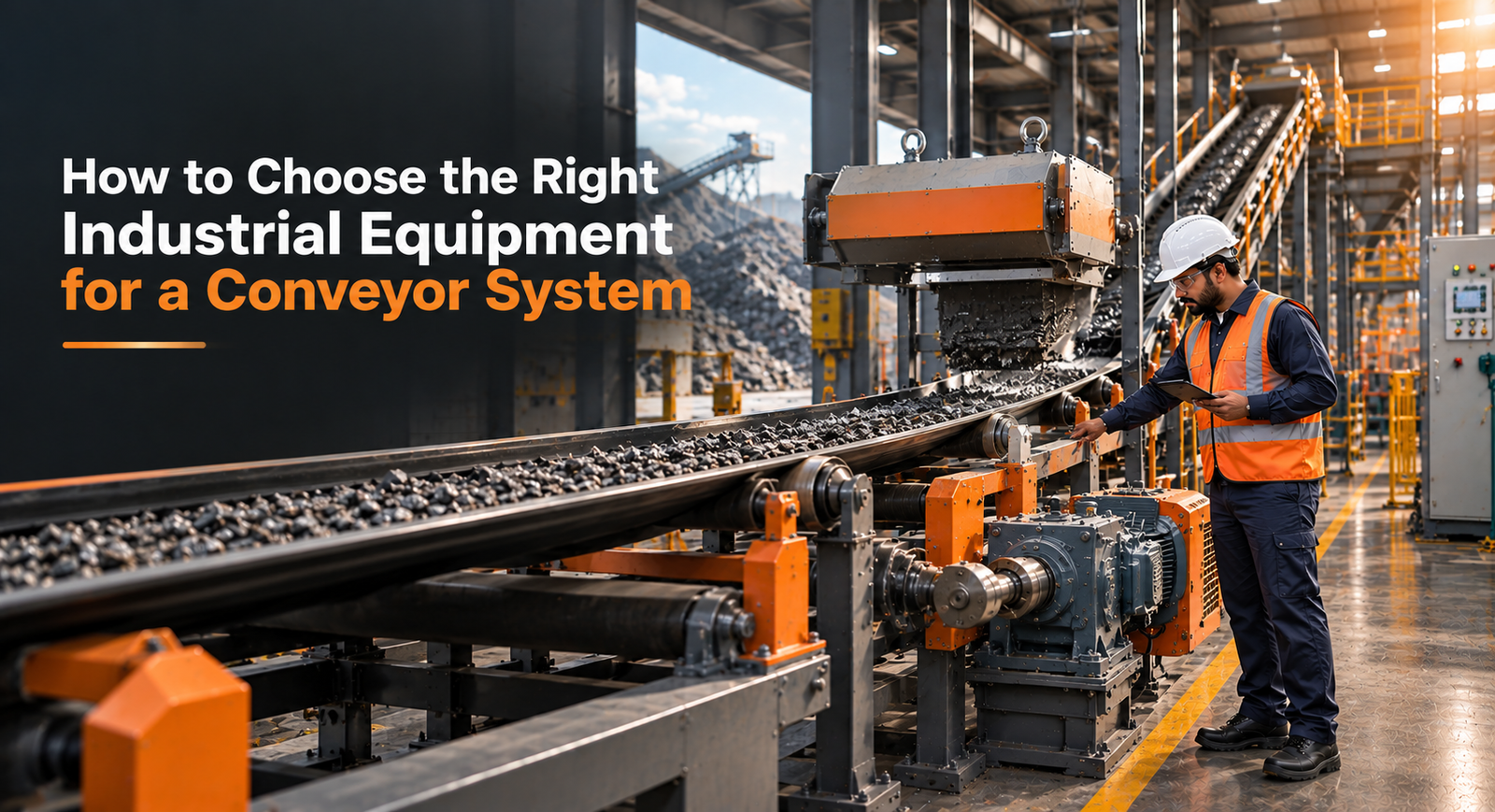
Conveyor systems demonstrate particularly well why equipment must be evaluated as an integrated system.
Depending on the design, selection may involve:
- Conveyor rubber belt
- Head drum
- Tail drum
- Idler rollers
- Belt tensioner
- SMSR gearbox
- Electric motor
- Pulleys
- Bearings
- Plummer blocks
- UCP pillow blocks
Nisuka Industries’ published portfolio includes these types of conveyor and power-transmission components, including Conveyor Head & Tail Drums, Conveyor Idler Rollers, Conveyor Belt Tensioners, Conveyor Rubber Belts, SMSR Gearboxes, Plummer Blocks, UCP Pillow Blocks and Electric Motors.
A conveyor should not be designed by selecting each component independently.
Important application information includes:
- Belt width
- Belt speed
- Conveyor length
- Material
- Material load
- Required capacity
- Lift or incline
- Operating environment
- Duty cycle
- Temperature
- Conveyor configuration
- Installation arrangement
For example, when selecting Conveyor Idler Rollers manufacturer in Ahmedabad options, belt width alone may not provide enough information. Material load, impact, contamination, operating conditions and conveyor arrangement can also affect suitability.
Similarly, a Conveyor Belt Tensioner manufacturer in Ahmedabad should receive information about the conveyor configuration and belt requirements before an appropriate tensioning arrangement can be evaluated.
For drive systems, an SMSR Gearbox Manufacturers in Ahmedabad resource can be useful when researching shaft-mounted power transmission, but the final gearbox selection should still be based on torque, output speed, duty, load, mounting and conveyor requirements.
Nisuka describes its SMSR gearbox as a shaft-mounted speed-reduction solution used in conveyor and material-handling applications, with selection influenced by operating requirements.
Common Mistakes When Selecting Industrial Equipment
1. Choosing Based Only on Price
A low purchase price does not establish low lifecycle cost. Maintenance, energy, downtime and replacement expenses also matter.
2. Ignoring Operating Conditions
Equipment selected without considering dust, moisture, temperature, abrasion or contamination may not perform as expected.
3. Selecting Equipment Without Calculating the Load
Load determines many important equipment specifications. Incorrect load assumptions can lead to undersizing or unnecessary oversizing.
4. Ignoring Duty Cycle
Continuous operation places different demands on machinery than occasional or intermittent operation.
5. Overlooking Maintenance Requirements
Equipment that is difficult to inspect, lubricate or replace can increase maintenance time and downtime.
6. Failing to Check Compatibility
Shaft dimensions, mounting arrangements, power, speed and surrounding components must be compatible.
7. Ignoring Spare Parts Availability
Critical replacement components should be considered during procurement.
8. Not Considering Total Cost of Ownership
Initial price is only one component of the equipment lifecycle cost.
9. Providing Incomplete Application Information
A supplier cannot properly evaluate equipment suitability without meaningful application data.
10. Selecting Equipment Without Considering Future Requirements
Where production demand or operating conditions may change, buyers should consider whether the selected equipment can accommodate realistic future requirements.
When Should You Choose Standard Equipment vs Customized Equipment?
Standard equipment is generally appropriate when the available configuration matches the application’s dimensional, mechanical, environmental and operational requirements.
Application-specific or customized equipment may become relevant when there are:
- Unusual dimensions
- Unique mounting requirements
- Restricted installation space
- Special environmental conditions
- Integration constraints
- Unusual load requirements
- Specific duty-cycle requirements
Customization is not automatically better. It should solve a genuine engineering requirement.
The decision should be based on technical suitability, lifecycle economics, maintainability, availability and integration with the existing system.
Importance of Choosing the Right Industrial Equipment Manufacturer
A capable Industrial Equipment Manufacturer can contribute significantly to the selection process because the manufacturer understands its products, operating limits, design characteristics, manufacturing processes and application requirements.
Relevant evaluation areas include:
- Product engineering
- Manufacturing capabilities
- Application knowledge
- Quality control
- Product consistency
- Technical documentation
- Spare-parts availability
- Technical support
- After-sales assistance
Nisuka Industries states that it was established in 1994 and currently manufactures or supplies products including SMSR Gearboxes, Plummer Blocks, UCP Pillow Blocks, Suspension Magnets, Permanent Magnetic Drum Pulleys, Magnetic Separators, Conveyor Head & Tail Drums, Conveyor Idler Rollers, Conveyor Belt Tensioners, V-Belt Pulleys, Conveyor Rubber Belts and Electric Motors.
For buyers researching bearing-support systems, resources such as Top 10 Plummer Block Manufacturers in Hyderabad can also help explain the procurement factors involved in selecting bearing-housing manufacturers.
Similarly, Top 10 Plummer Block Manufacturers in West Bengal can be used as a regional supplier-research resource where geographically relevant. Nisuka’s blog currently lists this article among its published resources.
The important point is that regional availability should support—not replace—technical evaluation.
Conclusion
Choosing the right Industrial Equipment requires more than comparing catalogues or selecting the lowest quotation. The correct decision begins with understanding the application and translating that application into measurable operating requirements.
Load and capacity determine how much work the equipment must perform. Speed and power influence performance and system compatibility. Duty cycle affects the equipment’s operating demands. Dust, moisture, temperature, abrasion and other environmental conditions influence suitability. Installation space and mechanical interfaces determine whether components can be integrated effectively.
Maintenance must also be considered before purchase. Equipment that is difficult to inspect or service can create avoidable lifecycle costs. Spare-parts availability, technical documentation and supplier support are equally important for long-term procurement planning.
For conveyor and material-handling systems, this system-level approach is particularly important because belts, drums, idlers, tensioners, gearboxes, motors, bearings, pulleys and bearing housings must operate as a coordinated system.
Nisuka Industries’ published portfolio includes SMSR Gearboxes, Plummer Blocks, UCP Pillow Blocks, conveyor drums, idler rollers, belt tensioners, pulleys, conveyor belts, electric motors and magnetic separation products, making it relevant to industrial buyers evaluating interconnected conveyor and power-transmission components.
Ultimately, effective Industrial Equipment Procurement follows a simple principle: application first, specifications second, price third. By evaluating technical requirements, compatibility, maintenance, safety, lifecycle cost and manufacturer capability together, engineers, plant managers and procurement teams can make more informed equipment decisions.
For complex, heavy-duty or application-specific requirements, the appropriate approach is to share complete operating data with a qualified manufacturer or engineering professional and verify suitability before purchase.
FAQS
1. How do you choose the right industrial equipment?
Start with the application. Define the required function, load, capacity, speed, power, duty cycle, material characteristics and environment. Then evaluate compatibility, maintenance, safety, lifecycle cost and supplier capability before confirming the equipment specification.
2. What factors should be considered when selecting industrial equipment?
Consider application, load, capacity, speed, power, duty cycle, material characteristics, environment, installation space, compatibility, maintenance, safety, spare parts, lifecycle cost and manufacturer support.
3. Why is industrial equipment selection important?
The wrong equipment can lead to poor performance, excessive wear, compatibility problems, higher maintenance requirements and unnecessary downtime. Proper selection helps ensure that machinery is appropriate for its intended operating conditions.
4. How do I determine the required capacity of industrial equipment?
Determine the required production throughput and operating load, then consider maximum and peak conditions, material characteristics, duty cycle and relevant system constraints. Where calculations are required, use appropriate engineering methods and manufacturer data rather than relying only on average operating conditions.
5. Why does the operating environment matter when choosing industrial machinery?
Dust, moisture, corrosion, temperature, abrasion, chemicals and outdoor exposure can affect equipment materials, seals, lubrication, electrical components and maintenance requirements. Equipment should therefore be evaluated against the environment in which it will actually operate.