
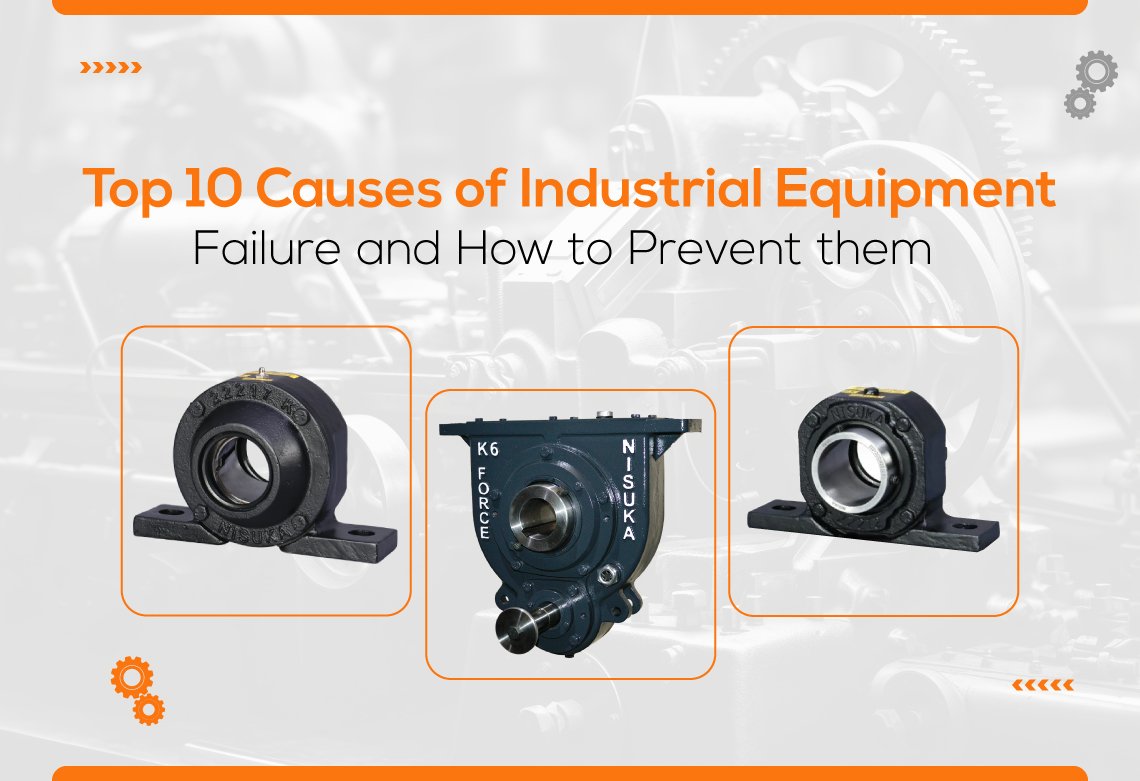
Top 10 Causes of Industrial Equipment Failure and How to Prevent them
A conveyor suddenly stops. The gearbox temperature has climbed beyond its normal operating range. A bearing starts producing an unusual grinding sound. Within minutes, an apparently small mechanical problem can turn into an unplanned production stoppage.
This is how Industrial Equipment Failure often develops in manufacturing and processing plants. The failure itself may appear sudden, but the underlying condition can have been developing for weeks or months through inadequate lubrication, misalignment, contamination, overloading, component wear, or missed inspections.
Unexpected equipment failure affects much more than a single machine. It can interrupt production, increase emergency maintenance costs, delay customer deliveries, reduce equipment availability, create safety risks, and accelerate wear on connected components. In conveyor-based operations, for example, a problem with a bearing, pulley, gearbox, or belt can affect an entire material-handling system.
For maintenance and reliability teams, the objective should therefore be more than repairing equipment after it breaks. Effective Industrial Equipment Maintenance focuses on identifying developing problems, understanding why they occurred, and taking corrective action before the same failure returns.
The most reliable approach combines appropriate equipment selection, preventive maintenance, condition monitoring, proper lubrication, correct alignment, controlled loading, operator training, and systematic failure analysis.
What Is Industrial Equipment Failure?
Industrial equipment failure occurs when a machine, assembly, or component can no longer perform its intended function safely, reliably, or within specified operating conditions.
Failure does not always mean that a machine completely stops.
A bearing operating at an abnormal temperature, a gearbox producing excessive vibration, or a conveyor pulley developing excessive wear may represent a developing failure even when the equipment is still running.
Industrial equipment failure can be classified in several ways:
- Mechanical failure: Failure of bearings, gears, shafts, couplings, belts, pulleys, or other mechanical components.
- Electrical failure: Problems involving motors, wiring, controls, sensors, insulation, or electrical protection.
- Structural failure: Cracking, deformation, fatigue, or loss of structural integrity.
- Component failure: Failure of an individual part that affects machine performance.
- Operational failure: Equipment cannot achieve its required output because of incorrect operating conditions, excessive loads, or improper use.
- Progressive failure: Performance deteriorates gradually through wear, fatigue, contamination, or lubrication degradation.
- Sudden failure: A component fails rapidly because of severe overload, fracture, seizure, impact, or another acute event.
- Partial failure: The machine continues operating but at reduced speed, capacity, efficiency, or reliability.
- Complete failure: The equipment can no longer perform its intended function.
The consequences can include production downtime, increased maintenance labour, poor product quality, energy inefficiency, safety exposure, and shortened equipment life.
Why Does Industrial Equipment Fail?
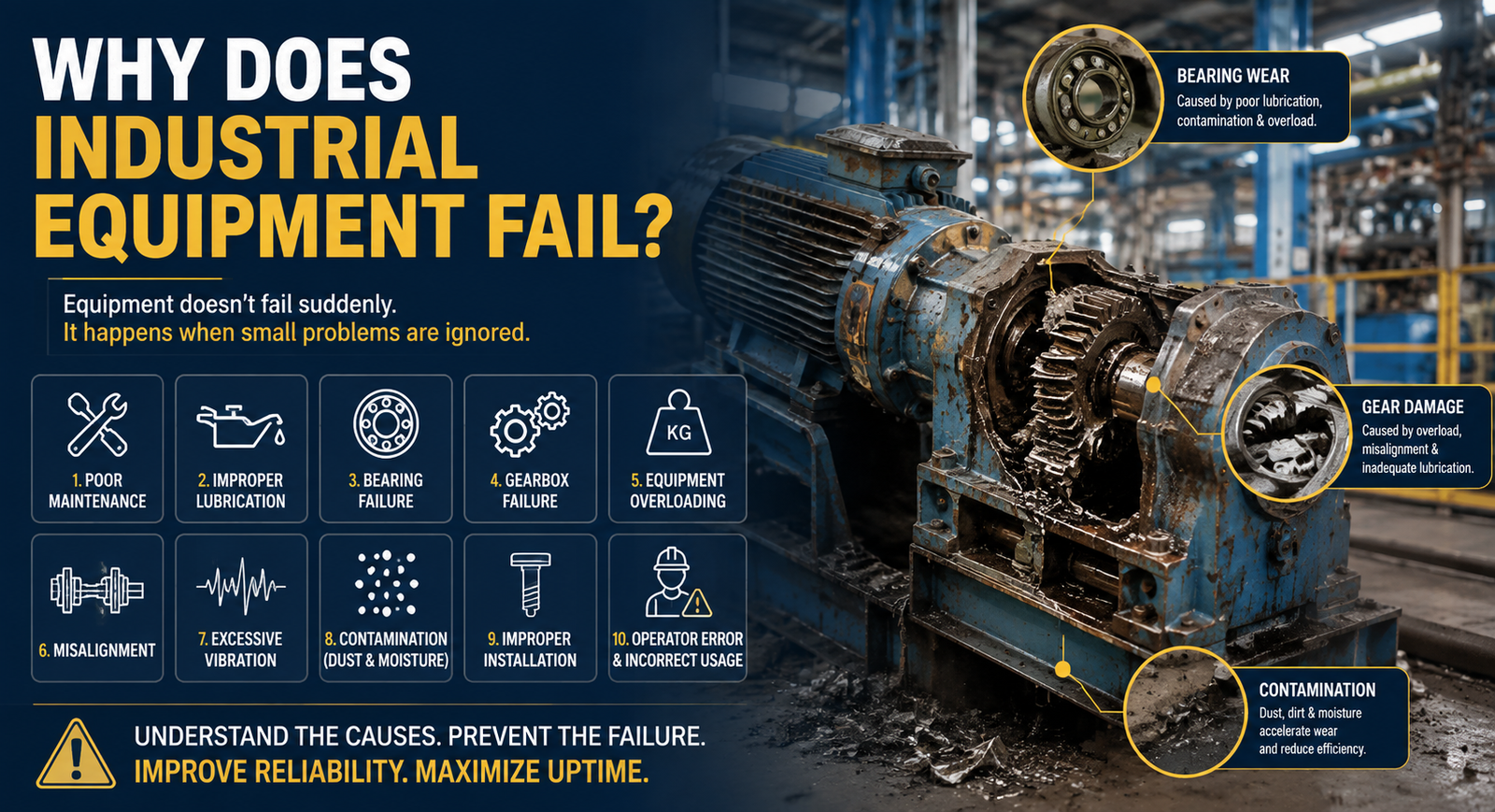
Industrial machinery rarely fails for only one reason. In many cases, several contributing conditions combine.
The most common categories include:
- Poor preventive maintenance
- Improper lubrication
- Bearing problems
- Gearbox problems
- Equipment overloading
- Misalignment
- Excessive vibration
- Contamination, dust, and moisture
- Improper installation
- Operator error or incorrect equipment usage
For example, repeated bearing failure may initially appear to be a bearing-quality issue. However, investigation may reveal excessive belt tension, shaft misalignment, contamination, incorrect bearing mounting, or insufficient lubrication.
This distinction is important. Replacing a failed component without identifying the failure mechanism can allow the same problem to happen again.
Effective maintenance engineering therefore asks two questions:
What failed?
and
Why did it fail?
Here are 10 Causes of Industrial Equipment Failure:
1. Poor Preventive Maintenance
What causes the problem?
One of the most common contributors to industrial machinery failure is an inadequate maintenance program.
Problems occur when inspections are skipped, lubrication is delayed, abnormal conditions are not documented, or servicing is performed only after equipment stops working.
A reactive maintenance culture can be particularly problematic for critical assets such as conveyor gearboxes, bearings, motors, pumps, compressors, crushers, and material-handling systems.
Common warning signs
Maintenance teams may observe:
- Increasing vibration
- Unusual noise
- Oil leakage
- Temperature increases
- Loose fasteners
- Repeated component failures
- Reduced operating performance
- Deteriorating conveyor tracking
- Increasing lubrication requirements
Impact on industrial equipment
Small defects can progressively affect connected components. A loose mounting arrangement, for example, can contribute to vibration and alignment problems. A neglected lubricant leak can eventually result in insufficient lubrication.
The result may be an avoidable breakdown rather than a planned maintenance intervention.
How to prevent it
Establish an asset-specific preventive maintenance program covering:
- Inspection requirements
- Lubrication requirements
- Alignment checks
- Bearing inspections
- Gearbox inspections
- Conveyor inspections
- Safety checks
- Component replacement criteria
- Maintenance documentation
Maintenance recommendation
Do not use one generic schedule for every machine. Maintenance intervals should consider manufacturer recommendations, duty cycle, operating environment, equipment criticality, load, speed, contamination, and previous failure history.
A strong Industrial Machinery Maintenance program should also record recurring failures so engineers can identify patterns rather than treating each breakdown as an isolated event.
2. Improper Lubrication
What causes the problem?
Lubrication is fundamental to the reliability of bearings, gears, shafts, and other moving components.
Lubrication-related failures can result from:
- Insufficient lubricant
- Excessive lubricant
- Incorrect lubricant type
- Incorrect viscosity
- Contaminated lubricant
- Incorrect lubrication interval
- Lubricant degradation
- Poor storage or handling
- Mixing incompatible lubricants
Too little lubricant can increase friction and wear. However, more lubricant is not automatically better; excessive lubrication can also create heat and operating problems in some applications.
Common warning signs
Look for:
- Abnormal bearing temperature
- Gearbox overheating
- Discoloured lubricant
- Metal particles in lubricant
- Oil leakage
- Unusual gear or bearing noise
- Increased friction
- Accelerated component wear
Impact on industrial equipment
Poor lubrication can damage bearing raceways, rolling elements, gears, seals, and other surfaces. In gearboxes, lubricant condition directly affects the operating environment of gears and bearings.
How to prevent it
Create a documented lubrication management system that specifies:
- Correct lubricant
- Correct quantity
- Application method
- Lubrication interval
- Storage requirements
- Contamination-control procedures
- Inspection requirements
Lubricants should be selected according to the equipment manufacturer’s specifications and operating conditions.
Maintenance recommendation
Avoid treating lubrication as simply a routine greasing activity. It should be considered part of Industrial Equipment Reliability.
For critical assets, lubricant inspection or oil analysis may help identify contamination, wear debris, oxidation, or other developing problems.
3. Bearing Failure
What causes the problem?
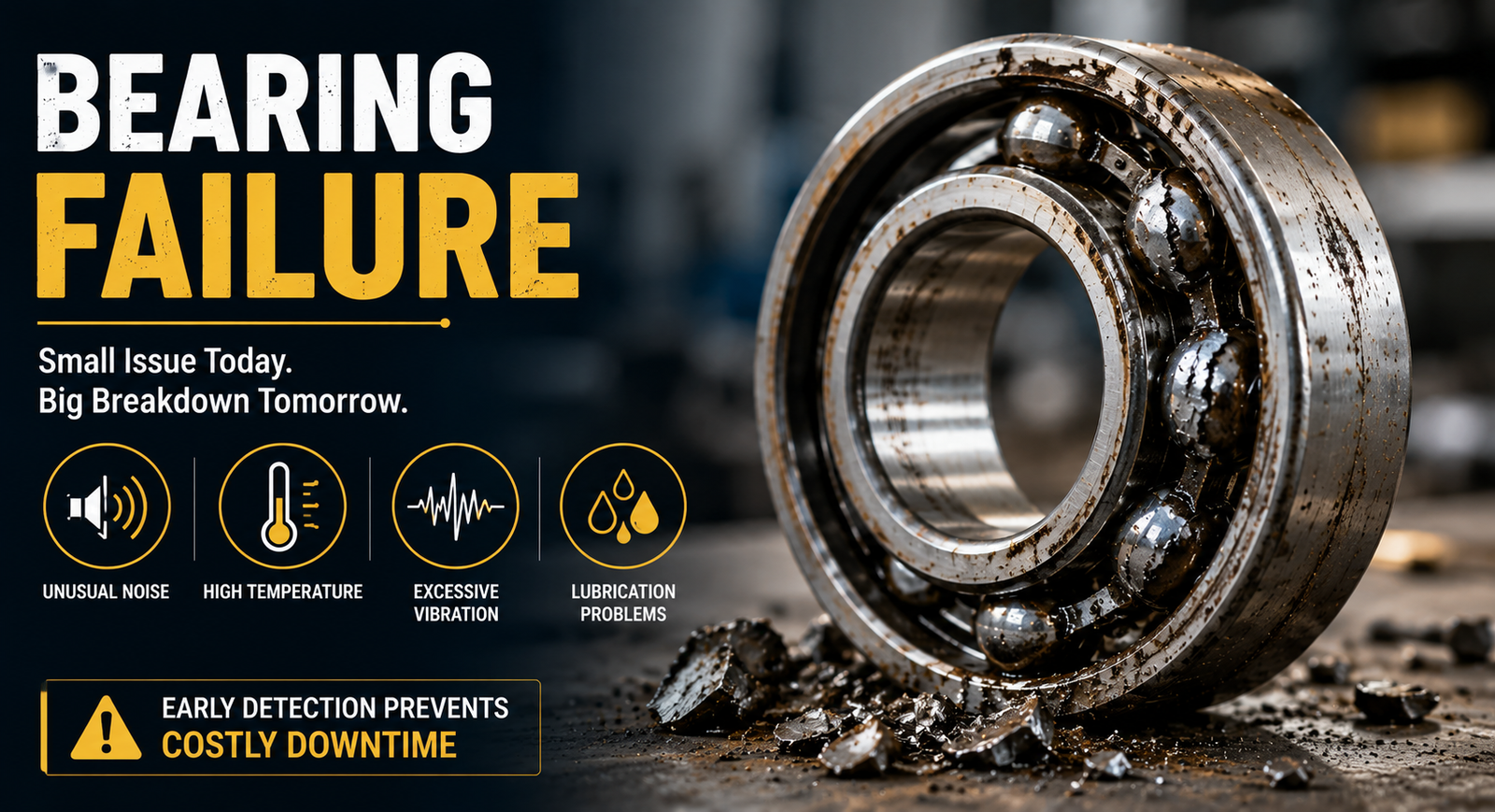
Bearings are critical components in rotating equipment, but they can fail because of several interacting factors.
Common causes include:
- Poor lubrication
- Contamination
- Misalignment
- Excessive load
- Incorrect installation
- Improper shaft fit
- Excessive vibration
- Incorrect bearing selection
- Inadequate sealing
- Operating conditions outside design requirements
In conveyor systems, bearings supporting pulleys, shafts, and rollers may be exposed to dust, moisture, vibration, impact loading, and continuous operation.
Common warning signs
Typical warning signs include:
- Grinding or rumbling noise
- Increased temperature
- Excessive vibration
- Shaft movement
- Lubricant leakage
- Repeated bearing replacement
- Reduced rotating smoothness
Impact on industrial equipment
A damaged bearing can create secondary problems. Increased vibration can affect couplings, shafts, seals, gearboxes, and mounting structures.
If a bearing seizes, the consequences can be considerably more severe.
How to prevent it
Bearing reliability starts before installation.
Engineers should verify:
- Correct bearing type
- Correct load capacity
- Appropriate housing
- Shaft compatibility
- Proper mounting method
- Correct lubrication
- Adequate sealing
- Correct alignment
Pillow blocks, plummer blocks, and bearing housings should be selected according to the actual application rather than simply by matching a nominal shaft dimension.
For maintenance and procurement teams comparing heavy-duty bearing housing solutions, Top 10 Plummer Block Manufacturers in Hyderabad is a relevant reference when evaluating manufacturers and industrial bearing-support options.
Maintenance recommendation
When a bearing fails repeatedly, investigate the operating environment and installation conditions before simply replacing it.
Useful diagnostic questions include:
Was the bearing overloaded? Was it correctly aligned? Was contamination present? Was the lubricant appropriate? Was the shaft or housing fit correct?
4. Gearbox Failure
What causes the problem?
Gearboxes transfer torque and control speed, making them critical to many industrial machines.
Common gearbox failure mechanisms include:
- Gear tooth wear
- Lubrication problems
- Excessive load
- Misalignment
- Bearing damage
- Excessive operating temperature
- Contamination
- Incorrect gearbox selection
- Improper installation
- Shock loading
A gearbox may continue running while internal damage is developing, which is why condition monitoring is valuable.
Common warning signs
Maintenance teams should investigate:
- Unusual gear noise
- Rising temperature
- Oil leakage
- Increased vibration
- Metal particles in lubricant
- Abnormal speed
- Repeated seal failure
- Reduced torque transmission
Impact on industrial equipment
A gearbox failure can stop conveyors, crushers, material-handling systems, mixers, and production lines.
The correct gearbox must be selected according to speed, torque, duty cycle, load characteristics, mounting arrangement, environmental conditions, and application requirements.
Nisuka Industries manufactures SMSR Gearbox solutions used in conveyor, crusher, and material-handling applications. Its website describes its shaft-mounted gearbox range as designed for heavy-duty industrial applications and notes the use of features such as case-hardened gears, selected anti-friction bearings, sealing arrangements, and tapper-bush mounting systems.
For procurement teams researching SMSR Gearbox Manufacturer in Ahmedabad, the important evaluation criteria should extend beyond purchase price to application suitability, engineering support, installation requirements, serviceability, and spare-parts availability.
Maintenance recommendation
Check gearbox oil condition, temperature, vibration, seals, mounting, and load regularly.
If a gearbox repeatedly fails, investigate the driven machine as well. The gearbox may be experiencing a load, alignment, or torque condition that was not present in the original design assumptions.
Need a Reliable Gearbox Solution?
Share your application requirements with our technical team and get the right gearbox solution for your industrial needs.
Speak With Our Technical Team
Get expert assistance for product selection, specifications and industrial applications.
4304, 4321 C/1-B Phase IV, Near Sethi Ind. Gases, G.I.D.C., Vatva, Ahmedabad – 382445, Gujarat, India.
Tell Us What You Need
Complete the form and our team will connect with you shortly.
5. Equipment Overloading
What causes the problem?
Equipment designed for a particular load range can experience accelerated wear when operated beyond its intended capacity.
Overloading can result from:
- Excessive material quantity
- Incorrect equipment sizing
- Increased conveyor loading
- High starting torque
- Shock loads
- Process modifications
- Blockages
- Frequent starts and stops
- Incorrect speed or operating conditions
Common warning signs
Indicators may include:
- Motor current increases
- Gearbox temperature rises
- Bearing temperature increases
- Belt slippage
- Excessive vibration
- Reduced speed
- Frequent coupling failures
- Repeated gearbox or shaft damage
Impact on industrial equipment
Excessive loading can transfer abnormal forces to bearings, shafts, gears, couplings, motors, pulleys, and gearboxes.
Repeated overload conditions are particularly harmful because the equipment may appear to operate normally while fatigue and wear accumulate.
How to prevent it
Before selecting equipment, calculate:
- Required torque
- Operating speed
- Load
- Duty cycle
- Starting conditions
- Shock loading
- Conveyor capacity
- Environmental conditions
Maintenance recommendation
Do not compensate for chronic overload simply by replacing components with heavier ones. First determine whether the equipment is correctly sized for the application.
Correct equipment selection is one of the most important stages of Industrial Equipment Maintenance because maintenance cannot fully compensate for fundamentally unsuitable equipment.
6. Misalignment
What causes the problem?
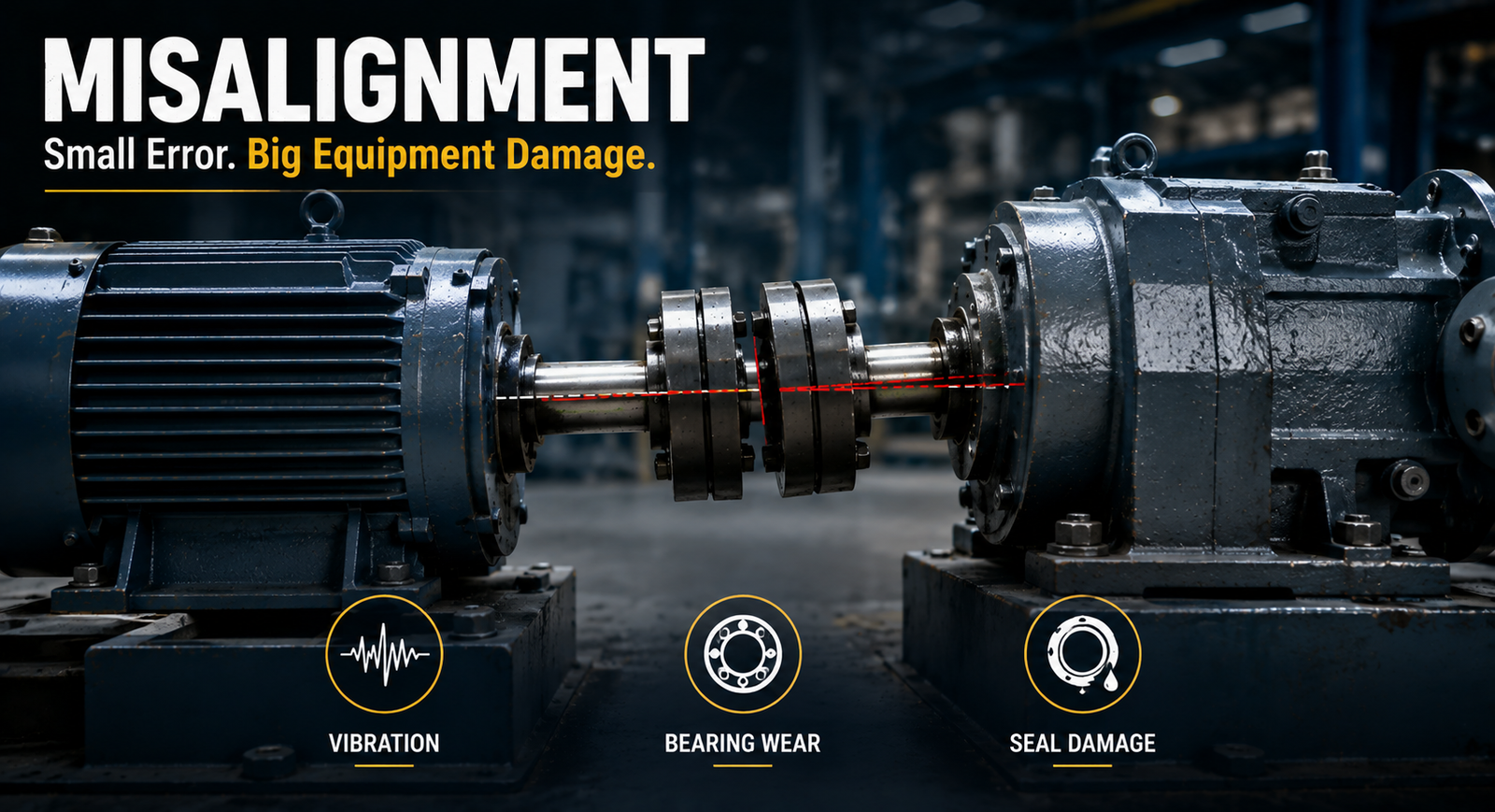
Misalignment occurs when connected rotating components do not operate within the required geometric relationship.
Common examples include:
- Shaft misalignment
- Coupling misalignment
- Pulley misalignment
- Bearing alignment problems
- Conveyor pulley misalignment
- Incorrect mounting
- Installation errors
Common warning signs
Misalignment can contribute to:
- Excessive vibration
- Bearing wear
- Seal damage
- Coupling wear
- Gear wear
- Increased temperature
- Increased energy demand
- Uneven belt tracking
Impact on industrial equipment
Misalignment introduces additional forces into rotating systems.
For conveyor equipment, pulley alignment and belt tracking are particularly important. Poor alignment can increase belt wear, create tracking problems, and place additional loading on bearings and shafts.
How to prevent it
Use appropriate alignment procedures during installation and maintenance.
Depending on the equipment, this may involve:
- Shaft alignment
- Coupling alignment
- Pulley alignment
- Bearing housing inspection
- Base inspection
- Conveyor tracking checks
Maintenance recommendation
Alignment should be checked after major installation work, component replacement, structural changes, or whenever vibration or abnormal wear suggests a problem.
For anyone researching What is a Shaft Mounted Speed Reducer Gearbox?, it is equally important to understand that gearbox selection and mounting arrangement must be evaluated together with shaft, pulley, and conveyor geometry.
7. Excessive Vibration
What causes the problem?
Vibration is not necessarily a failure itself. It is often a symptom of an underlying mechanical condition.
Possible causes include:
- Imbalance
- Misalignment
- Bearing damage
- Gear damage
- Loose components
- Bent shafts
- Structural problems
- Resonance
- Mechanical looseness
Common warning signs
A change in vibration level, frequency pattern, or operating behaviour can indicate developing machinery problems.
Maintenance teams should pay attention to:
- Increasing vibration
- New vibration frequencies
- Machine movement
- Loose foundations
- Abnormal bearing noise
- Increasing gearbox vibration
Impact on industrial equipment
Excessive vibration can accelerate wear and may transfer mechanical forces to neighbouring components.
For critical rotating assets, vibration monitoring can form an important part of predictive maintenance.
How to prevent it
Establish baseline vibration measurements where appropriate and investigate significant deviations.
The monitoring method should be selected according to equipment criticality and the type of failure being investigated.
Maintenance recommendation
Use vibration monitoring as part of Industrial Equipment Troubleshooting, not as a replacement for physical inspection.
A vibration reading should be interpreted in context with machine speed, load, temperature, operating history, and previous measurements.
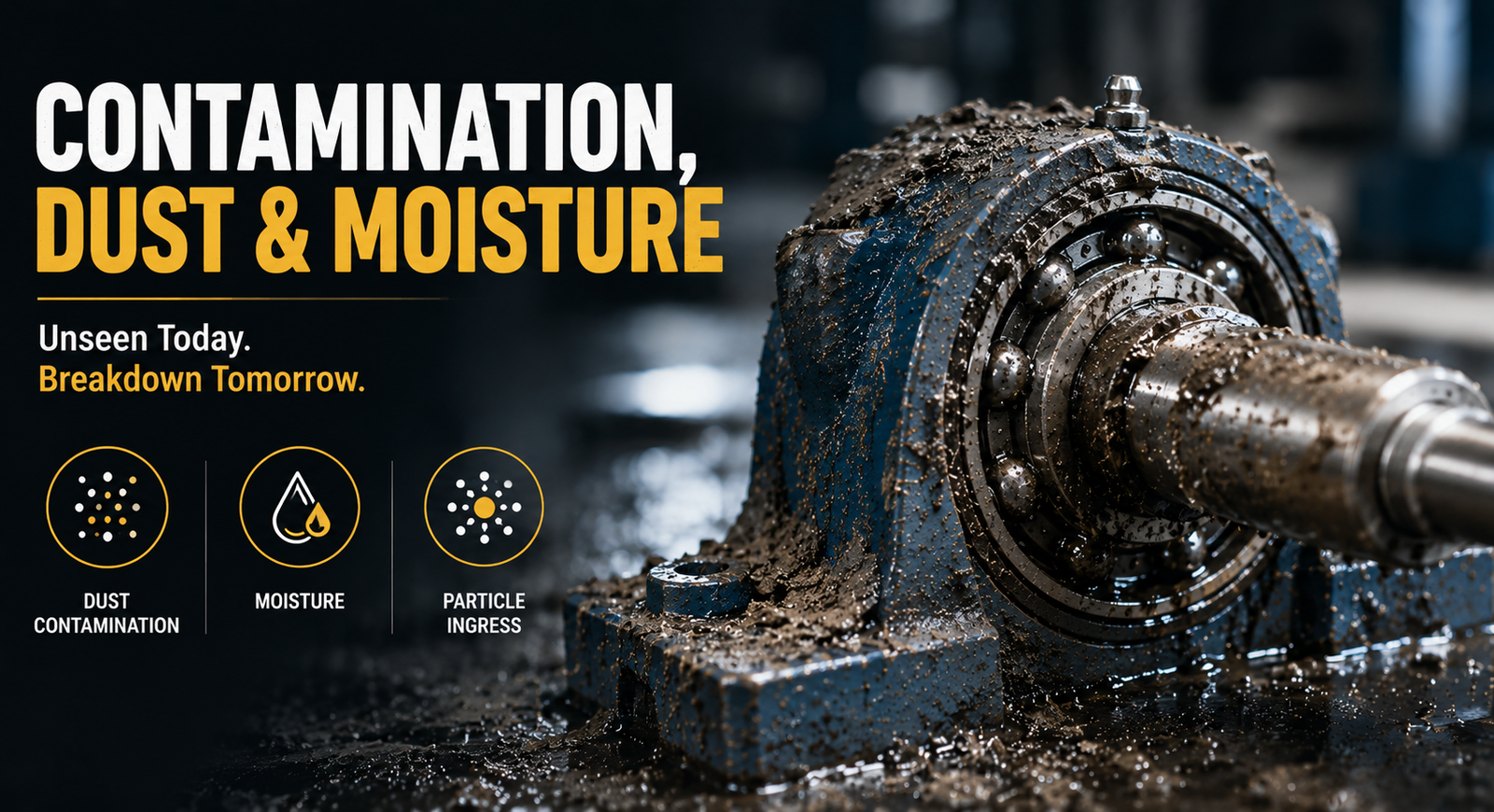
8. Contamination, Dust & Moisture
What causes the problem?
Industrial equipment frequently operates in harsh environments.
Dust, dirt, water, chemicals, abrasive particles, and other contaminants can enter bearings, gearboxes, seals, and lubrication systems.
This is particularly challenging in:
- Cement plants
- Mining operations
- Steel plants
- Food-processing facilities
- Chemical plants
- Power-generation facilities
- Aggregate handling
- Recycling plants
Common warning signs
Potential indicators include:
- Contaminated lubricant
- Premature bearing wear
- Seal damage
- Corrosion
- Gear wear
- Increased vibration
- Abnormal temperature
- Frequent lubrication problems
Impact on industrial equipment
Contamination can reduce lubricant effectiveness and accelerate surface wear.
In conveyor systems, environmental contamination can also affect bearings, rollers, pulleys, tensioning equipment, and other components.
How to prevent it
Use appropriate:
- Seals
- Guards
- Covers
- Breathers
- Lubrication practices
- Cleaning procedures
- Storage practices
Maintenance teams should also consider the environment when selecting components.
A component suitable for a clean indoor application may not be suitable for a dusty mining or cement environment without appropriate protection.
Maintenance recommendation
Do not wait for contamination to cause visible damage. Establish contamination-control procedures at the equipment design and installation stage.
9. Improper Installation
What causes the problem?
A high-quality component can still fail prematurely if it is installed incorrectly.
Common installation problems include:
- Incorrect shaft fit
- Improper bearing mounting
- Incorrect tightening
- Poor alignment
- Incorrect lubrication
- Improper mounting
- Incorrect component selection
- Damaged seals
- Incorrect coupling installation
Common warning signs
Installation-related problems may appear as:
- Immediate vibration
- Premature bearing failure
- Oil leakage
- Excessive temperature
- Abnormal noise
- Shaft movement
- Fastener loosening
Impact on industrial equipment
Installation errors can create forces that were never considered in the original equipment design.
This is why manufacturer installation specifications are important.
How to prevent it
Maintenance and installation teams should follow:
- Manufacturer instructions
- Correct torque values
- Shaft and housing requirements
- Alignment procedures
- Lubrication requirements
- Recommended mounting methods
Maintenance recommendation
Document critical installation checks for important equipment.
When a new component fails shortly after installation, do not automatically assume the replacement component was defective. Review installation conditions, alignment, load, lubrication, and operating environment.
10. Operator Error & Incorrect Equipment Usage
What causes the problem?
Machines are designed around specific operating procedures. Incorrect use can cause accelerated wear or immediate damage.
Examples include:
- Exceeding rated capacity
- Incorrect startup procedures
- Incorrect shutdown
- Ignoring warning signs
- Poor operator training
- Incorrect adjustments
- Bypassing safety procedures
- Continuing operation after abnormal noise or vibration
Common warning signs
Recurring failures that correlate with specific operating shifts, processes, or operating conditions can indicate an operational issue.
Impact on industrial equipment
Incorrect operation can cause:
- Shock loading
- Overheating
- Belt slippage
- Gearbox overload
- Bearing damage
- Motor stress
- Increased wear
How to prevent it
Develop clear standard operating procedures covering:
- Startup
- Shutdown
- Loading
- Inspection
- Emergency response
- Equipment limits
- Abnormal-condition reporting
Maintenance recommendation
Operators should not be expected to diagnose every mechanical problem. However, they should know which abnormal conditions require immediate escalation.
A well-trained operator can become an important part of the plant’s early-warning system.
How to Prevent Industrial Equipment Failure
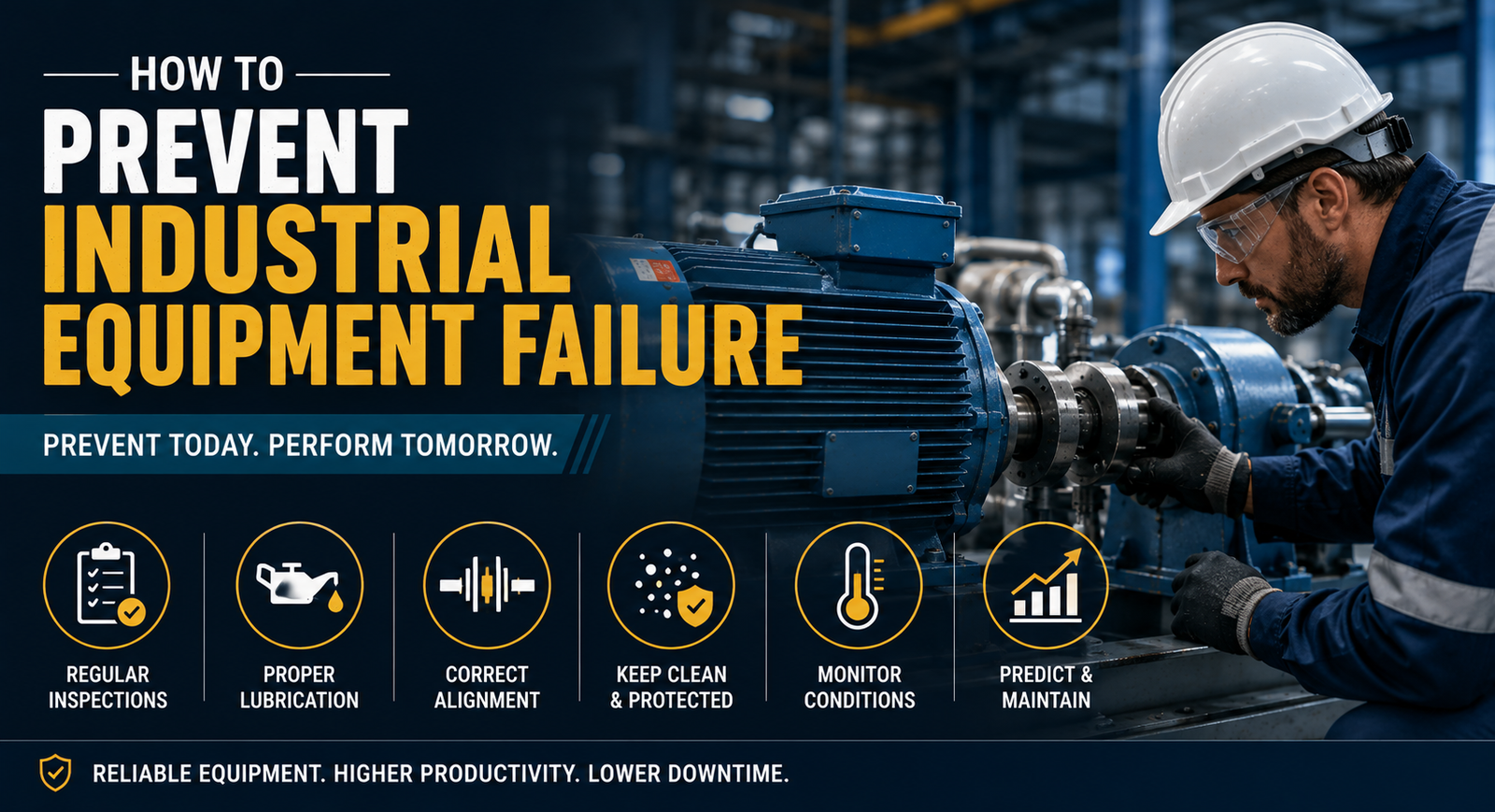
A practical reliability program should combine several maintenance strategies instead of relying on one approach.
1. Establish preventive maintenance
Schedule inspections and servicing according to equipment requirements and operating conditions.
2. Use predictive maintenance where justified
Critical rotating equipment may benefit from vibration, temperature, oil, or other condition-monitoring techniques.
3. Inspect equipment regularly
Look for changes in noise, vibration, leakage, temperature, wear, and alignment.
4. Control lubrication
Specify the right lubricant, quantity, interval, storage procedure, and contamination controls.
5. Monitor vibration
Establish suitable baselines and investigate significant changes.
6. Monitor temperature
Temperature trends can provide useful evidence of developing mechanical problems.
7. Check alignment
Inspect shafts, couplings, pulleys, bearings, and conveyor arrangements where applicable.
8. Control equipment loading
Confirm that actual operating loads remain within the design requirements.
9. Inspect bearings and gearboxes
Look for wear, leakage, temperature changes, vibration, and lubricant problems.
10. Train operators
Make operating limits and abnormal-condition reporting procedures clear.
11. Maintain critical spare parts
Identify components where long procurement lead times could significantly extend downtime.
12. Document failures
Record what failed, operating conditions, symptoms, root causes, corrective actions, and recurrence.
This transforms maintenance from a reactive activity into a continuous reliability-improvement process.
How to Improve Industrial Equipment Reliability
Industrial reliability improves when maintenance, engineering, operations, and procurement work together.
- Select correctly sized equipment.
Evaluate load, speed, torque, duty cycle, environment, and application requirements. - Follow manufacturer specifications.
Installation, lubrication, alignment, and operating requirements should not be treated as optional. - Establish preventive maintenance schedules.
Use equipment-specific maintenance plans rather than generic calendars. - Monitor critical equipment condition.
Use vibration, temperature, oil analysis, or other appropriate methods. - Maintain correct lubrication.
Control lubricant selection, quantity, cleanliness, and frequency. - Check alignment regularly.
Investigate recurring vibration and wear for potential alignment problems. - Monitor vibration and temperature.
Trends can help identify developing mechanical conditions. - Train operators.
Operators should understand equipment limits and abnormal-condition reporting. - Maintain critical spare parts.
Balance inventory cost against equipment criticality and lead time. - Analyze recurring failures.
Use root-cause analysis to prevent repetition rather than repeatedly replacing the same component.
Key Factors to Consider When Selecting Industrial Equipment
Equipment selection is one of the earliest opportunities to prevent future reliability problems.
Before purchasing or specifying industrial machinery, evaluate:
- Load requirements
- Operating speed
- Torque requirements
- Duty cycle
- Starting conditions
- Shock loading
- Operating environment
- Temperature
- Dust and contamination
- Corrosion exposure
- Equipment compatibility
- Maintenance requirements
- Spare-parts availability
- Manufacturer support
- Installation requirements
- Total cost of ownership
- Expected operating conditions
Procurement teams should provide manufacturers with accurate application information.
For example, specifying only the required motor power may not be sufficient when selecting a gearbox. Engineers may also need information about speed, torque, service conditions, duty cycle, driven load, mounting arrangement, and environmental conditions.
For teams comparing Top 10 Pillow Block Manufacturers in India, the evaluation should therefore focus on more than product availability. Engineering capability, application support, dimensional consistency, material quality, customization, delivery reliability, and technical assistance can all influence long-term equipment performance.
The better the application data, the better the opportunity for correct equipment selection..
Conclusion
Industrial Equipment Failure is often preventable when maintenance teams identify deterioration early and address the underlying cause rather than repeatedly replacing failed components.
Effective reliability begins with correct equipment selection and continues through proper installation, lubrication, alignment, load management, inspection, condition monitoring, and operator training.
Bearings and gearboxes require particular attention because their condition can strongly influence the performance of connected machinery. Conveyor systems also require coordinated maintenance of gearboxes, shafts, bearings, pulleys, belts, tensioning systems, and rollers.
Preventive maintenance provides a structured foundation, while predictive maintenance can provide additional insight into the condition of critical assets. Neither approach should be applied blindly; maintenance strategy should reflect equipment criticality, failure modes, operating environment, manufacturer recommendations, and plant requirements.
For industrial procurement teams, reliability should also be considered during equipment selection. Component compatibility, operating conditions, maintenance requirements, spare-parts availability, manufacturer support, and total cost of ownership can be as important as the initial purchase price.
Working with experienced industrial equipment manufacturers such as Nisuka Industries can help procurement and engineering teams evaluate relevant power-transmission, bearing, conveyor, and material-handling components according to their application requirements. Ultimately, reliable equipment performance comes from the combination of suitable components, correct engineering, disciplined maintenance, and responsible operation.
FAQS
1. What are the most common causes of industrial equipment failure?
The most common causes include poor maintenance, improper lubrication, bearing problems, gearbox damage, overloading, misalignment, excessive vibration, contamination, improper installation, and operator error. In practice, failures often result from multiple contributing factors. For example, a bearing may fail because of a combination of incorrect lubrication, misalignment, contamination, and excessive loading rather than one isolated problem.
2. How can industrial equipment failure be prevented?
Industrial equipment failure can be reduced through correct equipment selection, preventive maintenance, condition monitoring, proper lubrication, alignment checks, load control, contamination management, operator training, and systematic failure analysis. Critical assets may also benefit from predictive maintenance techniques such as vibration, temperature, or lubricant-condition monitoring. Maintenance practices should always be adapted to equipment manufacturer recommendations and actual operating conditions.
3. What is the difference between equipment failure and equipment breakdown?
Equipment failure means that a machine or component can no longer perform its intended function within acceptable conditions. A breakdown generally refers to a failure severe enough to interrupt operation. Therefore, a machine can experience a developing failure without immediately breaking down. Detecting abnormal temperature, vibration, noise, or wear can provide an opportunity to correct the failure before it results in an unplanned shutdown.
4. How does preventive maintenance reduce equipment failure?
Preventive maintenance reduces risk by identifying and addressing known deterioration mechanisms before they develop into severe failures. Activities may include inspection, lubrication, alignment checks, cleaning, tightening, and condition-based component servicing. The objective is not simply to replace parts at fixed intervals but to maintain equipment according to manufacturer recommendations, operating conditions, criticality, and known failure modes.
5. What factors affect the lifespan of a pillow block?
Industrial machinery can overheat because of excessive loading, insufficient or excessive lubrication, bearing damage, gear problems, misalignment, inadequate cooling, restricted airflow, electrical problems, or operation outside design conditions. Temperature trends are more useful when interpreted alongside load, speed, vibration, lubricant condition, and historical operating data. A temperature increase should therefore trigger investigation rather than an automatic component replacement.
6 replies on “Top 10 Causes of Industrial Equipment Failure and How to Prevent them ”
[516895]supplies professional anti-violence equipments and solutions for the whole world with strong and perfect production capacity. anti-violence.org
[410078]supplies professional anti-violence equipments and solutions for the whole world with strong and perfect production capacity. anti-violence.org
[106]godzcasino Official Login | বিকাশ দিয়ে স্লট গেম খেলুন,godzcasino অফিসিয়াল লগইন করে অনলাইনে স্লট গেম এবং রুলেটের রোমাঞ্চ উপভোগ করুন। অ্যাপ ডাউনলোড করে বিকাশ দিয়ে সহজে ডিপোজিট করে আজই খেলা শুরু করুন। visit: godzcasino
Yo, phbestcasino is where it’s at! Tried my luck there last night and had a blast. The slots are fire, and the payouts seem legit. Definitely gonna be hitting this spot again soon. Check it out at phbestcasino.
In reality, a lot of subjects are a lot more involved than a common typical observer might possibly decide on, based upon their position. I’m not thinking that am a professional
on the following idea being chatted about, and
so I presume it’s for different discussion board subscribers to contemplate.
I am not trying to make difficulties or be irritating.
Instead, I recognize from working experience that the aforementioned
will be the instance. I put into practice Postpartum Massage Therapy,
and in my own personal selected discipline, I experience it quite a lot.
Brand-new Postpartum Massage Therapists are likely to exaggerate claims;
that is, these individuals don’t at this point definitely recognise the
limitations of their own “scope of practice,” and consequently they might possibly come up with promises that are overbroad when discussing
with patients. It’s the very same occurrence; they
have been introduced to a topic, don’t recognize the full breadth of it, and now
assume they are the Specialists.
This is absolutely not the very first moment in time I found
a blogging site that was worth commenting on. This
actual blog post is significant to me personally. I really live a life-style of a great
number of modes; that is to say that my employment activities range the
gamut. I perform Postpartum Massage. Aside from that, I
buy and sell collectibles. I’m being taught Direct Admin. And, that’s just a handful of pursuits I
do. Anyway, my idea is, each of us all approaches a subject from
a distinctive perspective. Just about every experience we have shapes us and our
own perspective of ourselves and the world all around you and me.
I imagine finding some variety of increased awareness of reality is just where almost everything all of us chat regarding brings
us to. That being said, exactly how will people in that case relate?
Is it even possible? I suppose all of our personal contributions to the Internet Commons
transforms a great many people, possibly. Thus think about that, bloggers
and commenters. Your own opinion may perhaps assist a different
person. Or perhaps, commentary can easily do the antipode.
And, everyone, meaning, you, me, definitely have to care to
try to aid others to blossom and never wither.
Thank you for this specific blog site; I actually am logging this blog together with my other beneficial weblogs I’ve discovered that I
sometimes bothered to leave feedback on. Always keep publishing!
Keep expressing!