
Top 7 Common Conveyor Belt Problems and How to Fix Them
Conveyor systems are fundamental to bulk material handling in mining, cement, steel, quarrying, coal handling, power generation, ceramics, sand processing and many other industrial operations. When a conveyor operates correctly, material moves continuously with relatively little operator intervention. When something goes wrong, however, even a seemingly small belt issue can develop into material spillage, component damage, production interruption or an unexpected shutdown.
Common Conveyor Belt Problems include mistracking, slippage, premature wear, incorrect tension, material carryback, pulley and idler failures, and cuts or tears in the belt. These issues do not always have a single cause. A belt may track incorrectly because of pulley alignment, idler positioning, uneven loading, buildup or structural conditions. Similarly, slippage may involve tension, traction, loading or drive conditions.
For maintenance teams, the most important principle is therefore to identify the root cause rather than repeatedly correcting the symptom. Adjusting a tracking device without checking alignment, for example, may temporarily move the belt toward the center without addressing the underlying mechanical problem.
Nisuka Industries manufactures and supplies a range of conveyor and power-transmission components, including Conveyor Head & Tail Drums, Conveyor Idler Rollers, Conveyor Belt Tensioners, Conveyor Rubber Belts, SMSR Gearboxes, pulleys, Plummer Blocks, UCP Pillow Blocks and Electric Motors.
This guide examines seven common conveyor problems, their possible causes, practical troubleshooting methods and preventive measures.
What Are the Most Common Conveyor Belt Problems?
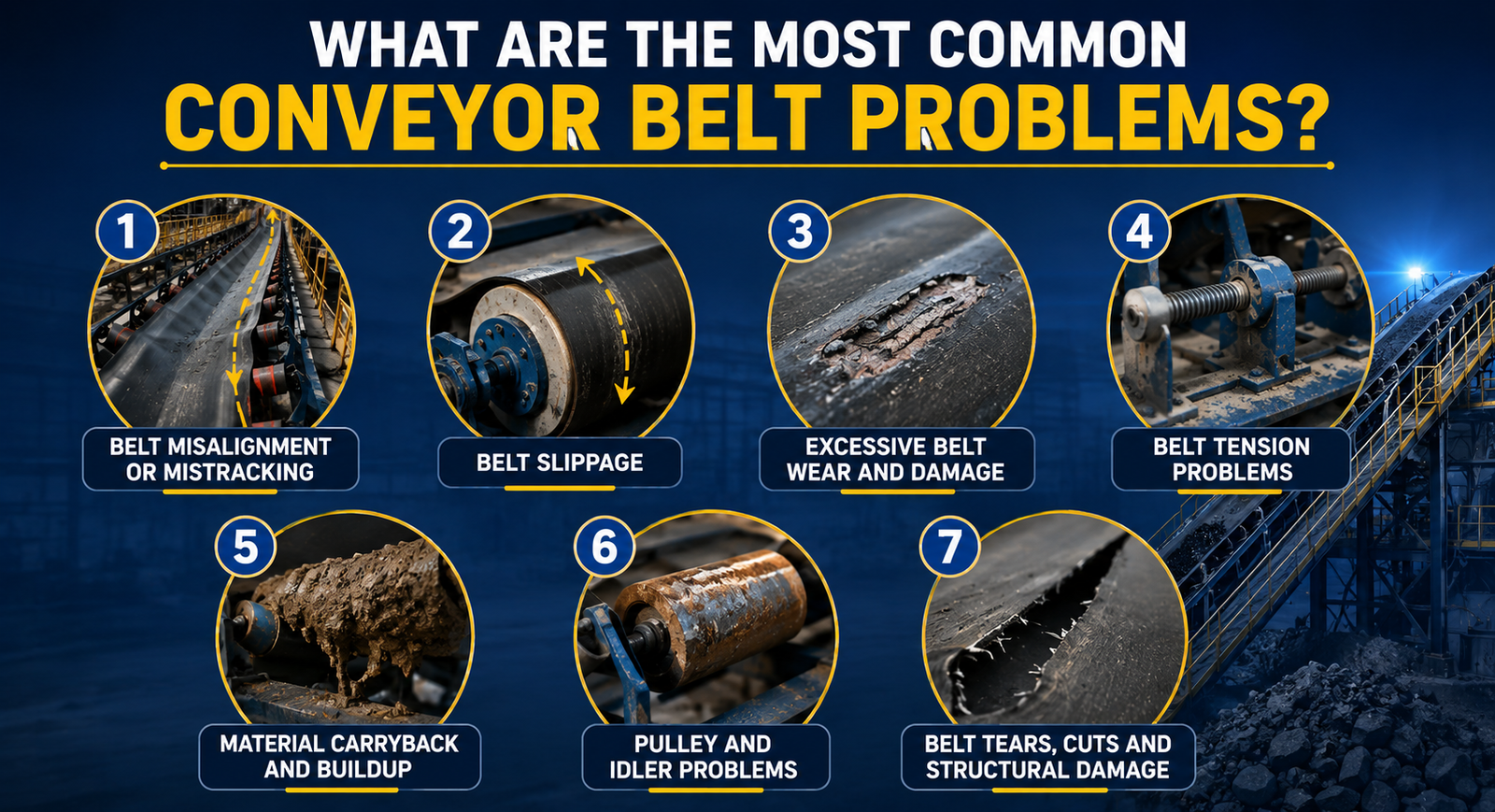
The most common conveyor belt problems generally involve belt tracking, slippage, wear, tension, material buildup and damage to supporting or driving components. Correct diagnosis requires consideration of the complete conveyor design, operating conditions, belt specification, loading arrangement and maintenance history.
The seven problems covered here are:
- Conveyor Belt Misalignment or Mistracking
- Conveyor Belt Slippage
- Excessive Belt Wear and Damage
- Conveyor Belt Tension Problems
- Material Carryback and Buildup
- Conveyor Pulley and Idler Problems
- Conveyor Belt Tears, Cuts and Structural Damage
1. Conveyor Belt Misalignment or Mistracking
Conveyor belt mistracking occurs when the belt does not remain in its intended path and progressively moves toward one side of the conveyor. It may touch the structure, run against pulley edges or idler frames, or repeatedly shift from side to side.
Conveyor Belt Tracking Problems should not automatically be treated as a simple tracking-adjustment issue. Tracking is influenced by several interacting factors, including pulley alignment, idler positioning, belt condition, loading, tension, buildup and the alignment of the conveyor structure.
Signs of Conveyor Belt Mistracking
Typical warning signs include:
- Belt consistently running toward one side.
- Belt edge rubbing against the conveyor structure.
- Frayed or damaged belt edges.
- Material falling from one side of the belt.
- Uneven belt wear.
- Repeated activation of belt-misalignment protection devices.
- Belt movement changing when the loading condition changes.
If the belt tracks correctly when empty but moves sideways under load, the loading arrangement should receive particular attention.
Common Causes of Belt Mistracking
Possible causes include:
- Misaligned head or tail pulleys.
- Incorrectly positioned carrying or return idlers.
- Uneven material loading.
- Material buildup on pulleys or rollers.
- Incorrect or uneven belt tension.
- Damaged idlers or pulley components.
- Belt splice geometry or belt-condition problems.
- Structural misalignment.
A belt should not be repeatedly forced into position using tracking adjustments without determining why it is moving.
How to Fix Conveyor Belt Tracking Problems
A practical troubleshooting sequence is:
- Stop the conveyor according to the site’s isolation procedure.
- Inspect the belt edges for rubbing or damage.
- Check whether the belt is centered on the loading point.
- Inspect head and tail pulley alignment.
- Check carrying and return idlers for alignment and damage.
- Look for material buildup on pulleys and rollers.
- Inspect belt tension and splice condition.
- Check the conveyor structure for alignment issues.
- Correct the identified mechanical or loading problem.
- Restart and observe the belt under controlled conditions.
Do not make multiple adjustments simultaneously if you need to establish cause and effect. Change one relevant variable at a time where practical and safe.
How to Prevent Belt Mistracking
Preventive measures include regular pulley and idler inspections, cleaning buildup, checking belt condition, maintaining appropriate tension and verifying that material enters the belt centrally.
Correct component selection also matters. A properly designed tail pulley, for example, can contribute to stable belt return and alignment. Nisuka’s conveyor drum range includes head drums and tail drum/wing pulley configurations.
2. Conveyor Belt Slippage
Conveyor Belt Slippage occurs when the belt does not maintain adequate traction with the drive pulley and the pulley rotates without transferring sufficient movement to the belt.
A small amount of apparent movement at startup can be normal depending on the system, but persistent or excessive slippage is a fault condition requiring investigation.
How to Identify Conveyor Belt Slippage
Potential causes include:
- Insufficient belt tension.
- Inadequate traction at the drive pulley.
- Wet, oily or contaminated pulley surfaces.
- Excessive loading.
- Worn pulley lagging.
- Incorrect pulley configuration.
- Drive-system problems.
- Inadequate wrap or traction for the particular conveyor design.
Slippage should not automatically be corrected by simply increasing tension. Excessive tension can introduce additional loads into the belt, shafts, bearings and other components.
Common Causes of Belt Slippage
Potential causes include:
- Insufficient belt tension.
- Inadequate traction at the drive pulley.
- Wet, oily or contaminated pulley surfaces.
- Excessive loading.
- Worn pulley lagging.
- Incorrect pulley configuration.
- Drive-system problems.
- Inadequate wrap or traction for the particular conveyor design.
Slippage should not automatically be corrected by simply increasing tension. Excessive tension can introduce additional loads into the belt, shafts, bearings and other components.
How to Fix Conveyor Belt Slippage
Start by checking the belt tension against the conveyor manufacturer’s requirements. Then inspect the drive pulley surface and lagging for wear or contamination.
Also check:
- Material loading.
- Pulley condition.
- Drive motor operation.
- Gearbox condition.
- Belt condition.
- Conveyor startup requirements.
- Pulley alignment.
How to Prevent Belt Slippage
Maintain appropriate belt tension, keep the drive pulley surface in suitable condition, prevent contamination where possible, avoid overloading and inspect the drive system as part of routine Conveyor Belt Troubleshooting.
3. Excessive Conveyor Belt Wear and Damage
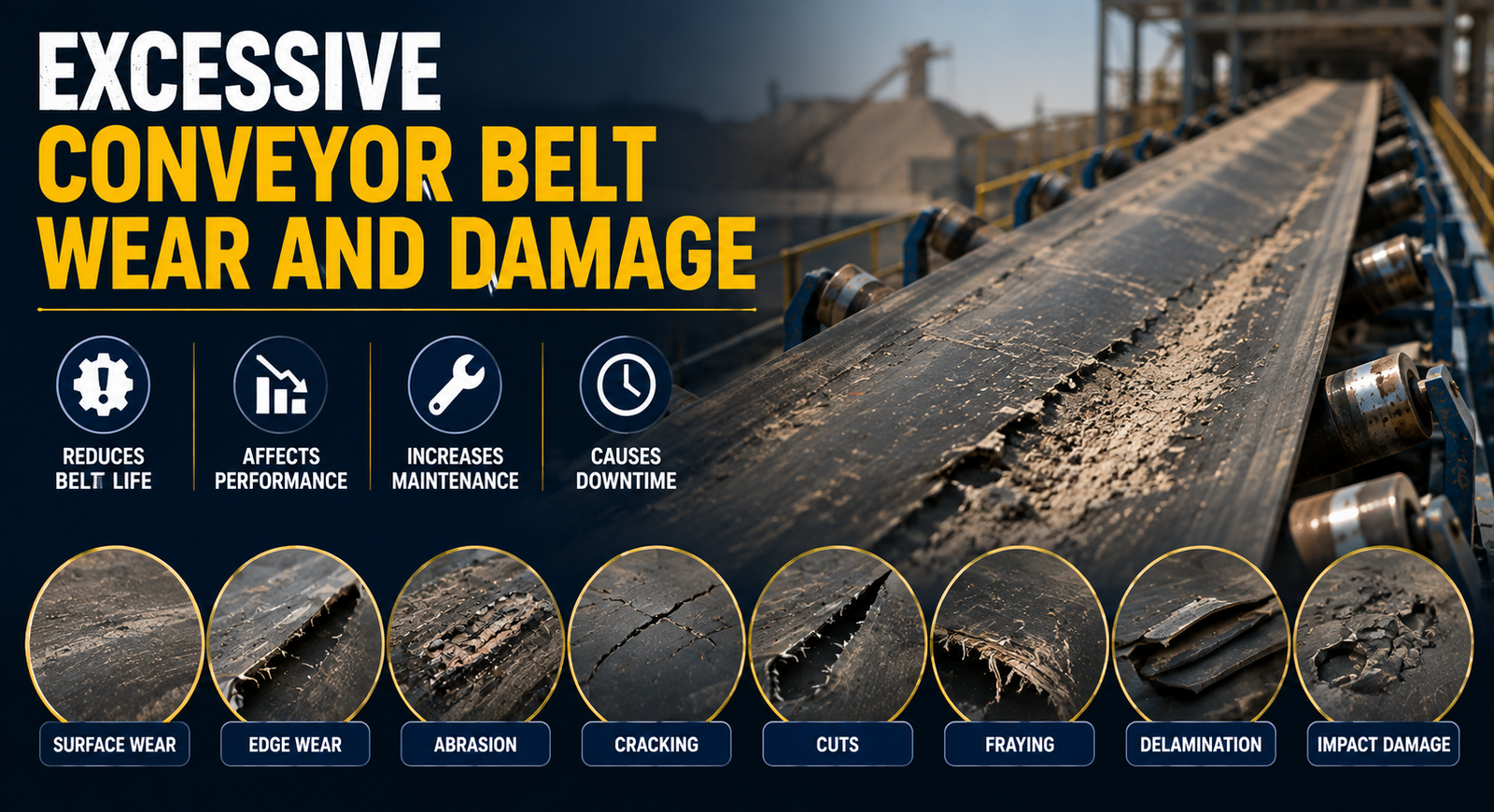
Belt wear is expected during normal operation, but accelerated or highly localized wear is an indication that something in the conveyor system may require investigation.
Common forms of Conveyor Belt Damage include surface abrasion, edge wear, cracking, cuts, fraying, delamination and impact damage.
Causes of Premature Conveyor Belt Wear
Potential causes include:
- Abrasive materials.
- Sharp or oversized material.
- Incorrect loading.
- Misaligned pulleys or idlers.
- Seized rollers.
- Material buildup.
- Excessive tension.
- Poor belt-cleaning arrangements.
- Damaged conveyor components.
- Improperly maintained belt splices.
The wear pattern often provides useful diagnostic information. For example, localized edge wear may point toward tracking or structural contact, while repeated impact damage around loading areas may indicate an issue with the material-transfer arrangement.
How to Fix Excessive Belt Wear
First identify the wear pattern rather than simply replacing the belt.
Inspect:
- Belt loading zone.
- Carrying idlers.
- Return rollers.
- Head and tail pulleys.
- Belt cleaners and scrapers.
- Belt alignment.
- Belt tension.
- Splices.
- Material buildup.
- Damaged or seized components.
If the belt specification itself is unsuitable for the material, impact conditions, temperature or duty cycle, replacement with a more appropriate belt may be necessary.
Preventive Measures for Longer Belt Life
Effective Conveyor Belt Maintenance should include routine visual inspection, checking belt edges, monitoring wear patterns, inspecting splices and removing sources of abnormal abrasion.
Maintenance personnel should distinguish between uniform service wear and localized abnormal wear. Uniform wear may reflect normal operating conditions; localized wear often provides evidence of a specific mechanical, loading or cleaning problem.
4. Conveyor Belt Tensioner Problems
A correct belt tensioner is essential for reliable conveyor operation. The belt must have sufficient tension to transmit the required drive force and operate correctly, but excessive tension can increase mechanical loading.
Both under-tensioning and over-tensioning can create Conveyor System Problems.
Signs of Incorrect Conveyor Belt Tensioner
Under-tensioning may contribute to:
- Belt slippage.
- Belt sag.
- Tracking instability.
- Poor startup performance.
- Inconsistent material movement.
Over-tensioning may contribute to:
- Excessive belt stress.
- Increased pulley and bearing loads.
- Accelerated belt wear.
- Higher mechanical loading.
- Premature component problems.
Belt stretch and changes in operating conditions can also alter the effective tension over time.
How to Correct Conveyor Belt Tensioner
Do not estimate tension solely by visual appearance where accurate tension information is required.
Maintenance teams should refer to the conveyor design documentation, belt manufacturer’s recommendations and tensioning arrangement. Inspect the take-up system, belt condition, splice and pulley arrangement before making significant adjustments.
A useful diagnostic question is:
Did the belt tensioner change because of normal belt elongation, or is another conveyor problem causing the tensioner to change?
That distinction is important.
Role of Belt Tensioners in Conveyor Systems
A conveyor belt tensioner helps maintain the required belt tension within the design of the particular conveyor. Different systems may use manual, spring-loaded, hydraulic, pneumatic or other tensioning arrangements.
Nisuka Industries lists conveyor belt tensioners as part of its industrial conveyor product portfolio. Its published material also describes tensioners as devices intended to regulate belt tension and help address issues such as slippage, misalignment and wear.
For procurement, the correct tensioning arrangement should be selected according to belt length, conveyor configuration, operating load, expected belt stretch and the manufacturer’s design requirements.
5. Material Carryback and Buildup
Material carryback is material that remains attached to the belt after the main discharge point and is subsequently transported along the return path.
Carryback is especially challenging when the conveyed material is wet, sticky or otherwise difficult to release from the belt surface.
How to Reduce Conveyor Belt Carryback
Possible measures include:
- Inspect and maintain belt cleaners.
- Check scraper condition and adjustment.
- Inspect the belt surface.
- Remove material buildup from return components.
- Review discharge conditions.
- Check belt tracking.
- Ensure the cleaning arrangement is appropriate for the material.
The goal is not simply to install a scraper. The cleaner, belt surface, material properties and conveyor operating conditions need to work together.
How Material Buildup Causes Other Conveyor Problems
Buildup can accumulate on:
- Return rollers.
- Tail pulleys.
- Carrying idlers.
- Conveyor structure.
- Other rotating components.
As buildup increases, it can alter roller or pulley geometry, contribute to tracking problems and increase wear.
A wing-style tail pulley can be useful in applications where material accumulation around the pulley is a concern. Nisuka’s published conveyor pulley information identifies wing tail pulleys as one configuration used to help manage material buildup.
The appropriate pulley design should nevertheless be selected according to the belt, material, loading arrangement and conveyor design rather than assuming one pulley type is suitable for every application.
6. Conveyor Pulley and Idler Problems
Pulleys and idlers are critical interfaces between the belt and conveyor structure. Problems in either can quickly become Conveyor Belt Issues because they directly influence belt support, alignment, traction and rotation.
Common Conveyor Pulley Problems
Typical pulley-related issues include:
- Worn lagging.
- Pulley misalignment.
- Damaged pulley shell.
- Material buildup.
- Shaft or bearing problems.
- Surface damage.
- Excessive vibration.
- Poor installation or alignment.
The head or drive pulley transfers power to the belt, while tail and other pulleys guide or redirect the belt. A drive pulley with inadequate traction can contribute to slippage, while a misaligned pulley can contribute to tracking problems.
Nisuka manufactures Conveyor Head & Tail Drums, including head drum and wing/tail drum configurations.
Common Conveyor Idler Problems
Common idler problems include:
- Seized rollers.
- Damaged bearings.
- Excessive noise.
- Uneven rotation.
- Material buildup.
- Damaged roller shells.
- Incorrect alignment.
- Excessive vibration.
A seized return idler can create localized belt wear. A damaged carrying idler can affect belt support and create an abnormal contact point.
Industrial buyers researching suitable sourcing options may naturally compare a Conveyor Idler Rollers manufacturer in Ahmedabad based on roller construction, bearing arrangement, dimensions, application requirements and supply capability.
How to Troubleshoot Pulley and Idler Issues
After safely isolating the conveyor:
- Visually inspect each accessible component.
- Check for seized or damaged rollers.
- Look for abnormal wear marks on the belt.
- Inspect pulley surfaces.
- Check buildup.
- Verify alignment.
- Check bearings and housings.
- Investigate abnormal noise or vibration.
- Replace or repair defective components according to the manufacturer’s recommendations.
- Recheck belt tracking after corrective work.
A bearing problem should not be considered separately from the component around it. Shaft alignment, bearing housing condition, contamination, lubrication and loading can all influence rotating-component performance.
For background on bearing terminology, Nisuka also publishes What is bearing?, covering bearing and housed-bearing concepts relevant to industrial rotating machinery.
7. Conveyor Belt Tears, Cuts and Structural Damage
Severe belt damage can develop rapidly, particularly in bulk-material applications where sharp, oversized or foreign objects enter the conveyor.
Common forms include:
- Longitudinal tears.
- Transverse cuts.
- Edge damage.
- Impact damage.
- Splice failure.
- Belt separation.
- Severe abrasion.
How to Identify Serious Conveyor Belt Damage
Inspect for:
- Cuts extending through the belt.
- Exposed reinforcement.
- Separation between belt layers.
- Damaged edges.
- Repeated splice failures.
- Deep impact marks.
- Progressive cracks.
- Structural deformation.
A small localized defect and a long tear through the belt should not be treated as equivalent failures.
Can a Damaged Conveyor Belt Be Repaired?
In some circumstances, localized belt damage can be repaired using an appropriate repair method. Whether repair is practical depends on the size, depth and location of the damage, belt construction, operating conditions, repair history and expected remaining service life.
Replacement may become more appropriate when structural damage is extensive, failures repeatedly occur in the same area or the belt has reached a point where repair no longer provides a practical service solution.
The belt manufacturer or qualified conveyor specialist should determine the appropriate repair method for critical applications.
How to Prevent Conveyor Belt Tears and Cuts
Prevention starts with identifying what caused the damage.
Check:
- Loading chutes.
- Material size.
- Foreign-object contamination.
- Impact conditions.
- Conveyor components.
- Belt alignment.
- Splices.
- Belt cleaners.
- Pulley and idler condition.
Repeated belt repair without correcting the source of damage can turn a manageable issue into a recurring Conveyor Belt Breakdown.
How to Troubleshoot Conveyor Belt Problems Step by Step
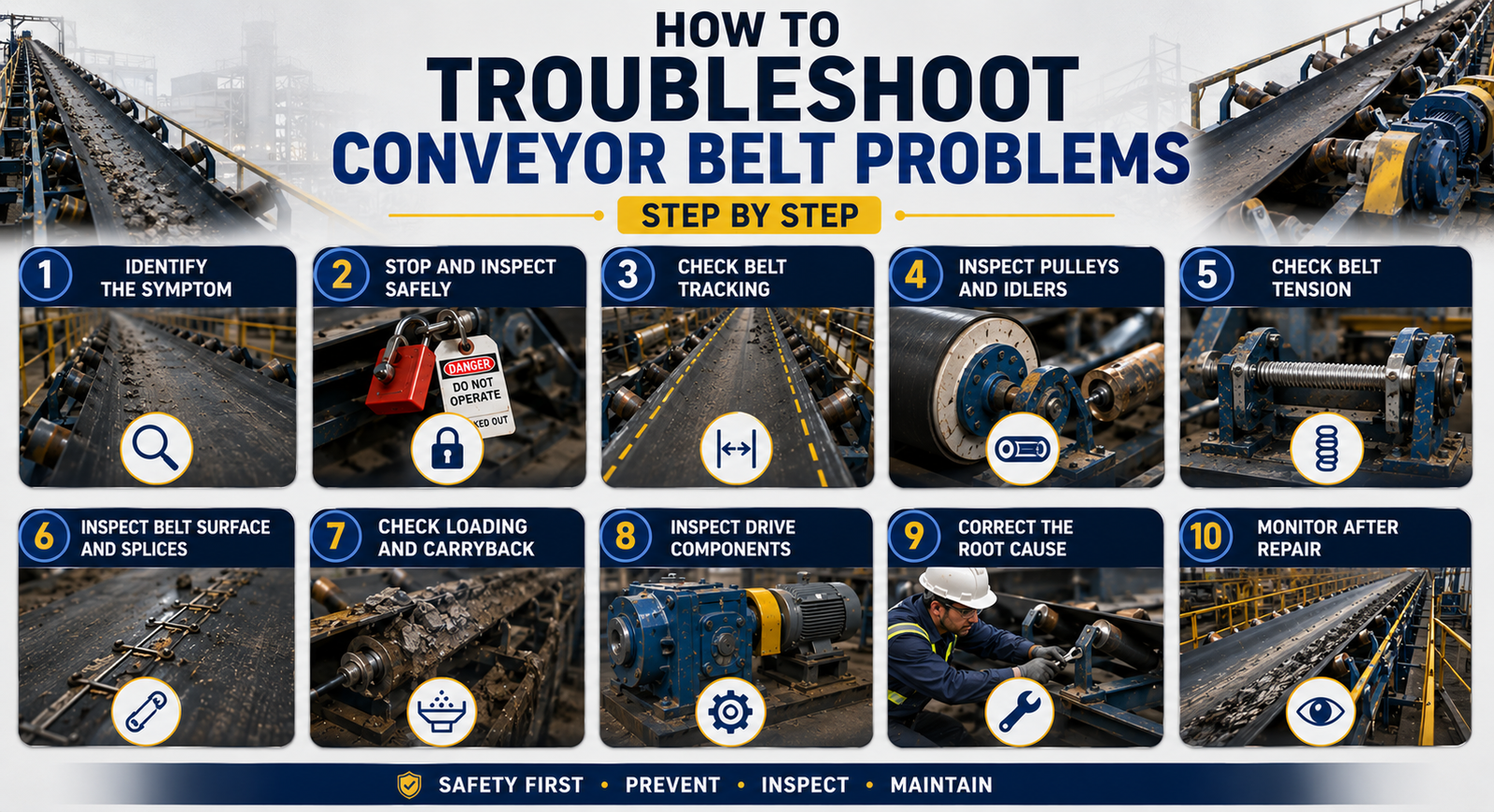
A systematic approach is more effective than making random adjustments.
Step 1: Identify the Symptom
Record exactly what is happening.
Is the belt slipping, tracking incorrectly, wearing rapidly, carrying material back or producing unusual noise?
Step 2: Stop and Inspect the Conveyor Safely
Follow the site’s lockout/tagout, isolation, and machine-safety procedures before entering hazardous areas or working on the conveyor.
Never treat an operating conveyor as safe simply because the belt appears stationary.
Step 3: Check Belt Tracking and Alignment
Inspect the belt path, pulley alignment, idler positioning and structural condition.
Step 4: Inspect Pulleys and Idlers
Look for seized rollers, worn lagging, damaged shells, buildup, vibration and abnormal rotation.
Step 5: Check Belt Tensioner
Verify the tensioning arrangement and compare actual conditions with the conveyor and belt manufacturer’s requirements.
Step 6: Inspect Belt Surface and Splices
Look for cuts, cracks, abrasion, edge damage, and splice deterioration.
Step 7: Check Material Loading and Carryback
Confirm that material enters the belt appropriately and that buildup is not changing the belt’s running conditions.
Step 8: Inspect Drive Components
Check the motor, gearbox, drive pulley and associated power-transmission components for abnormal operating conditions.
Nisuka’s SMSR gearboxes are designed for direct mounting on conveyor drive shafts and are among the company’s listed conveyor power-transmission products.
Step 9: Correct the Root Cause
Avoid treating only the visible symptom. If a belt is mistracking because an idler frame is misaligned, repeatedly adjusting the belt may not solve the underlying problem.
Step 10: Monitor the Conveyor After Repair
After corrective work, observe the conveyor under appropriate operating conditions. Confirm that the original symptom has disappeared and that no secondary problem has been introduced.
Importance of Quality Conveyor Components
Conveyor reliability depends on the interaction between the belt, pulleys, idlers, tensioning system, drive, bearings and supporting structure.
Important components include:
- Conveyor Head & Tail Drums
- Idler Rollers
- Belt Tensioners
- Conveyor Rubber Belts
- Conveyor Pulleys
- SMSR Gearboxes
- Bearings
- Plummer Blocks
- UCP Pillow Blocks
- Electric Motors
These components should be selected according to the actual application, including:
- Belt width.
- Conveyor speed.
- Material load.
- Material characteristics.
- Required belt tension.
- Environmental conditions.
- Duty cycle.
- Conveyor configuration.
- Operating temperature.
- Installation arrangement.
For example, choosing an idler solely by belt width may be insufficient if the application involves heavy impact, abrasive material or severe environmental contamination.
Similarly, a gearbox should be evaluated according to required speed, torque, duty, load characteristics and conveyor configuration rather than simply selecting a nominally compatible motor size.
For conveyor drive applications, industrial buyers may evaluate an SMSR Gearbox manufacturer in Ahmedabad based on required torque, output speed, belt load, duty cycle, mounting arrangement, operating environment and conveyor configuration.
Nisuka’s published product range includes SMSR gearboxes, Plummer Blocks, UCP Pillow Blocks, Conveyor Head & Tail Drums, Conveyor Idler Rollers, Conveyor Belt Tensioners, V-Belt Pulleys, Conveyor Rubber Belts and Electric Motors.
Why Choose the Right Conveyor Component Manufacturer?
Selecting a conveyor component manufacturer or supplier should involve more than comparing unit prices.
Industrial buyers should evaluate:
- Manufacturing capability.
- Material quality.
- Machining precision.
- Product range.
- Engineering support.
- Customization capability.
- Quality-control practices.
- Product availability.
- Delivery capability.
- After-sales support.
- Industry experience.
- Application knowledge.
For maintenance and procurement teams, technical compatibility is particularly important. A component should match the conveyor’s dimensions, load, speed, duty cycle, environmental conditions and installation arrangement.
For example, when sourcing a Conveyor Belt Tensioner manufacturer in Ahmedabad, buyers should provide sufficient conveyor information for the supplier to evaluate the required tensioning arrangement rather than selecting a tensioner solely by product name.
Likewise, buyers evaluating rotating-shaft support may need to understand the differences between bearing housings, Plummer Blocks and UCP Pillow Blocks before selecting the appropriate arrangement.
Nisuka Industries states that it has operated since 1994 and lists manufacturing of SMSR Gearboxes, Plummer Blocks, UCP Pillow Blocks, Conveyor Head & Tail Drums, Conveyor Idler Rollers, Conveyor Belt Tensioners and other industrial components among its activities.
Conclusion
Conveyor Belt Problems rarely have a single universal cause. Mistracking, slippage, premature wear, incorrect tension, carryback, pulley and idler failures, and belt damage can develop from interactions between the belt, components, loading conditions, alignment, operating environment and maintenance practices.
The most effective approach is therefore symptom → inspection → root cause → corrective action → monitoring.
Maintenance teams should pay particular attention to belt tracking, appropriate tension, pulley and idler condition, material loading, carryback, belt splices and drive components. Early identification of abnormal wear or operating behavior can help prevent a relatively localized issue from developing into a larger conveyor belt breakdown.
Component selection also matters. Head and tail drums, idler rollers, tensioners, belts, pulleys, gearboxes, bearings, Plummer Blocks, UCP Pillow Blocks and motors should be selected according to the conveyor’s actual operating requirements rather than simply by nominal size.
Nisuka Industries offers a broad portfolio of conveyor and power-transmission components for industrial applications, including Conveyor Head & Tail Drums, Idler Rollers, Belt Tensioners, Conveyor Rubber Belts, SMSR Gearboxes, pulleys, Plummer Blocks, UCP Pillow Blocks and Electric Motors.
For engineers, maintenance teams and procurement professionals dealing with recurring conveyor problems, the priority should always be to understand the application and identify the underlying mechanical cause before selecting a component or repair strategy. A qualified conveyor component manufacturer can help evaluate the relevant requirements and identify an appropriate solution for the specific system.
FAQS
1. What are the most common conveyor belt problems?
Common problems include mistracking, slippage, premature wear, incorrect tension, carryback, pulley and idler failures, and belt cuts or tears. Multiple underlying causes may produce similar symptoms, so inspection is necessary before selecting a repair.
2. What causes conveyor belt mistracking?
Mistracking can be caused by pulley or idler misalignment, uneven loading, material buildup, incorrect tension, damaged components, belt condition, or structural alignment problems. The actual cause should be established through systematic inspection.
3. How do you fix a conveyor belt that keeps slipping?
Check belt tensioner, drive-pulley traction, lagging condition, contamination, loading and drive components. Increasing tension without determining the cause may create additional mechanical loading. The corrective action should follow the conveyor and belt manufacturer’s requirements.
4. Why does a conveyor belt wear out quickly?
Premature wear can result from abrasive material, sharp material, impact, incorrect loading, tracking problems, seized idlers, material buildup, excessive tension or an unsuitable belt. Inspecting the wear pattern can help identify the source.
5. What causes conveyor belt damage?
Belt damage can result from sharp or oversized material, excessive impact, foreign objects, damaged conveyor components, poor loading conditions, splice problems, mistracking and abrasion. Repeated damage should trigger a root-cause investigation.