
How to Calculate Conveyor Belt Speed: Formula, RPM & Calculation Guide
Conveyor systems play an important role in manufacturing, mining, packaging, warehousing, and material handling. They move raw materials, finished products, and bulk goods from one location to another. For these systems to operate correctly, engineers must understand how fast the conveyor belt needs to move.
How to calculate conveyor belt speed is a common question when designing a new conveyor, checking an existing system, or selecting a suitable motor and gearbox. The speed of a conveyor belt depends mainly on the drive pulley diameter and its rotational speed, measured in revolutions per minute (RPM).
A correct Conveyor Belt Speed Calculation helps engineers estimate how quickly materials will travel through a conveyor system. It also supports decisions about production flow, material handling capacity, and drive-system requirements.
In this guide, we explain the Conveyor Belt Speed Formula, pulley RPM, unit conversions, practical numerical examples, and the relationship between motor speed and gearbox ratio. We also discuss the role of SMSR gearboxes in suitable industrial conveyor applications.
What Is Conveyor Belt Speed?
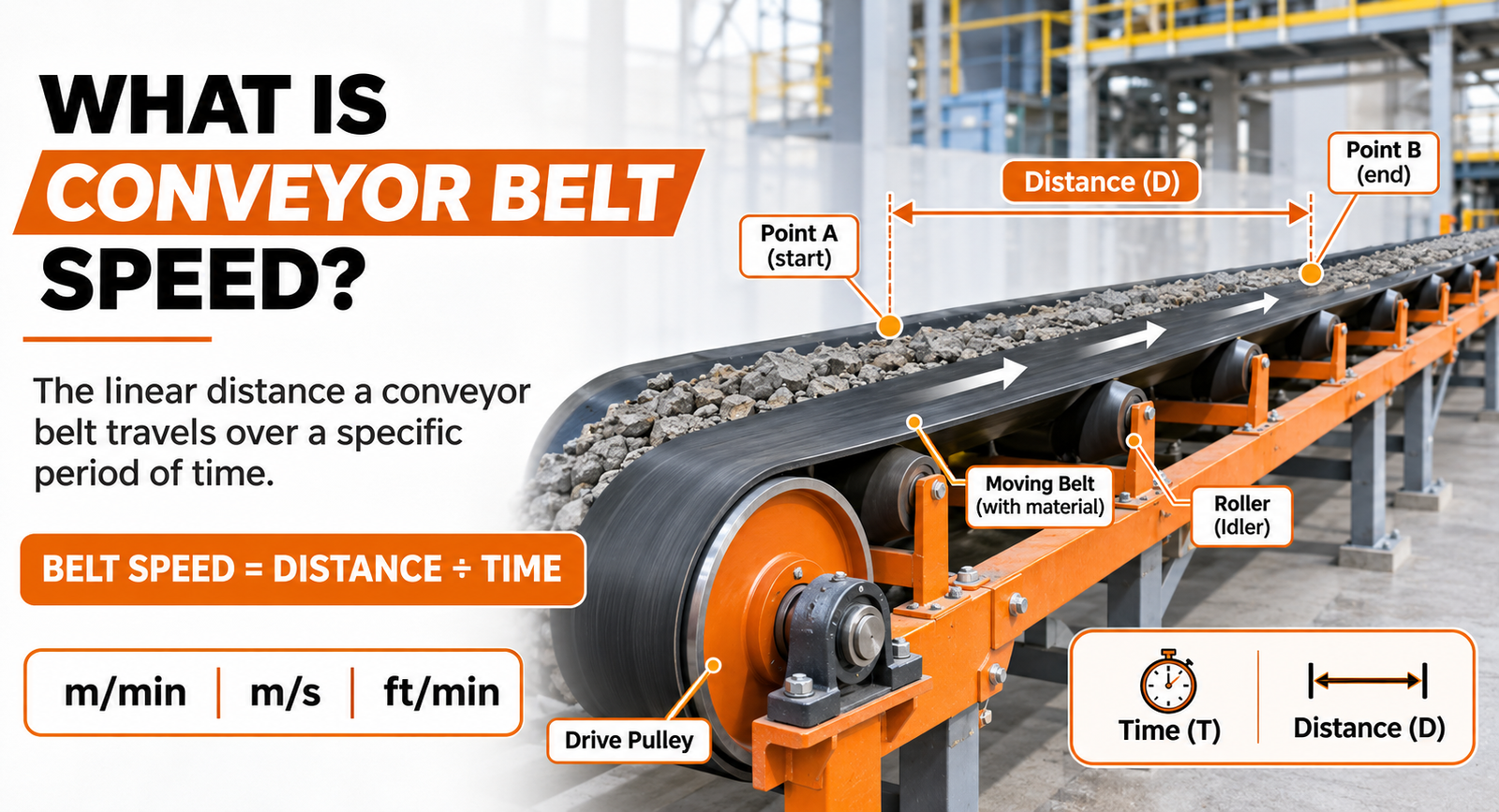
Conveyor belt speed is the linear distance travelled by a conveyor belt in a given period. It is commonly measured in meters per minute (m/min), meters per second (m/s), or feet per minute (ft/min).
For example, if a conveyor belt travels 30 meters in one minute, its belt speed is 30 m/min.
It is important to understand the difference between belt speed and pulley rotational speed. Belt speed describes the linear movement of the belt, while pulley RPM describes how many complete revolutions the pulley makes in one minute.
Understanding Conveyor Belt Velocity
Conveyor belt velocity refers to the speed at which the belt moves along its path. The drive pulley transfers rotational movement to the belt through contact and friction.
When the drive pulley rotates, it moves a certain length of belt with each revolution. That distance depends on the pulley circumference. Therefore, pulley diameter and RPM determine the theoretical linear speed of the belt.
Why Conveyor Belt Speed Is Important in Industrial Applications
The correct conveyor speed helps maintain the required material flow and production rate. Different applications have different speed requirements.
For example:
- Manufacturing lines need suitable speeds to move products between production stages.
- Packaging conveyors need controlled movement to coordinate with filling, sealing, and labeling equipment.
- Mining conveyors transport bulk materials over different distances and layouts.
- Warehouse conveyors move packages between sorting, storage, and dispatch areas.
- Processing plants require controlled material movement to match production requirements.
A conveyor operating too quickly or too slowly can a
What Is Pulley RPM in a Conveyor System?
Pulley RPM means the number of complete revolutions made by a conveyor pulley in one minute. In a typical belt conveyor, the drive pulley rotates and moves the belt.
The drive pulley RPM is an important value in a Conveyor Belt Speed Calculation because it determines how many times the pulley circumference passes through the belt in one minute.
What Is Conveyor Pulley RPM?
If a drive pulley rotates at 60 RPM, it completes 60 revolutions in one minute.
If its circumference is 0.7854 meters, the theoretical belt movement is
0.7854 × 60 = 47.124 meters per minute.
This means the belt travels approximately 47.12 m/min, assuming there is no slip and the effective pulley diameter is 250 mm.
How Pulley Diameter Affects Conveyor Belt Speed
A larger pulley has a greater circumference than a smaller pulley. As a result, it moves more belt length during each revolution.
For example, a 300 mm pulley moves more belt length per revolution than a 200 mm pulley when both rotate at the same RPM.
How Pulley RPM Affects Conveyor Belt Speed
When pulley diameter remains unchanged, increasing pulley RPM increases theoretical belt speed.
For example, a 250 mm pulley rotating at 40 RPM produces a lower theoretical belt speed than the same pulley rotating at 80 RPM.
However, pulley RPM must remain within the mechanical and operating limits of the conveyor system.
What Is the Conveyor Belt Speed Formula?
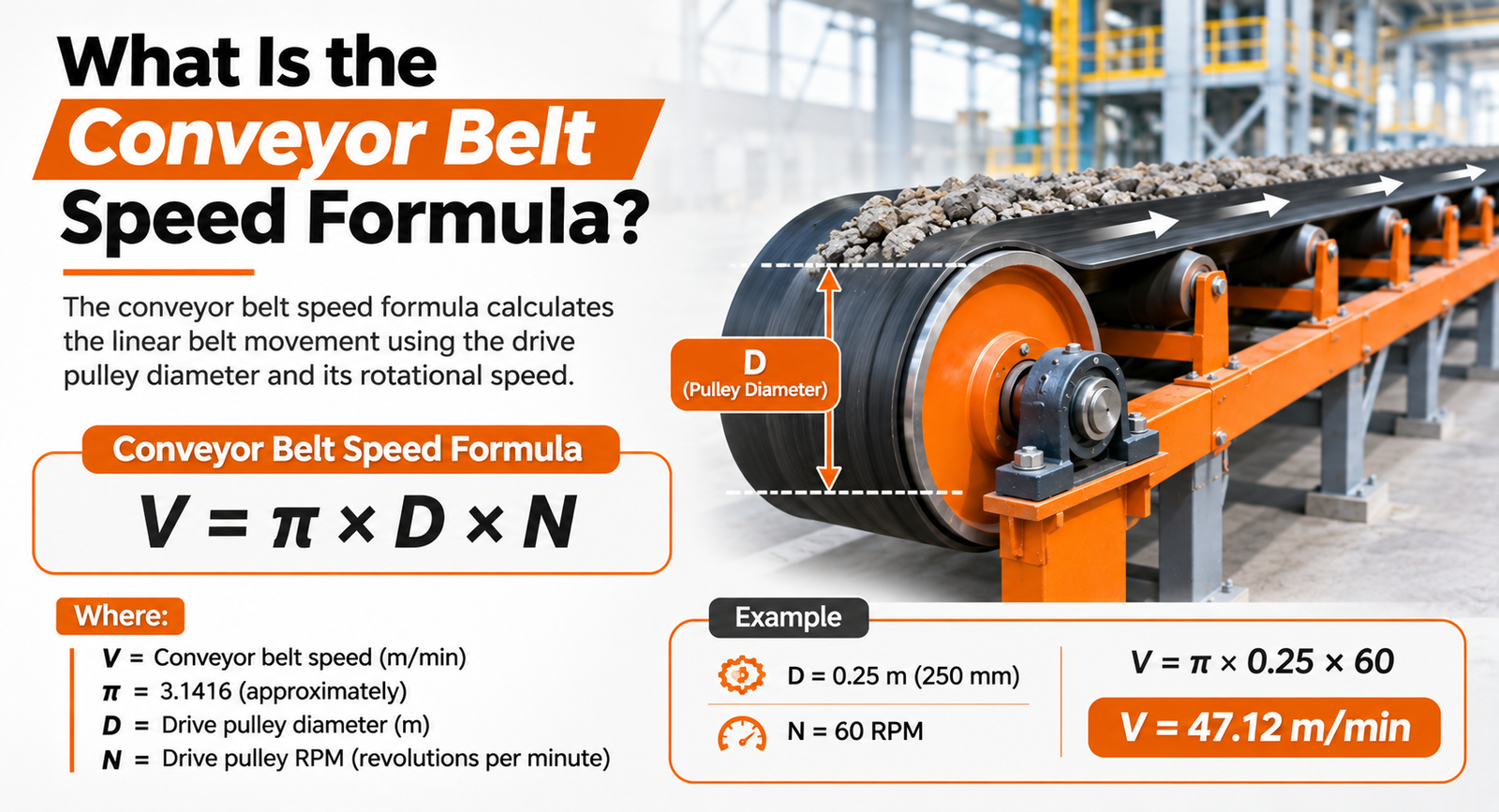
The standard Conveyor Belt Speed Formula is:
Conveyor Belt Speed = Pulley Circumference × Pulley RPM
Pulley circumference is calculated as
Pulley Circumference = π × Pulley Diameter
Therefore:
Conveyor Belt Speed = π × D × RPM
Where:
- D = Drive pulley diameter
- RPM = Drive pulley rotational speed
- π = Approximately 3.14159
- Belt speed = Linear movement of the belt per minute when consistent units are used
The formula calculates theoretical belt speed. Actual operating speed can differ because of belt slip, effective pulley diameter, drive conditions, and other system characteristics.
Conveyor Belt Speed Formula in Meters per Minute
When pulley diameter is measured in meters, use:
Belt Speed (m/min) = π × Pulley Diameter (m) × RPM
For example:
- Pulley diameter = 0.25 m
- Pulley RPM = 60
Belt Speed = 3.14159 × 0.25 × 60
Belt Speed = 47.12 m/min
This is the standard method for calculating Conveyor Belt Speed in Meters per Minute when the pulley diameter is available in meters.
Conveyor Belt Speed Formula Using Pulley Diameter in Millimeters
Industrial pulley dimensions are often measured in millimeters. In that case, use:
Belt Speed (m/min) = π × Pulley Diameter (mm) × RPM ÷ 1000
Dividing by 1000 converts the pulley diameter from millimeters to meters.
For example, for a 250 mm pulley rotating at 60 RPM:
Belt Speed = 3.14159 × 250 × 60 ÷ 1000
Belt Speed = 47.12 m/min
Conveyor Belt Speed Formula in Meters per Second
To convert belt speed from meters per minute to meters per second:
Belt Speed (m/s) = Belt Speed (m/min) ÷ 60
For a conveyor operating at 47.12 m/min:
47.12 ÷ 60 = 0.785 m/s
Therefore, the theoretical belt speed is approximately 0.785 m/s.
How to Calculate Conveyor Belt Speed Step by Step
Follow these steps to Calculate Speed of Conveyor Belt using the drive pulley dimensions and rotational speed.
Step 1 – Identify the Drive Pulley Diameter
First, identify the diameter of the drive pulley responsible for moving the belt.
Use the appropriate effective diameter for the calculation. Depending on the pulley construction and belt arrangement, the effective diameter at the belt contact surface may differ from a basic shaft or hub measurement.
Also confirm whether the measurement is in millimeters or meters.
Step 2 – Determine the Drive Pulley RPM
Find the actual rotational speed of the drive pulley.
You may obtain this value from equipment documentation, a suitable speed measurement instrument, or the drive-system calculation.
Do not automatically use motor RPM as pulley RPM. If a gearbox or another transmission arrangement is installed between the motor and pulley, the output speed will be different.
Step 3 – Apply the Conveyor Belt Speed Formula
Use:
Belt Speed (m/min) = π × Pulley Diameter (m) × Pulley RPM
Alternatively, when diameter is in millimeters:
Belt Speed (m/min) = π × Pulley Diameter (mm) × RPM ÷ 1000
Enter the correct values and calculate the result.
Step 4 – Convert the Result into the Required Unit
Depending on the application, the calculated speed may need to be expressed in m/min, m/s or ft/min.
Use the appropriate conversion formula and maintain consistent units.
Step 5 – Verify the Calculated Conveyor Speed
The formula gives a theoretical result. Compare it with the actual conveyor operating requirements.
Check the drive arrangement, belt condition, loading, pulley condition and possible slip. If accurate operating speed is important, measure the moving belt using a suitable speed-measuring instrument.
You can explore Conveyor Belt Tensioner Manufacturer in India for information about conveyor belt tensioner-related products and content.
How to Calculate Conveyor Belt Speed—Practical Examples
The following examples demonstrate how the formula works. These are simplified calculations, not specifications for any particular Nisuka product.
Example 1 – Conveyor Speed with a 200 mm Pulley
Assume:
- Drive pulley diameter = 200 mm
- Drive pulley RPM = 60 RPM
Formula:
Belt Speed (m/min) = π × D × RPM ÷ 1000
Substitute the values:
= 3.14159 × 200 × 60 ÷ 1000
= 37.699 m/min
Answer: The theoretical conveyor belt speed is approximately 37.70 m/min.
This means the belt travels approximately 37.70 meters in one minute under the stated assumptions.
Example 2 – Conveyor Speed with a 300 mm Pulley
Assume:
- Drive pulley diameter = 300 mm
- Drive pulley RPM = 45 RPM
Calculation:
Belt Speed = 3.14159 × 300 × 45 ÷ 1000
= 42.4115 m/min
Answer: The theoretical conveyor belt speed is approximately 42.41 m/min.
The larger pulley moves more belt length per revolution. Its RPM is lower than in Example 1, but the resulting belt speed is higher because the pulley diameter is larger.
Example 3 – Calculate Conveyor Belt Speed in Meters per Second
Assume:
- Drive pulley diameter = 250 mm
- Drive pulley RPM = 80 RPM
First, calculate the speed in meters per minute:
Belt Speed = 3.14159 × 250 × 80 ÷ 1000
= 62.8318 m/min
Now convert the result into meters per second:
Belt Speed (m/s) = 62.8318 ÷ 60
= 1.0472 m/s
Answer: The theoretical belt speed is approximately 62.83 m/min or 1.05 m/s.
Example 4 – Calculate Drive Pulley RPM from Required Belt Speed
Sometimes engineers know the required belt speed and pulley diameter but need to determine the required pulley RPM.
Assume:
- Required belt speed = 30 m/min
- Drive pulley diameter = 250 mm or 0.25 m
First, calculate pulley circumference:
Circumference = π × 0.25
= 0.7854 m
Now calculate pulley RPM:
Pulley RPM = Belt Speed ÷ Pulley Circumference
= 30 ÷ 0.7854
= 38.20 RPM
Answer: The required theoretical drive pulley speed is approximately 38.20 RPM.
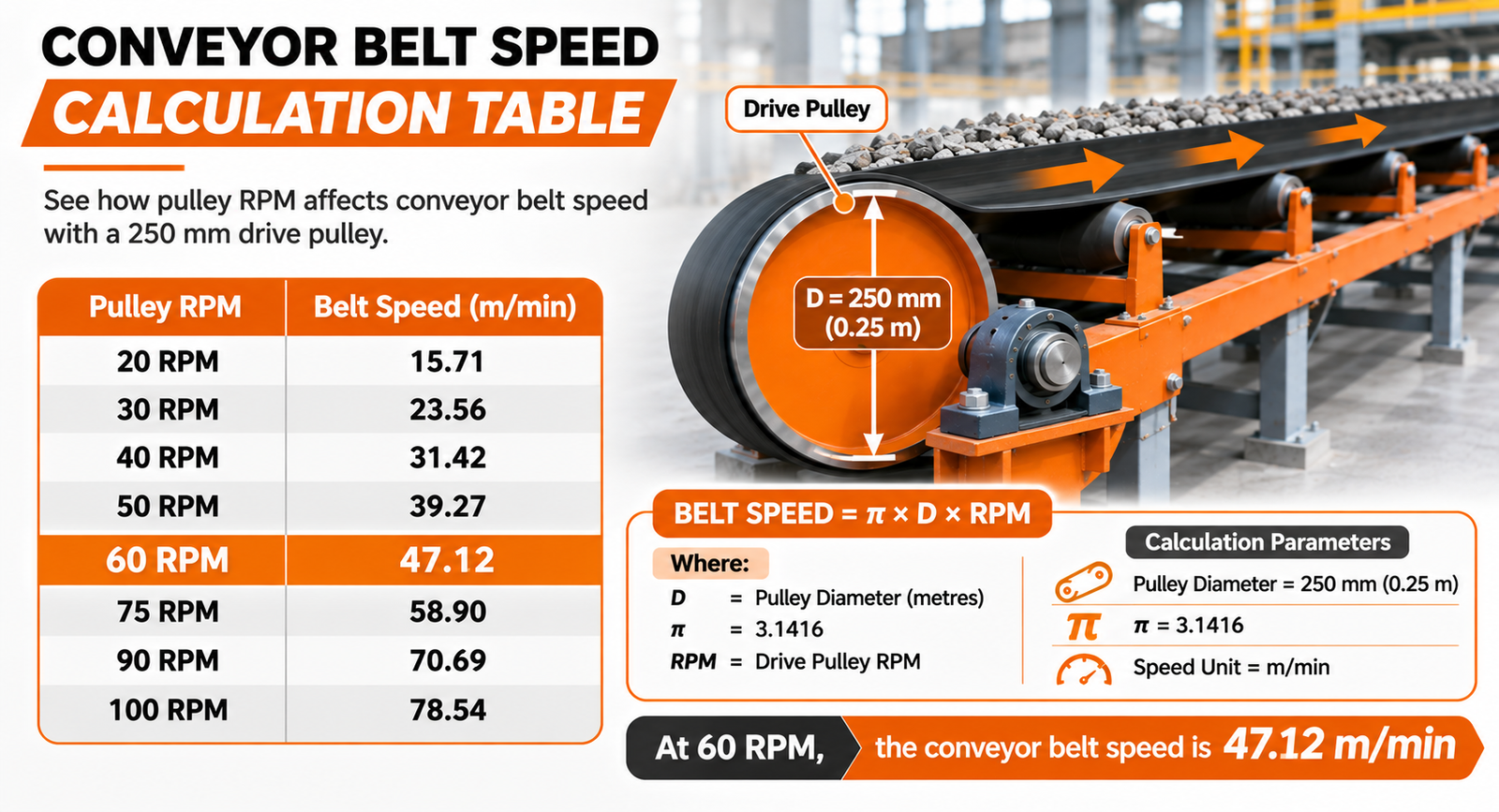
Conveyor Belt Speed Calculation Table
How Does Pulley RPM Affect Conveyor Belt Speed?
Pulley RPM determines how many times the pulley circumference moves through the belt in one minute.
1. increasing Pulley RPM
When pulley diameter remains constant, increasing pulley RPM increases theoretical conveyor belt speed.
For example, a 250 mm pulley operating at 40 RPM produces approximately 31.42 m/min. At 80 RPM, the theoretical speed becomes approximately 62.83 m/min.
Any speed increase must remain within the permitted operating limits of the conveyor, belt, drive and connected equipment.
2. Reducing Pulley RPM
Reducing pulley RPM lowers theoretical belt speed. This can be achieved through a suitable gearbox ratio or an appropriate speed-control arrangement, depending on the drive design.
A lower speed may be needed when material flow, process timing or equipment requirements call for slower movement.
Role of Motor and Gearbox in Conveyor Belt Speed
A conveyor motor supplies rotational power to the drive system. When a reduction gearbox is installed, it reduces the motor’s rotational speed and provides the output speed required by the driven equipment.
The calculation chain is:
Motor RPM → Gearbox Ratio → Drive Pulley RPM → Conveyor Belt Speed
The basic relationship for a reduction gearbox is:
Gearbox Output RPM = Motor RPM ÷ Gearbox Ratio
Example:
Assume:
- Motor speed = 1440 RPM
- Gearbox reduction ratio = 20:1
- Drive pulley diameter = 250 mm
First, calculate gearbox output speed:
1440 ÷ 20 = 72 RPM
Assuming the drive pulley rotates at the gearbox output speed:
Belt Speed = 3.14159 × 0.25 × 72
= 56.55 m/min
The theoretical conveyor belt speed is approximately 56.55 m/min.
This simplified example assumes a direct relationship between gearbox output and pulley speed. Additional transmission components, if present, must also be considered.
For a detailed explanation, read How to Calculate Gearbox Ratio and Output RPM.
Factors to Consider When Selecting Conveyor Belt Speed
The correct conveyor speed depends on the complete application. Engineers should evaluate the following factors before finalizing a conveyor operating speed.
1. Material Being Conveyed
Material size, weight, shape, moisture content, abrasiveness, and flow characteristics can influence the required speed. Fragile products may need controlled movement, while bulk material systems require consideration of loading and transfer conditions.
2. Conveyor Load and Material Flow
The amount of material transported over a given period affects conveyor operating requirements. Engineers should consider the required flow rate, material distribution and loading conditions rather than selecting speed based on RPM alone.
3. Conveyor Length and Layout
Long conveyors, inclined systems, and conveyors with multiple transfer points may have different design requirements. The complete layout should be reviewed to ensure suitable material movement and drive performance.
4. Pulley Diameter
Pulley diameter determines the belt length moved during each revolution. The selected diameter must be compatible with the belt, shaft, bearings, and conveyor design.
5. Drive Motor and Gearbox
Motor speed and gearbox ratio determine the available drive speed. The motor and gearbox should be selected according to the required output RPM, torque, load characteristics, and operating duty.
6. Belt Type and Conveyor Design
Different belt constructions and conveyor arrangements have different operating requirements. Belt strength, width, flexibility, surface characteristics, and manufacturer recommendations should be considered.
7. Operating Environment
Dust, temperature, moisture, chemical exposure, and other environmental conditions may influence conveyor component selection and operating requirements.
8. Safety and Material Handling Requirements
The conveyor speed should support safe material movement, suitable transfer conditions and the operating requirements of connected machinery. Guards, emergency stops, and other safety provisions must also be considered in the system design.
How to Calculate Conveyor Belt Speed for Industrial Applications
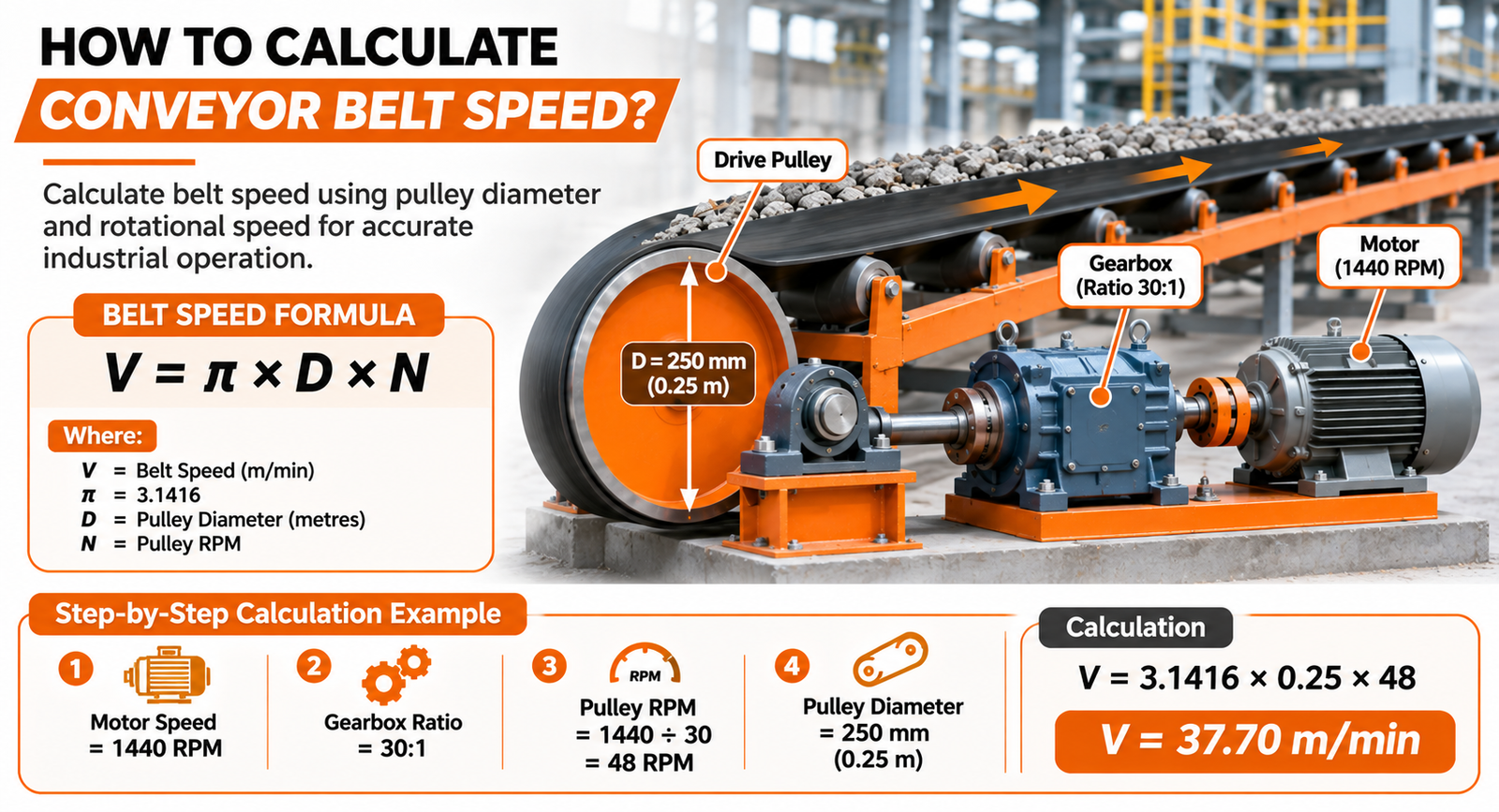
A Belt Conveyor Speed calculation is useful in several industrial environments. However, the required speed varies according to the process and equipment.
Conveyor Speed in Manufacturing Lines
Manufacturing lines use conveyors to move components and products between workstations. The belt speed must be coordinated with production cycle times and the capacity of connected machines.
Conveyor Speed in Material Handling Systems
Bulk material handling systems transport materials between storage, processing and dispatch areas. Engineers must consider material flow, loading, conveyor layout and the required transport rate.
Conveyor Speed in Packaging and Processing
Packaging systems may require controlled movement to coordinate with filling, labeling, inspection, and sealing operations. A suitable speed helps maintain synchronization between conveyor movement and processing equipment.
Selecting the Required Conveyor Operating Speed
The required speed should be determined from the production process, material characteristics, loading conditions, and conveyor design.
Engineers should not assume that a particular RPM or pulley diameter will suit every installation. The complete drive arrangement must be checked before selecting the final operating speed.
Explore SMSR Gearbox manufacturer in Ahmedabad to learn more about Nisuka’s published gearbox range. For application selection, the required motor speed, output RPM, torque, load, mounting arrangement, and duty conditions should be confirmed.
Conclusion – Calculate the Right Conveyor Belt Speed for Your Application
Understanding How to calculate conveyor belt speed helps engineers determine the linear movement of a conveyor belt using drive pulley diameter and RPM. The basic formula is Belt Speed = π × Pulley Diameter × Pulley RPM. When the pulley diameter is measured in meters, the result is obtained in meters per minute. When it is measured in millimeters, divide the result by 1000.
However, accurate conveyor speed calculation requires more than entering two values into a formula. Engineers must distinguish motor RPM from drive pulley RPM, consider the gearbox reduction ratio, and check the actual operating conditions. Material characteristics, loading, belt construction, conveyor layout, and process requirements also influence the final speed selection.
For suitable conveyor drive applications, an SMSR gearbox can help reduce motor speed to the required output speed. Nisuka Industries publishes SMSR gearboxes and a range of related conveyor components for industrial applications.
For further industrial gearbox information, read How Industrial Gearboxes for Cement Industry Applications Improve Efficiency.
FAQS
1. How do industrial gearboxes improve efficiency in cement manufacturing?
Multiply the drive pulley circumference by its RPM. The formula is Belt Speed = π × Pulley Diameter × RPM. If the diameter is in meters, the result is in meters per minute. If it is in millimeters, divide the result by 1000 to obtain m/min.
2. How do you calculate conveyor belt speed in meters per minute?
Use Belt Speed (m/min) = π × Pulley Diameter (m) × Pulley RPM. If the pulley diameter is in millimeters, use π × Diameter (mm) × RPM ÷ 1000.
3. How does pulley RPM affect conveyor speed?
When pulley diameter remains unchanged, increasing pulley RPM increases theoretical conveyor speed. Reducing RPM decreases it. Actual speed may differ because of belt slip and other operating conditions.
4. How does a gearbox affect conveyor belt speed?
A reduction gearbox lowers the motor’s rotational speed according to its reduction ratio. Its output speed determines the drive pulley speed when directly connected. The pulley diameter and output RPM then determine theoretical conveyor belt speed.