
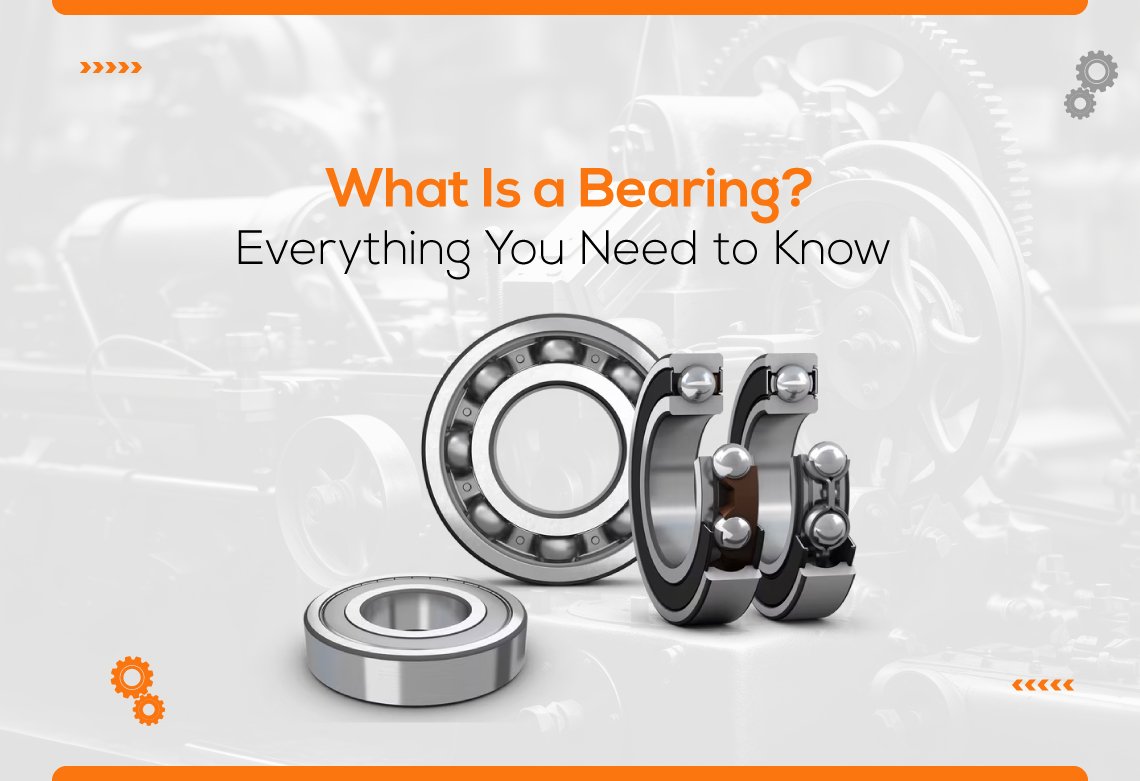
What Is a Bearing? Everything You Need to Know
A bearing is a mechanical component that supports moving or rotating parts while reducing friction and controlling their movement. In rotating machinery, bearings support shafts, transmit loads, maintain shaft position, and allow smooth rotation between moving and stationary components.
Understanding what is a bearing is essential for anyone working with industrial machinery. Motors, pumps, conveyors, gearboxes, fans, crushers, agricultural equipment, and material-handling systems all depend on appropriately selected bearing arrangements.
Bearings are not simply friction-reduction devices. They help control shaft movement, accommodate radial and axial loads, maintain the relationship between rotating and stationary components, and contribute to reliable machine operation. Different designs use balls, rollers, or sliding surfaces depending on the application.
Industrial environments can make bearing selection particularly demanding. Steel plants, cement plants, mines, power-generation facilities, paper mills, textile machinery, sugar mills, and conveyor systems may expose bearings to high loads, vibration, dust, moisture, temperature changes, shock, and long operating cycles.
Selecting the correct bearing therefore requires more than matching a shaft diameter. Load, speed, temperature, contamination, lubrication, alignment, mounting arrangement, available space, and maintenance requirements all need to be considered.
This guide explains the bearing meaning, how bearings work, major bearing types, bearing components, industrial applications, selection criteria, maintenance practices, common failure causes, and procurement considerations.
What Is a Bearing?
A bearing is a mechanical component that supports and guides moving parts while reducing friction between contacting surfaces. It allows controlled movement, carries machine loads, maintains shaft position, and helps transfer forces between rotating and stationary components.
In a rotating machine, a bearing typically supports a shaft while allowing it to rotate relative to a housing or machine structure. The bearing controls the contact between the moving shaft and its support so that the machine can operate with less friction and wear.
The main functions of a bearing include:
- Supporting radial loads
- Supporting axial loads where the design permits
- Reducing friction
- Controlling shaft movement
- Maintaining shaft position
- Transmitting loads into the machine structure
- Supporting rotational movement
- Helping manage alignment
- Reducing wear between moving components
The exact function depends on bearing construction. A deep groove ball bearing, cylindrical roller bearing, spherical roller bearing, thrust bearing, and plain bearing do not perform identically.
This is why the bearing definition should be understood as more than “a component that reduces friction.” A bearing is part of a complete mechanical system involving the shaft, housing, lubricant, load, alignment, and operating environment.
For example, a conveyor pulley may use bearings at both ends of its shaft. The bearings support the pulley assembly and transfer loads into the supporting structure while allowing the shaft to rotate.
How Does a Bearing Work?
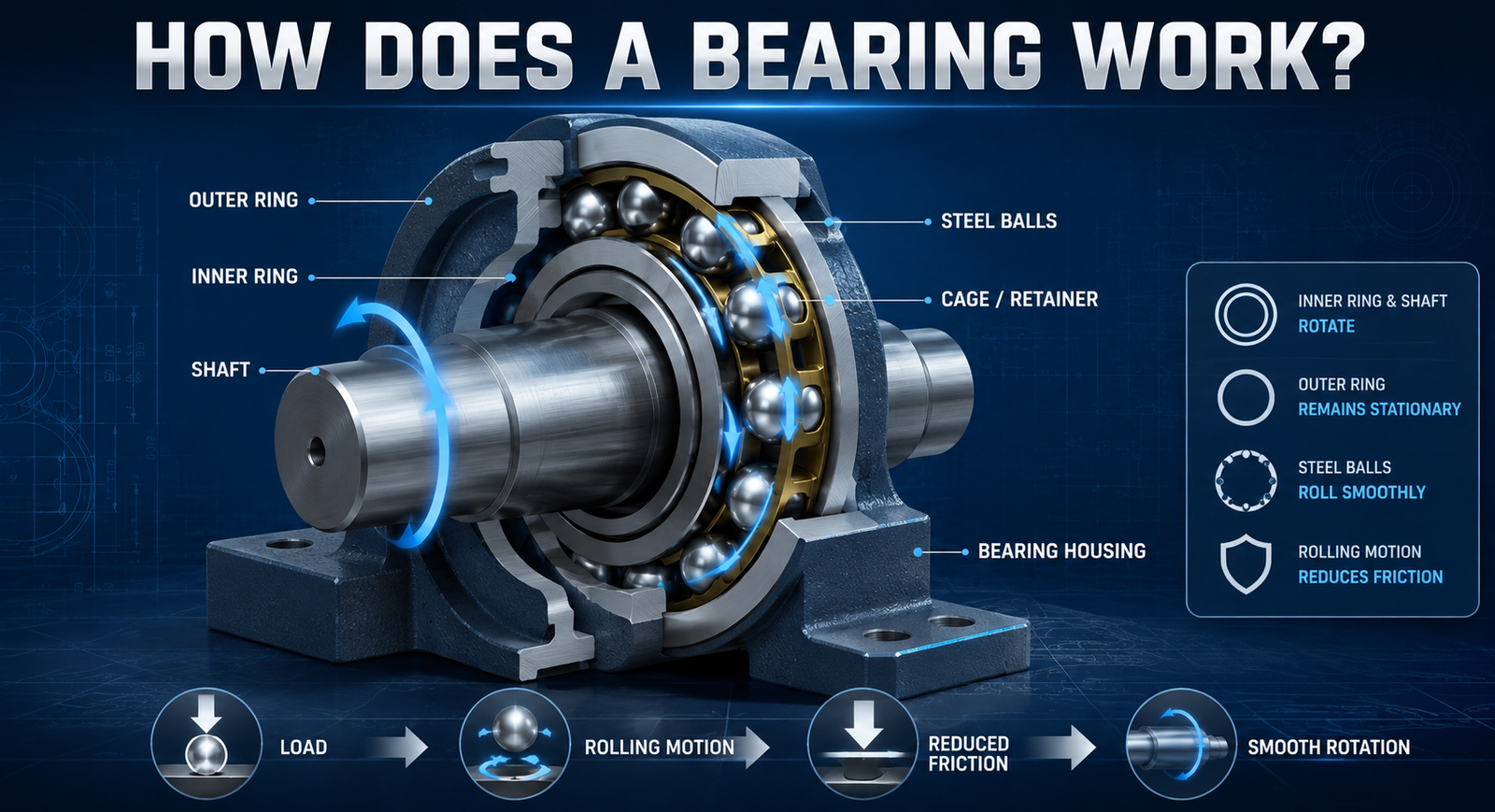
A bearing works by controlling contact between moving and stationary components so that motion occurs with reduced resistance while the bearing carries the required load. Rolling bearings use balls or rollers; plain bearings use controlled sliding surfaces.
In a rolling-element bearing, the shaft is connected to or supported by the inner ring, while the outer ring is supported by the housing. Balls or rollers move between the two rings.
The basic operating process is:
- The shaft or bearing ring rotates.
- The applied load acts on the bearing.
- Rolling elements transfer the load between the inner and outer rings.
- The cage keeps rolling elements appropriately spaced.
- Lubricant reduces friction and surface damage.
- Seals or shields can help retain lubricant and control contamination.
- Correct clearance and alignment allow the bearing to operate properly.
Rolling Contact vs Sliding Contact
Rolling-element bearings use balls or rollers between surfaces. Instead of two surfaces sliding directly against each other, the rolling elements provide controlled rolling contact.
Plain or sliding bearings work differently. Their surfaces slide relative to each other, normally with a suitable material and lubrication system.
Neither approach is automatically suitable for every machine. How bearings work must be evaluated alongside the load, speed, temperature, space, lubrication, alignment, and operating environment.
A conveyor shaft is a simple example. The shaft needs to rotate continuously while the supporting structure remains stationary. A suitable bearing arrangement transfers the shaft loads to the structure while permitting rotation.
What Are the Main Components of a Bearing?
A typical rolling-element bearing consists of several components designed to work together.
1. Inner Ring
The inner ring normally interfaces with the shaft. It contains the internal raceway on which the rolling elements operate.
The shaft-to-inner-ring relationship is important. An incorrect fit can result in movement between components, excessive stress, or difficulty during installation.
2. Outer Ring
The outer ring normally interfaces with the housing or machine structure. Its raceway forms the second rolling contact surface.
The outer ring and housing must provide appropriate support without creating harmful distortion or alignment problems.
3. Rolling Elements
Rolling elements carry the load between the rings.
Common forms include:
- Balls: Used in many ball-bearing designs and suitable for a wide range of applications.
- Cylindrical rollers: Provide line contact and are commonly used where high radial load capability is required.
- Tapered rollers: Designed for applications involving radial and axial loads in suitable arrangements.
- Spherical rollers: Used where high radial loading and accommodation of certain misalignment conditions are important.
- Needle rollers: Long, relatively small-diameter rollers used where compact radial dimensions are required.
4. Cage
The cage maintains spacing between rolling elements and guides their movement. It helps prevent excessive rolling-element-to-rolling-element contact.
5. Seals and Shields
Seals and shields help control the internal bearing environment. Depending on their design, they can help retain lubricant and reduce the entry of dust, moisture, and other contaminants.
6. Lubricant
Grease or oil reduces friction, controls heat, minimizes wear, and protects bearing surfaces.
Lubrication is one of the most important factors influencing bearing performance and service life.
What Are the Different Types of Bearings?
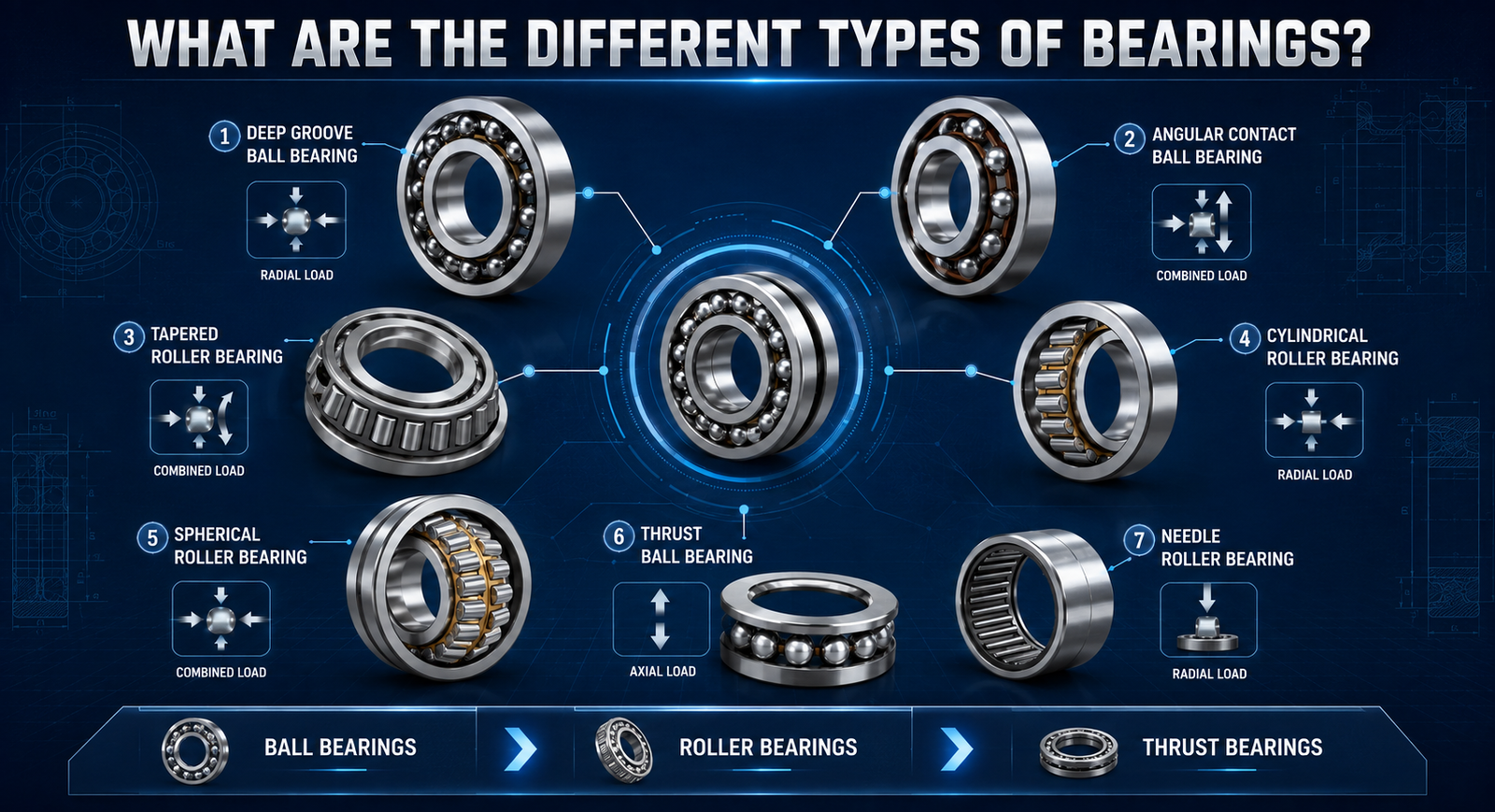
Different bearing designs exist because machines experience different combinations of load, speed, alignment, temperature, space, and environmental conditions.
1. Deep Groove Ball Bearings
Deep groove ball bearings are widely used for general rotating machinery. Their design can accommodate radial loads and, depending on the arrangement, certain axial loads.
They are common in motors, pumps, fans, and general industrial equipment.
2. Angular Contact Bearings
Angular contact bearings are designed to carry radial and axial loads in appropriate configurations. They are frequently used where axial forces are important alongside radial loading.
3. Cylindrical Roller Bearings
Cylindrical roller bearings use rollers rather than balls and provide line contact. They are commonly considered for applications requiring substantial radial load capability.
4. Tapered Roller Bearings
Tapered roller bearings are designed to handle radial and axial loads in suitable arrangements. They are often found in machinery where combined loading is significant.
5. Spherical Roller Bearings
Spherical roller bearings are commonly selected for high radial loading and applications where the bearing arrangement needs to accommodate certain shaft or housing misalignment conditions.
6. Needle Roller Bearings
Needle bearings use relatively small-diameter rollers and can provide useful load capability within compact radial spaces.
7. Thrust Bearings
Thrust bearings are primarily designed for axial loading. They are used where forces act substantially along the shaft axis.
8. Mounted Bearings
Mounted units such as pillow blocks and UCP units combine a bearing insert with a housing, making them practical for many shaft-support applications.
What Is a Pillow Block Bearing?
A pillow block bearing is a mounted bearing unit in which a bearing insert is installed inside a housing that can be fixed to a machine structure. It provides shaft support while simplifying mounting and replacement in many industrial applications.
A typical pillow block arrangement includes:
- Bearing housing
- Bearing insert
- Mounting base
- Shaft-locking arrangement appropriate to the design
- Sealing arrangement
- Lubrication provision where applicable
Pillow block units are commonly used in:
- Conveyor systems
- Material-handling equipment
- Agricultural machinery
- Fans
- Packaging machinery
- General industrial equipment
The housing supports the bearing while the insert provides the rolling interface for the shaft.
When selecting Pillow Block Bearings, engineers should consider shaft diameter, radial and axial loads, operating speed, temperature, contamination, alignment, lubrication, mounting arrangement, and expected service conditions.
For readers researching suppliers, a related internal resource such as Top 10 Pillow Block Manufacturers in India can be useful when comparing manufacturers and understanding procurement considerations.
Nisuka Industries can also be considered as an Indian industrial component manufacturer relevant to pillow block bearings, bearing housings, and related power-transmission components. Actual product selection should be based on the technical requirements of the machine.
What Is a Plummer Block?
A plummer block is a housed bearing arrangement used to support a rotating shaft, particularly in industrial machinery where robust shaft support and maintenance accessibility are important
Many plummer block designs use split housings. This can make bearing inspection and replacement more accessible because the housing can be opened without necessarily removing the entire shaft assembly, depending on the machine design.
Plummer blocks are commonly encountered in:
- Mining equipment
- Cement plants
- Steel plants
- Conveyors
- Material-handling machinery
- Heavy engineering equipment
- Crushers and associated systems
The terminology is not completely uniform across industries and regions. In some markets, “pillow block” and “plummer block” can be used differently. Therefore, buyers should verify the actual housing design, bearing arrangement, and mounting method.
Companies researching regional suppliers may also use resources such as Plummer Block Manufacturer in Ahmedabad, Top 10 Plummer Block Manufacturers in Hyderabad, and Top 10 Plummer Block Manufacturers in West Bengal when evaluating available manufacturing sources.
How to Choose the Right Bearing?
The right bearing is selected by matching the bearing design to the application’s load, speed, shaft dimensions, temperature, environment, alignment, lubrication, mounting arrangement, and required service life.
A practical selection process is:
- Determine the load type. Identify radial, axial, combined, and shock loads.
- Calculate or estimate the required load capacity. Use actual machine information wherever possible.
- Determine operating speed. Consider both normal and peak speeds.
- Check shaft diameter. Confirm the bearing bore and shaft interface.
- Consider operating temperature. Temperature affects lubricant and bearing materials.
- Evaluate contamination. Consider dust, water, process material, chemicals, and other contaminants.
- Determine lubrication requirements. Select grease or oil based on the machine and bearing requirements.
- Check available space. Consider bearing dimensions and surrounding components.
- Consider shaft and housing alignment. Determine whether misalignment may occur.
- Consider shock and vibration. Heavy-duty machinery may require a different bearing arrangement from lightly loaded equipment.
- Evaluate expected service life. Consider both calculated life and actual operating conditions.
- Confirm housing and mounting requirements. Check the complete bearing unit, not just the bearing itself.
Procurement teams should provide suppliers with as much application information as possible. A bearing designation without application details may not be sufficient to determine whether a replacement is technically appropriate.
What Causes Bearing Failure?
Bearing failure can result from lubrication problems, contamination, misalignment, overloading, incorrect installation, unsuitable fits, vibration, temperature, corrosion, electrical damage, or fatigue.
If a plant is experiencing repeated equipment breakdowns, bearing failure should also be evaluated in the broader context of machine design and maintenance. An internal guide such as Top 10 Causes of Industrial Equipment Failure can provide useful context for investigating recurring failures.
How to Maintain Industrial Bearings
Industrial bearing maintenance involves controlling lubrication, contamination, alignment, temperature, vibration, installation condition, and mounting integrity while identifying abnormal operating conditions early.
Recommended practices include:
- Inspect bearings regularly.
- Check lubrication condition.
- Follow appropriate relubrication practices.
- Monitor vibration where practical.
- Monitor bearing or housing temperature.
- Control dust and moisture.
- Check shaft alignment.
- Inspect bearing housings.
- Check mounting fasteners.
- Inspect seals.
- Investigate abnormal noise.
- Maintain records of recurring failures.
- Plan replacement for critical equipment when appropriate.
Industrial Applications of Bearings
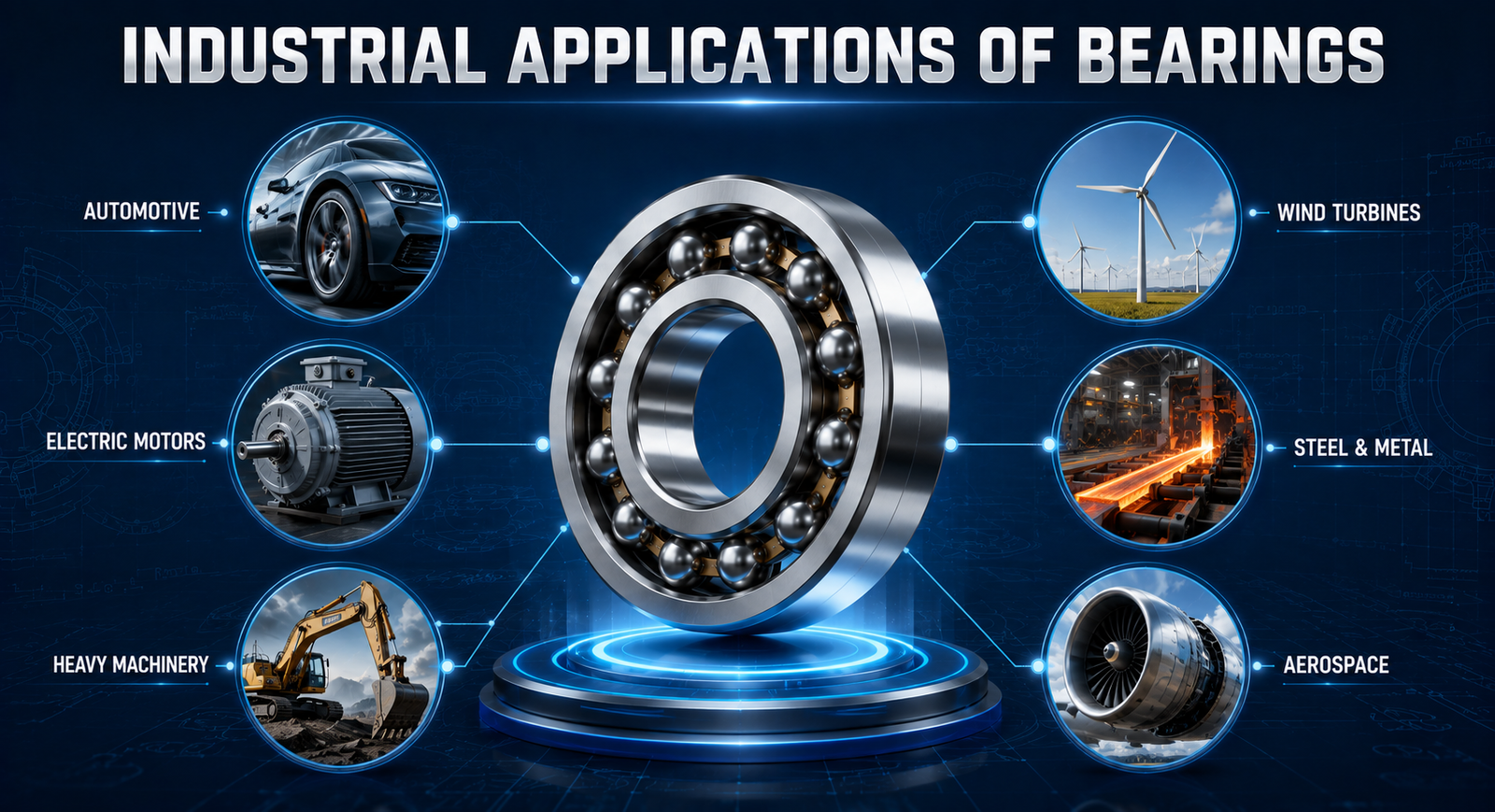
Bearings are used throughout industrial machinery wherever controlled movement and load support are required.
1. Steel Plants
Steel plants use bearings in conveyors, rollers, fans, pumps, motors, gearboxes, and other rotating equipment. Applications can involve high loads, vibration, heat, water, dust, and continuous operation.
2. Cement Plants
Cement plants use bearings in conveyors, crushers, fans, mills, pumps, and material-handling equipment. Dust contamination is an important consideration in many areas.
3. Mining
Mining machinery may expose bearings to heavy loads, shock, vibration, abrasive dust, and difficult maintenance conditions.
4. Power Plants
Fans, pumps, motors, conveyors, and auxiliary rotating machinery depend on appropriate bearing arrangements.
5. Conveyor Systems
Bearings support shafts, pulleys, rollers, and drive assemblies throughout conveyor systems.
6. Material Handling
Material-handling systems use bearings in rollers, pulleys, drive shafts, and other rotating components.
7. Textile Machinery
Textile machinery can require bearings that operate at controlled speeds with suitable vibration, lubrication, and contamination management.
8. Paper Mills
Paper machinery includes numerous rotating shafts and rollers and may require careful consideration of speed, moisture, temperature, load, and continuous operation.
9. Sugar Mills
Sugar mills use bearings in conveyors, rollers, pumps, drives, and other machinery exposed to demanding operating conditions.
10. Food Processing and Packaging
Food-processing and packaging equipment may require special consideration of contamination control, cleaning conditions, sealing, lubrication, and applicable equipment requirements.
Other applications include agricultural machinery, pumps, fans, electric motors, heavy engineering equipment, and OEM machinery.
Where rotating equipment incorporates speed-reduction systems, bearings also work alongside components such as Industrial Gearboxes and SMSR Gearbox arrangements.
Benefits of Using High-Quality Industrial Bearings
Appropriately selected and properly maintained industrial bearings can contribute to:
- Longer useful service life
- Reduced friction
- Reliable shaft support
- Appropriate alignment control
- Reduced vibration
- Lower maintenance requirements
- Reduced risk of unplanned downtime
- Improved machine reliability
- Better operating efficiency
- Lower total cost of ownership
However, bearing quality alone does not guarantee performance.
A high-quality bearing can still fail because of contamination, overloading, inadequate lubrication, incorrect installation, poor alignment, unsuitable shaft fits, or excessive vibration.
The most reliable approach is therefore to consider the bearing, shaft, housing, lubricant, load, environment, and maintenance program as one system.
Conclusion
Understanding what is a bearing provides the foundation for making better decisions about rotating machinery. Bearings support shafts, transfer loads, reduce friction, control movement, and help industrial machines operate efficiently and reliably.
The correct bearing is not simply the one that fits a shaft. Engineers and procurement teams must consider radial and axial loads, operating speed, temperature, contamination, lubrication, alignment, shock, vibration, available space, housing arrangement, and expected operating conditions.
Mounted solutions such as Pillow Block Bearings, UCP Pillow Block Bearings, and Plummer Blocks can provide practical shaft-support arrangements for conveyors and other industrial equipment when correctly matched to the machine.
Good maintenance is equally important. Correct lubrication, installation, alignment, contamination control, inspection, and vibration or temperature monitoring can help identify problems before they become major failures.
For companies sourcing industrial bearing components in India, an experienced industrial bearing manufacturer can provide bearing and housing solutions appropriate to specific applications. Nisuka Industries can be considered as an Indian manufacturer of industrial bearing housing and related power-transmission components, subject to technical suitability for the application.
Whether the requirement involves conveyor equipment, heavy-duty machinery, material handling, mining, cement, steel, or another industrial application, the most effective approach is to select the complete bearing arrangement according to the machine’s actual operating requirements—not simply by size, name, or purchase price.
FAQS
1. What is the main purpose of a bearing?
The main purpose of a bearing is to support moving components while allowing controlled movement with reduced friction. Bearings also help maintain shaft position, transfer loads, control movement, and reduce wear between moving and stationary machine components.
2. How does a bearing reduce friction?
A rolling bearing reduces friction by using balls or rollers between its rings, replacing much of the direct sliding contact with rolling contact. Lubrication further reduces resistance and protects the contacting surfaces. Plain bearings use controlled sliding surfaces and appropriate lubrication.
3. What are the main types of bearings?
Major types include deep groove ball bearings, angular contact bearings, cylindrical roller bearings, tapered roller bearings, spherical roller bearings, needle roller bearings, thrust bearings, pillow block units, and plummer blocks. Selection depends on load, speed, alignment, space, environment, and machine requirements.
4. What is the difference between a ball bearing and a roller bearing?
A ball bearing uses spherical rolling elements, while a roller bearing uses cylindrical, tapered, spherical, or needle-shaped elements. Roller bearings provide line contact and can be advantageous for certain high-load applications, while ball bearings are widely used across many general rotating-machine applications.
5. Which bearing is suitable for conveyor systems?
The suitable conveyor bearing depends on pulley and shaft loads, speed, shaft diameter, alignment, contamination, shock, mounting arrangement, and maintenance requirements. Pillow block units and plummer block arrangements are both used in conveyor systems, but the machine’s actual operating conditions should determine the selection.